
AC Fan Not Spinning? Causes, Quick Checks, and Repair Costs
CONTACT US
Contact Us

Our
SERVICEs
AC Fan Not Spinning? Causes, Quick Checks, and Repair Costs
Above All Heating And Air Conditioning / October 22, 2026 / AC Repair, Air Conditioner Repair, Air Conditioning
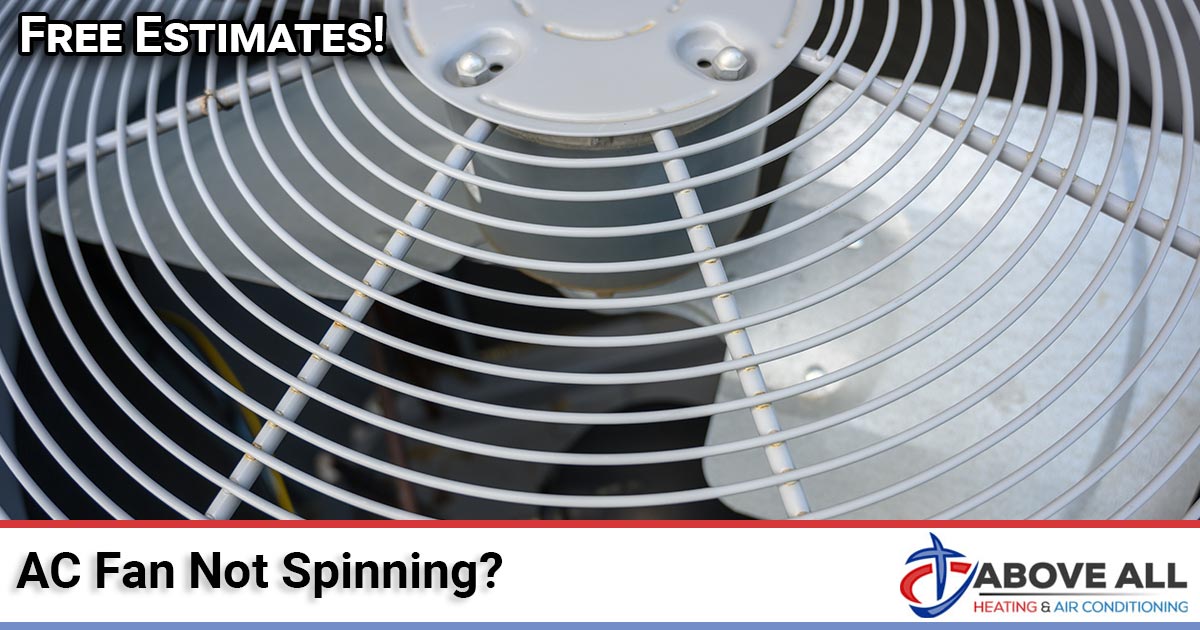
AC fan not spinning? The cause is usually a failed run capacitor, a worn-out condenser fan motor, a stuck contactor, or a power or thermostat problem. Turn the system off at the thermostat right away: without the outdoor fan, the compressor can overheat within minutes, and that turns a modest repair into an expensive one.
An outdoor fan that won’t turn is one of the most common no-cool calls we get at Above All Heating and Air, especially after a long run of hot days. The good news is that most fan failures come down to a handful of parts, and a few of the first checks are safe for any homeowner to do. Below we explain which fan you are actually looking at, what each symptom usually means, what you can check yourself, where to stop and call a technician, and what affects the repair cost.
First, Which Fan Isn’t Spinning?
A central air conditioner has two fans, and they fail for different reasons. Knowing which one has stopped saves time on the phone and points toward the right fix.
- The outdoor condenser fan sits under the grille on top of the outdoor unit. It pulls outdoor air across the condenser coil so the refrigerant can release the heat it carried out of your house. When people search for “AC fan not spinning,” this is usually the fan they mean.
- The indoor blower lives inside your furnace or air handler (in a garage, closet or attic). It pushes air across the indoor coil and through your ducts. If the blower stops, you will feel little or no air at the vents even though the outdoor unit may be running.
Trane suggests checking the condenser fan first because you can see it from the top of the outdoor unit; if that fan is turning normally but airflow inside is weak, the indoor blower motor becomes the suspect (according to Trane’s troubleshooting guide). Most of this article focuses on the outdoor fan, with notes on the blower where the causes overlap.
Why Is My AC Fan Not Spinning? Causes at a Glance
This table matches what you see and hear to the most likely cause. It is a starting point, not a diagnosis, since several parts can produce similar symptoms.
| What you notice | Most likely cause | Safe to check yourself? |
|---|---|---|
| Outdoor unit hums, fan doesn’t turn | Failed or weak run capacitor (or a seized motor) | No. Shut the system off and call a technician |
| Fan starts if nudged with a stick, then runs | Failing capacitor or worn motor bearings | No. This is a warning sign, not a fix |
| Outdoor unit completely silent | Thermostat setting, tripped breaker, outdoor disconnect, blown fuse or contactor | Thermostat and breaker, yes. Inside the unit, no |
| Compressor runs, fan doesn’t | Capacitor, fan motor or motor wiring | No. Turn the system off immediately |
| Fan spins slowly or stops after a few minutes | Weak capacitor or a motor overheating on its thermal limit | No |
| Grinding, clanking or wobbling before it stopped | Bent or broken fan blade, debris, failing bearings | Look from outside with power off; no reaching in |
| Top of unit very hot or a burning smell | Burned-out fan motor | No. Power off and call |
| No air from indoor vents at all | Indoor blower motor, blower capacitor, control board, or a frozen coil | Filter and thermostat, yes |
The Most Common Causes, Explained
1. A bad run capacitor
The capacitor is a small metal cylinder that stores and releases the electrical boost a motor needs to start turning and keep running efficiently. Most outdoor units use a dual capacitor that serves both the compressor and the condenser fan. When it weakens, the motor gets power but not enough push to overcome its own resistance, so you hear a hum and see a fan that sits still or turns lazily. Capacitors take a beating in heat, which is why we see so many fail late in the cooling season. Our guide to signs your AC capacitor is going bad goes deeper on this part.
Capacitors hold a high-voltage charge even after the power is off, which is why Carrier and Trane both tell homeowners to leave capacitor work to a technician (Carrier; Trane). We agree.
2. A worn-out or burned-out condenser fan motor
The fan motor runs for thousands of hours a year here, often in direct afternoon sun. Over time the bearings wear, the windings overheat, and the motor either seizes or simply stops. Signs include a fan that won’t turn even with a good capacitor, a motor that is hot to the touch at the top of the unit, a burning smell, or a fan that starts, slows, and shuts off as its internal thermal protection trips. A failing motor also stresses the capacitor, so the two often fail together.
3. A stuck or pitted contactor
The contactor is the switch inside the outdoor unit that closes when your thermostat calls for cooling and sends line voltage to the compressor and fan. If its contacts are burned, pitted, or the coil has failed, nothing outside gets power and the whole unit stays silent. A contactor can also stick closed, which keeps the outdoor unit running when it should be off. Insects and ants are a surprisingly common cause of contactor problems because they get between the contacts.
4. Power and thermostat problems
Before blaming a part, confirm the system is actually being told to cool. A thermostat set to “heat,” “off” or “fan only,” a schedule on a smart thermostat, dead thermostat batteries, a tripped breaker, or a pulled outdoor disconnect will all leave the outdoor fan still. If your breaker trips again after one reset, there is an electrical fault to find. Our article on an AC that keeps tripping the breaker explains what that usually means.
5. Debris, a bent blade, or failing bearings
Sticks, leaves, palm fronds and wind-blown trash can jam the blade or bend it into the grille. A bent blade throws the fan out of balance, which you will hear as clanking or rattling, and it can wear out the motor bearings quickly. Carrier advises not running the AC if the blades are damaged (Carrier).
6. A frozen coil, a clogged filter, or a control board problem (indoor blower)
If it is the indoor blower that stopped, a badly clogged filter or a frozen evaporator coil is often involved, and the blower has its own capacitor (on many older PSC motors) or an electronic module (on ECM motors) that can fail. The furnace or air handler control board also tells the blower when to run, so a failed relay can look like a dead motor.
The “Push-Start” Symptom: Why It Isn’t a Fix
One of the questions we hear most is “Why doesn’t my AC fan spin until I push it?” If a gentle push with a stick through the grille gets the fan going and it then runs normally, the motor has power but isn’t getting enough starting torque. That almost always points to a weak capacitor, and sometimes to motor bearings that have started to drag.
You will see advice online to keep the system running this way. We don’t recommend it. Reaching toward a fan blade that can start without warning is a real injury risk, the unit has live high-voltage parts inside, and a weak capacitor makes the motor (and sometimes the compressor) run hotter every time it struggles to start. A fan that needs a push today usually won’t start at all within days or weeks, often on the hottest afternoon of the week. Treat it as a sign to schedule a repair, not as a workaround.
What You Can Safely Check Yourself
These steps are safe for homeowners and solve a fair number of “dead fan” calls. Stop at any point where something looks burned, smells hot, or the breaker trips again.
- Turn the system off at the thermostat. This protects the compressor while you check things.
- Check the thermostat settings. Make sure it is set to “cool,” the set point is several degrees below the room temperature, and no schedule or eco mode is holding it off. Replace the batteries if it has them.
- Check the breakers. Look for tripped breakers labeled AC, condenser, furnace or air handler. Reset a tripped breaker once by pushing it fully off, then on. If it trips again, leave it off and call us.
- Check the outdoor disconnect. The small box mounted on the wall near the outdoor unit should be in the “on” position or have its pull-out block fully seated.
- Check the indoor equipment switch and the air filter. The furnace or air handler usually has a light-style switch nearby; make sure it is on. Replace a dirty filter.
- Look at the outdoor unit with the power off. From outside the grille, look for sticks, leaves or debris on the blade, and for a blade that is visibly bent. Clear loose debris around the unit; do not reach inside the cabinet.
- Wait, then try again. Leave the system off for about five minutes, then set the thermostat to cool. Watch and listen at the outdoor unit for the first minute.
If the fan still doesn’t spin, or you hear humming without movement, turn the system back off and call a technician. If your whole outdoor unit is silent and these checks didn’t help, our guide to an AC that won’t turn on covers a few more power-side checks.
When to Stop and Call a Pro
Call a licensed technician, and keep the system off, if any of these apply:
- The outdoor unit hums or buzzes but the fan doesn’t move.
- The compressor is running but the fan isn’t.
- The breaker trips again after one reset.
- You smell burning, see scorched wiring, or the top of the unit is very hot.
- The fan only runs after you push it.
- The fan blade is bent or the motor grinds.
Do not open the electrical panel on the outdoor unit, touch the capacitor, or try to bypass the contactor. Those parts carry line voltage, and the capacitor can hold a dangerous charge after the power is off.
Is It Okay to Run Your AC If the Fan Isn’t Working?
No. The condenser fan is what carries heat away from the refrigerant. Without it, pressure and temperature inside the outdoor unit climb fast, the compressor overheats and trips its internal overload, and repeated cycles like that shorten its life. Carrier warns that running with the fan off can overheat the compressor and advises turning the system off immediately (Carrier). The compressor is the most expensive part of the system to replace, which is why we treat a stalled fan as a “turn it off now” problem. If you are curious how a compressor failure plays out, see our article on an AC compressor not working.
If the indoor blower is the one that stopped, running the system can freeze the indoor coil because no air is moving across it. Turn it off and let any ice melt before a technician arrives.
How We Tell a Bad Capacitor From a Bad Fan Motor
Homeowners often ask how to tell if the fan motor or the capacitor is bad. From the outside, the symptoms overlap, so the honest answer is that it takes testing. Here is what our technicians do on a no-spin call:
- Confirm power and control. We verify the thermostat call, the low-voltage signal at the outdoor unit, and line voltage through the disconnect and contactor.
- Inspect and test the contactor. We look for pitted or burned contacts and confirm it pulls in and passes voltage.
- Safely discharge and test the capacitor. We measure its actual microfarad rating against the rating printed on the part. A capacitor that reads meaningfully below spec, or one that is bulging or leaking, gets replaced.
- Test the fan motor. We check the windings for opens or shorts, measure amperage while running, and spin the shaft by hand with the power off to feel for dragging or seized bearings.
- Check the blade and mounting. A bent blade or loose set screw can cause noise and early motor failure.
- Check the rest of the system. A fan that stopped may have let the compressor overheat, so we confirm the compressor and refrigerant pressures are normal once the fan is running again.
A rule of thumb: if a new, correctly rated capacitor gets the fan spinning at full speed with normal amperage, the motor is usually fine. If the motor is hot, smells burned, won’t turn freely by hand, or draws high amps even with a good capacitor, the motor is the problem. Many times we replace both, because an aging capacitor and an aging motor tend to take each other down.
Repair or Replace the Fan Motor?
A failed condenser fan motor is a normal, routine repair. In most cases replacing the motor (and usually the capacitor with it) is the right call, and the rest of the system is unaffected. We look harder at the bigger picture when:
- The system is near the end of its expected life and has had several other repairs.
- The compressor was damaged by overheating while the fan was out.
- The condenser coil is badly corroded or leaking refrigerant.
- The fan motor or blade for an older or discontinued model is hard to source.
If any of those apply, we will tell you plainly and give you both options. Our guide to what your AC condenser does explains how the fan, coil and compressor work together, which helps when you are weighing a repair against a replacement.
What Affects the Cost to Fix an AC Fan That Isn’t Spinning
We don’t publish flat repair prices here, because national averages don’t reflect the Inland Empire market and the right repair depends on what we find. These are the factors that move the price on a fan repair:
| Cost factor | Why it matters |
|---|---|
| Which part failed | A capacitor or contactor is a smaller repair than a fan motor; a motor plus capacitor is more; compressor damage is a different conversation entirely. |
| Motor type | A standard single-speed (PSC) condenser motor costs less than a variable-speed ECM motor used on many high-efficiency systems. |
| OEM vs. universal part | Some units need a manufacturer-specific motor; others accept a quality universal replacement matched to horsepower, RPM, rotation and voltage. |
| Blade condition | A bent or cracked blade should be replaced with the motor, or it will wear out the new one. |
| Warranty coverage | Many manufacturers cover parts for a period after a registered installation; labor usually isn’t covered unless you have a labor warranty or plan. |
| Timing | After-hours or weekend emergency calls typically cost more than a scheduled weekday visit. |
| Knock-on damage | Running the system with a dead fan can damage the compressor, which is why turning it off early protects your wallet. |
Our technicians give you a clear price before any work starts. If you want a number for your system, you can request a free AC service quote, and our air conditioning repair service page explains how our repair visits work.
Why Inland Empire Heat Is Hard on AC Fans
Fan motors and capacitors are heat-sensitive parts, and our climate gives them a long, demanding season. In Murrieta, Temecula, Menifee and the surrounding valleys, cooling season often starts in spring and runs well into fall, so outdoor fans log far more hours than they would in a milder coastal area. Units on the west or south side of a house sit in strong afternoon sun, which adds heat to the motor and capacitor on top of the heat they are already rejecting.
Dust and debris add to it. Santa Ana winds blow leaves, palm debris and fine dust into outdoor units, and a coil packed with dust makes the whole system run hotter and longer. That is one reason we see clusters of capacitor and fan motor failures after heat waves and wind events. Keeping a couple of feet of clearance around the unit, rinsing the coil gently, and having a technician check the capacitor and motor amperage once a year all help. A yearly AC tune-up is the best time to catch a weak capacitor before it strands your fan.
How to Prevent AC Fan Problems
- Schedule annual maintenance. A technician can test the capacitor against its rating and measure motor amperage, two things you can’t see from the outside.
- Keep the outdoor unit clear. Trim plants back, clear leaves after windy days, and keep trash cans and stored items away from the grille.
- Change your filter on schedule. A clean filter keeps the indoor blower and coil healthy.
- Listen for changes. New humming, rattling or a slow start is the time to call, before the fan stops completely.
- Turn the system off when something is wrong. A few hours without cooling is far cheaper than a damaged compressor.
If your fan has stopped and your house is warming up, you may also find our article on an AC that’s not cooling helpful while you wait for a technician.
Frequently Asked Questions
Should I turn off my AC if the fan isn’t spinning?
Yes. Turn the system off at the thermostat as soon as you notice the outdoor fan isn’t spinning. Without the fan, the compressor can’t shed heat and can overheat quickly, which risks the most expensive part of your system. Leave it off until a technician has found the cause. If the house gets hot, ceiling fans and closed blinds help while you wait.
Why is my AC fan not kicking on the outside?
The most common reasons are a failed run capacitor, a burned-out condenser fan motor, a bad contactor, or a power problem such as a tripped breaker or an outdoor disconnect that is off. Check the thermostat setting, the breakers and the disconnect first. If the unit hums but the fan stays still, the capacitor or motor is the likely culprit and needs a technician.
How do I reset my outside AC fan?
Turn the thermostat off, switch off the AC breaker and the outdoor disconnect, wait about five minutes, then restore power and set the thermostat back to cool. Some outdoor units also have a reset on the control board, but most do not have a user reset button. If the fan still won’t start after a power reset, the problem is a failed part rather than a tripped control, so call a technician.
How to tell if a fan motor or capacitor is bad?
A humming fan that won’t start, or one that starts after a push, usually points to the capacitor. A motor that is hot, smells burned, won’t spin freely by hand, or still fails with a good capacitor usually means the motor is bad. The only reliable way to know is testing: a technician safely discharges the capacitor, measures its microfarads against its rating, and checks the motor windings and amperage.
How much does it cost to fix an AC fan that isn’t spinning?
It depends on which part failed. A capacitor or contactor replacement is a smaller repair, while a condenser fan motor, especially a variable-speed ECM motor, costs more. Warranty coverage, part availability, a damaged blade and emergency timing also affect the price. We give you a clear price before any work begins, and you can request a free quote online.
Can I run my AC if the fan is not working?
No. Running the AC without the outdoor fan lets heat and pressure build in the outdoor unit, which can overheat the compressor and shorten its life. If the indoor blower is out instead, the indoor coil can freeze. Turn the system off and schedule a repair rather than running it in short bursts.
Will AC work without a condenser fan?
Not properly. Without the condenser fan the refrigerant can’t release the heat it carried out of your home, so the air inside stops getting cold and the compressor runs hot until its overload shuts it off. Repeated overheating cycles like that are one of the ways a simple fan repair turns into a compressor replacement.
Why doesn’t my AC fan spin until I push it?
A fan that only starts after a push has power but not enough starting torque. That is almost always a weak run capacitor, and sometimes motor bearings that have started to drag. Pushing the fan is not a safe or lasting fix. The blade can start suddenly, and the weak part usually fails completely within days or weeks.
How do I fix my cooling fan not spinning?
Start with safe checks: thermostat set to cool, breakers and outdoor disconnect on, a clean filter, and no debris on the blade. If the fan still won’t spin, a technician needs to test the capacitor, contactor and motor. Replacing capacitors, contactors and fan motors involves high voltage, so it is a job for a licensed technician.
What happens when an AC condenser fan fails?
The outdoor unit can’t get rid of heat, so cooling drops off quickly, the compressor overheats, and the system may cycle on and off as the compressor’s overload protection trips. You may hear humming from the outdoor unit and feel warm or lukewarm air at the vents. Turning the system off protects the compressor.
Why is my AC fan running but the condenser isn’t working?
If the indoor blower runs but the outdoor unit is silent, the outdoor unit isn’t getting power or a signal. Common causes are a tripped breaker, an off disconnect, a failed contactor, a blown fuse, or a thermostat wiring problem. If the outdoor unit hums but its fan and compressor don’t start, a failed capacitor is likely.
Why is my AC not cooling but the fan is running?
When air blows but isn’t cold, the indoor blower is working but the cooling side isn’t. Common causes include a dirty filter, a stopped outdoor fan or compressor, low refrigerant from a leak, or a frozen coil. Check whether the outdoor fan is spinning. If it isn’t, turn the system off and call for service.
Should the outside fan run when the AC is on?
Yes. When your thermostat calls for cooling, the outdoor condenser fan and the compressor should both run. If the AC is on and the outdoor fan isn’t turning, something is wrong. The outdoor fan normally stops when the thermostat is satisfied, so a still fan between cycles is normal.
Why is my AC fan not turning on?
If no air comes from your vents, the indoor blower may not be getting a signal or may have a failed motor, capacitor or control board. A tripped breaker, a furnace switch turned off, or a thermostat issue can also be the cause. Check the thermostat, breakers, equipment switch and filter. If those are fine, the blower needs a technician.
How much is a fan motor for an AC unit?
The price of a condenser fan motor depends on whether it is a standard single-speed motor or a variable-speed ECM motor, and whether your unit needs a manufacturer-specific part. Labor, a replacement capacitor and a new blade if the old one is damaged are usually part of the job. We quote the full repair before starting.
Should AC fan be on auto or on?
For most homes, auto is the better setting. The blower runs only while the system is cooling, which uses less electricity and lets the indoor coil drain moisture between cycles. The on setting can even out temperatures and run air through a filter or purifier more often, but it uses more energy. Either way, this setting controls the indoor blower, not the outdoor fan.
Why is the fan on my AC unit not spinning when the compressor is running?
When the compressor runs but the outdoor fan doesn’t, the usual causes are a failed fan side of the dual capacitor, a burned-out fan motor, or a broken fan wire. This combination overheats the compressor quickly, so turn the system off at the thermostat right away and call a technician.
Need Help With an AC Fan That Won’t Spin?
If your outdoor fan has stopped, turn the system off and let our technicians take it from there. Above All Heating and Air diagnoses and repairs capacitors, contactors and fan motors across Murrieta, Temecula, Menifee and the surrounding Inland Empire. Contact us to schedule a repair, request a free AC service quote, or visit our homepage to see all of our heating and air conditioning services.
Schedule an Appointment Today
Get in touch with Above All Heating and Air Conditioning by calling us or filling out the form. We look forward to working with you.
