
Furnace Flame Sensor: Signs It’s Dirty, How to Clean It, and When to Replace It
CONTACT US
Contact Us

Our
SERVICEs
Furnace Flame Sensor: Signs It’s Dirty, How to Clean It, and When to Replace It
Above All Heating And Air Conditioning / November 13, 2026 / Furnace Repair, HVAC Services, Heating Repair
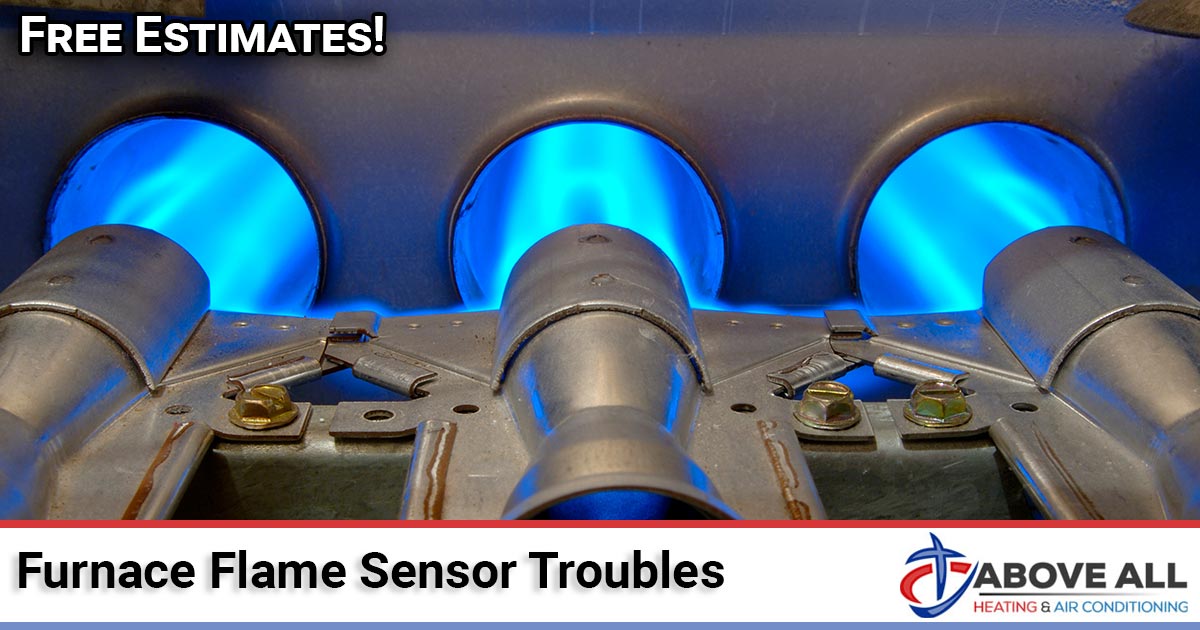
A furnace flame sensor is a thin metal rod that sits in the burner flame and tells the control board the gas has actually lit. When the rod gets coated with carbon or residue, the board can’t confirm the flame, so the furnace lights for a few seconds and then shuts the gas off. Cleaning the sensor often fixes it. If the problem returns soon after, the sensor, its wiring or the furnace ground needs a technician’s attention.
At Above All Heating and Air, a dirty furnace flame sensor is one of the most common reasons we get called out on the first cold nights of the year. The symptom is distinctive: you hear the furnace start, the burners light, and then everything goes quiet before any warm air arrives. This guide explains what the flame sensor does, how to tell when it’s the problem, how a careful homeowner can clean it, what not to do, and when it’s time to replace the part or call us.
What Does a Furnace Flame Sensor Do?
The flame sensor is a safety device. Its only job is to prove that a flame exists every time your gas furnace fires. Without that proof, the furnace could keep sending gas into the burner area with nothing burning it. Lennox describes the sensor as the part that confirms a flame is actually burning and shuts the furnace down before unburned gas can build up.
Physically, it is a short bent metal rod with a white ceramic insulator at its base, mounted on a bracket so the tip sits in the flame of one burner. A single wire runs from it back to the furnace control board. On most furnaces it sits on the opposite end of the burner row from the hot surface ignitor.
How a flame sensor works (flame rectification, in plain English)
Most modern furnaces use a method called flame rectification. When the furnace calls for heat, the control board sends a small voltage to the flame sensor rod. With no flame present, nothing happens. Once the burners light, the flame itself carries a tiny electrical current between the rod and the grounded burner. The board measures that current. If it sees it, the gas valve stays open. If it doesn’t see it within a few seconds, the board closes the gas valve and tries again.
That current is extremely small. It is measured in microamps (millionths of an amp). According to HVAC School’s flame sensing overview, the working range is roughly 0.5 to 10 microamps depending on the furnace, with typical readings in the 2 to 6 microamp range. Because the signal is so weak, even a thin coating on the rod can drop it below what the board needs. That’s why a part with no moving pieces causes so many no-heat calls.
Signs of a Dirty or Failing Furnace Flame Sensor
A dirty flame sensor has a very recognizable pattern. Look for these signs:
- The burners light, then go out within a few seconds. This is the classic symptom. The inducer fan starts, the ignitor glows, the burners light, and then the gas valve closes before the blower ever comes on.
- The furnace tries several times in a row. Most control boards retry ignition a set number of times. You may hear the start-up sequence repeat two or three times.
- The furnace locks out. After its allowed retries, the board stops trying and goes into a lockout, often for an hour, before it tries again on its own.
- A flame-related blink code. The status light on the control board flashes a pattern that the chart on the furnace door lists as something like “flame not sensed,” “failure to prove flame” or “ignition lockout.”
- Cold air or no heat. If the blower runs after a failed attempt to cool the heat exchanger, you may feel only cool air from the vents.
- Short cycling. A sensor that is borderline may hold the flame on some cycles and drop it on others, so the furnace seems to run in short bursts.
Lennox lists the same group of symptoms: lighting then shutting off after a few seconds, cycling on and off, cold air, lockouts after repeated ignition attempts, and flame-related error codes.
What Causes a Flame Sensor to Get Dirty?
The rod sits directly in the flame every time the furnace runs, so some buildup is normal over time. The usual culprits are:
- Carbon and combustion residue from normal burning, especially if the flame isn’t burning cleanly.
- Silica or glassy deposits. Dust, household chemical vapors and some cleaning or aerosol products drawn into the combustion air can leave a hard, whitish coating on the rod when heated.
- Oxidation of the metal itself as it heats and cools over many seasons.
- Dust and debris that settle on the burners and sensor while the furnace sits idle all summer.
A sensor that fouls quickly, for example within a few weeks of being cleaned, is a clue that something else is wrong, such as poor combustion, incorrect gas pressure or contaminated combustion air. That deserves a technician’s look rather than repeated cleaning.
How to Clean a Furnace Flame Sensor, Step by Step
Cleaning a flame sensor is a common maintenance task, and many handy homeowners do it. That said, it means opening the furnace and working near the gas burners. If you aren’t comfortable turning off gas and power, removing panels, or handling small fasteners in a tight space, stop here and call us. If your furnace manual has its own instructions, follow the manufacturer first.
What you’ll need: a nut driver or screwdriver (often 1/4-inch), a very fine abrasive pad or very fine steel wool, a clean dry cloth, and a phone to take photos.
- Turn the thermostat off. This prevents a call for heat while you’re working.
- Shut off power to the furnace. Switch off the furnace service switch (it looks like a light switch on or near the unit) or the breaker. Confirm the status light on the control board goes dark.
- Turn off the gas. Rotate the handle on the gas valve or gas line next to the furnace so it sits crosswise to the pipe.
- Let the furnace cool. If it ran recently, give the burner area time to cool down before you touch anything.
- Remove the front panels. Most furnaces have an upper burner panel and a lower blower panel. Set the screws somewhere safe.
- Find the flame sensor. Look along the row of burners for a single thin rod with a white ceramic base and one wire attached. It’s usually at the far end from the ignitor. Take a photo before you remove anything.
- Remove the sensor. Gently pull the wire off its terminal (pull the connector, not the wire), then remove the single screw holding the bracket. Slide the sensor out without bending the rod or knocking the ignitor. Hot surface ignitors are fragile, so keep your hands and tools clear of them.
- Clean only the metal rod. Lightly rub the rod with a very fine abrasive pad or very fine steel wool until the dull coating is gone and the metal looks clean. Use light pressure. You’re removing a film, not reshaping the rod.
- Wipe it clean. Wipe the rod with a clean, dry cloth to remove any loose particles. Don’t touch the cleaned rod with oily fingers, and don’t use sprays near the burner area.
- Inspect it. Look at the white ceramic insulator. If it is cracked, chipped or loose, the sensor should be replaced, not reinstalled.
- Reinstall it exactly as it was. Match your photo. The rod must sit in the flame path in the same position. Tighten the screw snugly and push the wire firmly back onto the terminal.
- Close up and restore gas and power. Reinstall the panels (the blower door must be fully seated or the furnace won’t run), turn the gas back on, restore power, and set the thermostat to heat.
- Watch a full cycle. The burners should light and stay lit, and the blower should start within a minute or so. If the furnace still shuts down after a few seconds, the problem isn’t just a dirty rod.
What Not to Do When Cleaning a Flame Sensor
- Don’t use coarse sandpaper or emery cloth. Coarse grit scratches the rod, and grit left behind can bake onto the surface and make the signal worse. HVAC School flags emery cloth for exactly this reason. A very fine pad with light pressure is the safer choice.
- Don’t bend the rod. Its position in the flame matters. A rod moved out of the flame will fail even when it’s perfectly clean.
- Don’t bypass the sensor or jump wires on the control board. The flame sensor is a safety control. Defeating it can let gas flow with no flame to burn it.
- Don’t touch or bump the ignitor. A hot surface ignitor can crack from a light tap or the oil from your skin.
- Don’t keep resetting a furnace that keeps locking out. One reset after cleaning is reasonable. Repeated lockouts mean the furnace needs a diagnosis.
- Don’t work on a furnace if you smell gas. See the safety section below.
Clean It or Replace It?
Cleaning fixes a lot of flame sensor problems, but not all of them. Use this table as a guide.
| What you find | Clean or replace? | Why |
|---|---|---|
| Dull, sooty or whitish film on the rod; ceramic intact | Clean | Surface buildup is the most common cause of a weak flame signal. |
| Furnace works for months after cleaning | Clean as part of yearly maintenance | Normal buildup. An annual tune-up keeps it in check. |
| Problem returns within days or weeks of cleaning | Call for diagnosis | Points to grounding, wiring, flame quality, gas pressure or contaminated combustion air. |
| Cracked, chipped or loose ceramic insulator | Replace | A cracked insulator can leak the signal to ground. |
| Rod is pitted, corroded, thinned or burned away | Replace | Damaged metal won’t hold a reliable signal even when clean. |
| Wire or terminal is burned, loose or corroded | Repair wiring or replace | A poor connection looks the same to the board as a dirty rod. |
| Microamp reading stays low after cleaning | Replace sensor or find the real cause | A technician confirms with a meter rather than guessing. |
Lennox recommends replacement when shutdowns continue after cleaning, when the sensor or wiring is visibly damaged, when ignition failures keep coming back, or when corrosion is present. Flame sensors don’t have a fixed replacement schedule. They wear gradually, so the right time to replace one is when testing or inspection shows it’s no longer doing its job.
Other Problems That Look Like a Bad Flame Sensor
Because the flame sensor is the part that “decides” whether the flame is real, problems elsewhere often show up as a flame sensing failure. When cleaning doesn’t fix it, these are the next suspects:
- Poor ground. Flame rectification needs a solid path back through the burner to ground. A loose ground wire, corroded connection or poor ground at the control board weakens the signal.
- Reversed polarity. If the hot and neutral wires feeding the furnace are reversed, many control boards can’t sense flame properly.
- Gas pressure or flame quality. A weak, lifting or lazy flame may not envelop the sensor rod. Incorrect gas pressure, dirty burners or poor combustion air can all cause this.
- Sensor position. A rod that has been bumped or bent out of the flame path won’t sense flame even when clean.
- Pressure switch problems. A pressure switch that drops out during the cycle also shuts the burners off. Learn more about how a furnace pressure switch works.
- A failing control board. Less common, and something we confirm only after every other check passes.
If the burners never light at all, the flame sensor isn’t the issue. Our guide to a furnace not igniting covers ignitor and gas supply problems, and our furnace won’t turn on checklist walks through the power and thermostat checks to try first.
When to Stop and Call a Professional
Some situations are not do-it-yourself problems. Stop and call in these cases:
- You smell gas (a rotten-egg odor). Don’t touch light switches or anything that could make a spark. Leave the home right away. Once you’re safely away from the building, call SoCalGas at 1-800-427-2200, or 911 if anyone could be in danger. That is SoCalGas’s own guidance for a suspected gas leak.
- Your carbon monoxide alarm sounds. Get everyone, including pets, outside into fresh air and call 911. Don’t go back inside until responders say it’s safe.
- You see scorch marks, soot around the burner area, melted wiring, or flames rolling out of the burner compartment.
- The ceramic on the sensor is cracked, or the wire is burned.
- The furnace still locks out after you’ve cleaned the sensor.
- You aren’t comfortable shutting off gas and power or opening the furnace.
What Our Technicians Check on a Flame Sensor Call
A technician doesn’t have to guess whether a flame sensor is the problem. When you call Above All Heating and Air, our technicians:
- Read the control board’s fault code and code history.
- Watch the full start-up sequence to see exactly when and how the furnace shuts down.
- Measure the flame signal in microamps with a meter while the burners are lit, and compare it to the manufacturer’s specification.
- Inspect the rod, ceramic insulator, wire and terminal.
- Check the furnace ground, wiring and incoming power polarity.
- Look at the burner flame and check gas pressure and burner condition.
- Clean or replace the sensor, then re-measure to confirm the signal is solid.
- Explain what we found and give you the price before any repair beyond the diagnosis.
Our furnace repair service covers Murrieta and surrounding communities, and our full range of heating services includes repair, maintenance and installation.
What Affects the Cost of a Flame Sensor Repair
A flame sensor is one of the less expensive furnace parts, but the total cost of a visit depends on a few things:
- Whether it needs cleaning or replacement. Cleaning takes less time and no parts.
- The furnace brand and model. Sensors are not universal. Some furnaces use a common style and others need a manufacturer-specific part.
- Furnace location. An attic furnace in summer heat or a tight closet installation takes longer to work on than a garage unit.
- What else is found. If the real cause is a ground, wiring, gas pressure or pressure switch problem, that repair adds to the visit.
- Timing and plan membership. A flame sensor cleaning is part of a routine tune-up, so maintenance plan customers often have it handled during a scheduled visit instead of a repair call.
Because national price averages don’t reflect Southern California labor and parts costs, we don’t publish a one-size-fits-all number. We diagnose first and tell you the price before we do the work.
Why Flame Sensors Act Up on the First Cold Night in the Inland Empire
Heating season in the Temecula Valley and the rest of the Inland Empire is short. Many furnaces sit unused from spring through fall, and then everyone turns the heat on during the same cold snap. That pattern is hard on flame sensors in a few ways:
- Months of idle dust. Dry weather and Santa Ana winds push fine dust into attics, garages and closets, where it settles on burners and the sensor rod.
- Attic furnaces. Many local tract homes have the furnace in the attic, where summer heat bakes wiring and connections, including the flame sensor wire and ground connections.
- Garage furnaces and household chemicals. A furnace in or near a garage may draw combustion air that carries vapors from paints, solvents, pool chemicals or aerosol products, which can leave deposits on the rod.
- A burst of demand. A sensor that was borderline last spring often fails on the first cold night, when the furnace runs several cycles back to back.
The easy fix is to test your heat on a mild fall day, before you actually need it, and to schedule maintenance before the cold arrives.
How a Heating Tune-Up Prevents Flame Sensor Problems
An annual heating tune-up is the simplest way to avoid a no-heat call from a dirty flame sensor. During a tune-up we clean the sensor, measure the flame signal, inspect the burners and ignitor, check the ground and wiring, and test the furnace’s other safety controls. Catching a weak signal in the fall is much easier than finding out on a cold night. Our HVAC maintenance plans schedule this for you each year.
Between visits, you can help by changing your filter on schedule, keeping the area around the furnace clean and free of stored chemicals, and making sure the furnace panels stay in place.
Frequently Asked Questions
What is a flame sensor on a furnace?
A flame sensor is a thin metal rod with a ceramic base that sits in the burner flame of a gas furnace. It proves to the control board that the gas has lit. If it can’t confirm a flame within a few seconds, the board shuts off the gas valve as a safety measure.
How does a furnace flame sensor work?
Most furnaces use flame rectification. The control board sends a small voltage to the rod, and when a flame is present it carries a tiny current measured in microamps back to the board. If the board detects that current, the gas valve stays open. If not, it shuts the gas off and retries.
Where is the flame sensor on a furnace?
Open the upper burner panel and look along the row of burners. The flame sensor is a single thin rod with a white ceramic insulator and one wire, usually mounted at the opposite end of the burners from the ignitor, with its tip positioned in one burner’s flame.
What does a furnace flame sensor look like?
It looks like a short, bent metal rod, often an L or hook shape, set in a white or tan ceramic insulator on a small metal bracket. One wire connects it to the control board. A dirty rod usually looks dull, dark or coated with a whitish film.
How do I know if my flame sensor is bad on my furnace?
The classic sign is burners that light and then shut off within a few seconds, followed by repeated retries and a lockout. A flame-related blink code on the control board points the same way. If cleaning doesn’t fix it, or the ceramic is cracked, the sensor or its wiring likely needs replacement.
What are the symptoms of a dirty flame sensor?
A dirty flame sensor causes the furnace to light briefly and then go out, retry several times, and often lock out. You may get cold air or no heat, short cycling, and a flame-sensing fault code. Some furnaces run fine on one cycle and fail on the next.
What happens if a furnace flame sensor is dirty?
The coating weakens the tiny electrical signal the board relies on, so the board can’t confirm the flame and closes the gas valve for safety. The furnace keeps retrying and may lock out, leaving the home without heat until the sensor is cleaned or the furnace resets.
How do I clean my flame sensor on my furnace?
Turn off the thermostat, power and gas, remove the burner panel, then unplug the sensor wire and remove its single mounting screw. Lightly rub only the metal rod with a very fine abrasive pad or very fine steel wool, wipe it clean, check the ceramic for cracks, and reinstall it exactly as it was.
Can I clean a flame sensor myself?
Many homeowners can, as long as they are comfortable shutting off power and gas and opening the furnace. Use light pressure, avoid coarse sandpaper, and don’t bump the fragile ignitor. If you smell gas, see damage, or the furnace still locks out afterward, call a technician instead.
Does cleaning a flame sensor work?
Often, yes. A coated rod is the most common flame sensing problem, and removing the film usually restores a strong signal. If the furnace starts failing again within days or weeks, cleaning is only masking another issue such as a poor ground, wiring fault, flame quality or gas pressure problem.
How often should a furnace flame sensor be cleaned?
For most homes, once a year during a fall heating tune-up is enough. Furnaces in dusty spaces or near garage chemicals may need it more often. If a sensor needs cleaning every few weeks, have a technician find out why it is fouling so quickly.
How often should I replace the flame sensor on my furnace?
There is no fixed replacement schedule. Flame sensors wear gradually, so replace one when inspection or a microamp test shows it is no longer working: a cracked ceramic, a pitted or corroded rod, damaged wiring, or a signal that stays weak after cleaning.
Can I replace a flame sensor myself?
It is a simple part mechanically, but the replacement must match your furnace model and sit in exactly the right position in the flame. Because the same symptom can come from grounding, wiring or gas pressure problems, we recommend having a technician confirm the diagnosis with a meter before buying a part.
How do you test a flame sensor on a furnace?
A technician places a meter set to DC microamps in series with the sensor wire and reads the flame signal while the burners are lit, then compares it to the manufacturer’s specification. They also check the rod for continuity and the ceramic for cracks. This is a job for a trained technician.
How do you reset a furnace flame sensor?
The flame sensor itself has no reset. What you reset is the control board lockout: turn off power at the service switch or breaker for about 30 seconds, then restore it. If the furnace locks out again on a flame fault, the sensor needs cleaning or testing rather than more resets.
How much does it cost to have a furnace flame sensor cleaned?
Cleaning is usually one of the simpler furnace service tasks, and it is included in our heating tune-up. The cost of a repair visit depends on your furnace, its location and whether other problems turn up. We diagnose first and give you the price before any work begins.
How much does it cost to replace a flame sensor on a furnace?
The part itself is one of the less expensive furnace components, but the total depends on the furnace brand and model, how hard the unit is to reach, and whether a wiring or ground problem is also involved. Since national averages don’t reflect Southern California costs, we quote after diagnosing.
Furnace Still Shutting Off? We Can Help
If your furnace lights and then goes out, or you’d rather not open it up yourself, contact Above All Heating and Air to schedule a diagnostic visit. Our technicians will test the flame sensor, find the real cause and give you the price before any work starts. Thinking about a new system? Request a free quote, or learn more about us on our homepage.
Schedule an Appointment Today
Get in touch with Above All Heating and Air Conditioning by calling us or filling out the form. We look forward to working with you.
