
Heat Pump vs. Furnace: Which Heats a Southern California Home Better?
CONTACT US
Contact Us

Our
SERVICEs
Heat Pump vs. Furnace: Which Heats a Southern California Home Better?
Above All Heating And Air Conditioning / November 18, 2026 / Furnace Service, HVAC Services, hvac tips
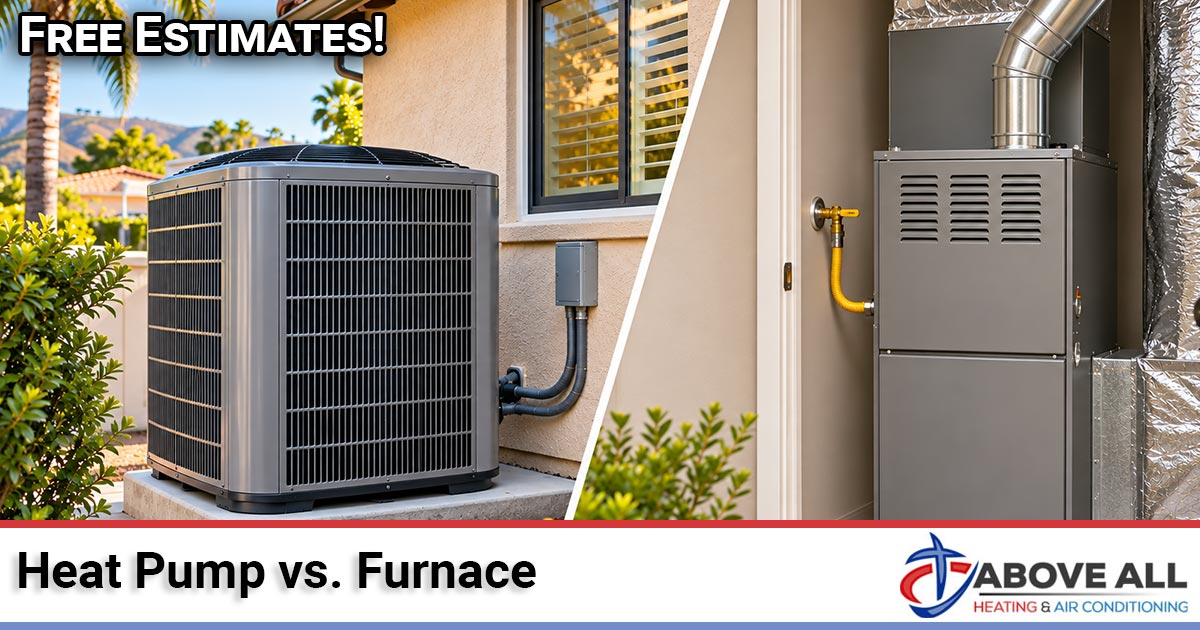
Heat pump vs furnace comes down to climate, fuel prices and what your home already has. In a mild-winter area like the Inland Empire, a modern heat pump can usually heat the whole house efficiently and also replace your air conditioner. A gas furnace still makes sense when you already have gas and ducts sized for it, your electrical panel is maxed out, or you want very warm air on the coldest nights.
We get this question a lot from homeowners in Murrieta, Temecula, Menifee and the surrounding valley, usually when an older furnace or AC is nearing the end and a replacement quote is on the table. This guide walks through how each system makes heat, what each costs to run here, what California rules actually say about gas furnaces right now, and how we help customers decide. It is written from the point of view of the technicians who install and service both.
Heat Pump vs Furnace: The Short Answer
A furnace makes heat. It burns natural gas (or runs electric heating elements) and blows the warm air through your ducts. A heat pump moves heat. It uses refrigerant and a compressor to pull heat out of the outdoor air, even cool air, and bring it inside. In summer it runs in reverse and works as your air conditioner.
Because it moves heat instead of creating it, a heat pump can deliver more heat energy than the electricity it uses. According to the U.S. Department of Energy, a properly installed heat pump “can deliver up to three times more heat energy to a home than the electrical energy it consumes.” A gas furnace, by comparison, can never deliver more than 100% of the energy in the fuel it burns.
For most Southern California homes that need a new heating and cooling system, a heat pump is a strong default. For some homes, a high-efficiency gas furnace, or a dual-fuel system that uses both, is the better fit. The rest of this article explains how to tell which group your home falls into.
How a Gas Furnace Heats Your Home
A gas furnace follows the same basic sequence every time the thermostat calls for heat:
- The draft inducer motor starts and clears the combustion chamber.
- The ignitor lights the gas burners, and the flame sensor confirms there is a flame.
- Hot combustion gases pass through the heat exchanger, which gets hot without mixing combustion gases into your air.
- The blower pushes house air across the outside of the heat exchanger and out through the ducts.
- Combustion gases leave through the flue or, on a high-efficiency furnace, through PVC venting.
Furnace efficiency is measured by AFUE (annual fuel utilization efficiency). The Department of Energy notes that older furnaces often run at 56% to 70% AFUE, while high-efficiency condensing models reach 90% to 98.5%. An 80% AFUE furnace turns 80% of the gas it burns into usable heat; the rest goes out the vent.
Furnaces produce air that feels noticeably hot at the register, and they heat a cold house quickly. The trade-off is that they burn fuel inside the home, so venting, the heat exchanger and carbon monoxide safety all matter. A furnace also does nothing for cooling, so it is almost always paired with a separate air conditioner and indoor coil.
How a Heat Pump Heats Your Home
A heat pump looks like an air conditioner condenser outside, with an air handler or furnace inside. The key part is the reversing valve, which lets the system change the direction refrigerant flows. In heating mode, the outdoor coil absorbs heat from the outside air, the compressor raises the refrigerant’s temperature, and the indoor coil releases that heat into your ducts.
Heat pump heating efficiency is measured by HSPF2 (heating seasonal performance factor), and cooling efficiency by SEER2. You may also see COP (coefficient of performance), which compares heat delivered to electricity used at a specific outdoor temperature. A COP of 3 means three units of heat for every unit of electricity. We explain the cooling side in our guide to SEER2 ratings.
Heat pumps typically run longer, gentler cycles and deliver air that feels warm rather than hot. Trane describes furnace heat as hot air blowing from the registers and heat pump heat as lower-temperature air with steadier airflow. Some people notice that difference at first; most stop noticing once the house holds an even temperature. In cold weather, heat pumps also run short defrost cycles, and many systems have electric backup heat strips or a gas furnace for the coldest hours. We cover what is normal in our heat pump maintenance guide.
Heat Pump vs Gas Furnace: Side-by-Side Comparison
| Factor | Heat pump | Gas furnace |
|---|---|---|
| How it heats | Moves heat from outdoor air using refrigerant | Burns natural gas in a heat exchanger |
| Cooling | Yes, it is also your air conditioner | No, needs a separate AC and coil |
| Efficiency rating | HSPF2 (heating), SEER2 (cooling), COP | AFUE (80% standard, 90%+ condensing) |
| Can deliver more energy than it uses? | Yes, often 2 to 3 times in mild weather | No, at most just under 100% |
| Feel of the air | Warm, steady, longer cycles | Hot, fast warm-up, shorter cycles |
| Performance in deep cold | Capacity drops as it gets colder; backup heat helps | Same output regardless of outdoor temperature |
| Operating cost drivers | Electric rate (SCE), efficiency, solar, thermostat habits | Gas rate (SoCalGas), AFUE, duct losses |
| Upfront cost drivers | Equipment tier, panel and circuit capacity, air handler or coil | AFUE tier, venting changes, gas line, plus a separate AC |
| Typical lifespan | About 10 to 15 years (Carrier) | About 15 to 20 years (Carrier) |
| Maintenance | Twice a year, since it runs in both seasons | Once a year before heating season |
| Combustion and CO | No combustion in the home | Burns fuel; needs sound venting and CO alarms |
The lifespan ranges come from Carrier’s heat pump vs furnace guide, which lists 10 to 15 years for heat pumps and 15 to 20 years for gas furnaces, and notes that actual life varies. Part of the gap is simple: a heat pump runs in summer and winter, while a furnace sits idle for most of the year here.
Heat Pump vs Furnace Cost: What You Pay Upfront and Every Month
We don’t publish installation price ranges, because national averages don’t reflect what equipment and labor cost in the Inland Empire, and every home is different. What we can do is show you what moves the number, so you can compare quotes fairly.
Upfront cost factors
| Cost factor | Why it matters |
|---|---|
| What you are replacing | Replacing a furnace and an aging AC together with one heat pump system is a different job than replacing a furnace alone and keeping a newer AC. |
| Equipment tier | Single-stage, two-stage and variable-speed (inverter) equipment differ in comfort, efficiency and price, for both heat pumps and furnaces. |
| System size | A load calculation decides capacity. Oversized or undersized systems cost more to run and wear out sooner. |
| Electrical capacity | A heat pump and backup heat strips may need a dedicated circuit or, in some older homes, a panel upgrade. |
| Venting and gas line | Going from an 80% to a 90%+ furnace often means new PVC venting and a condensate drain; a heat pump with no furnace needs neither. |
| Ductwork | Leaky or undersized attic ducts hurt either system. Heat pumps are more sensitive to low airflow. |
| Location and access | Attic, closet and garage installs differ in labor time. |
| Permits and testing | Riverside County requires permits for HVAC changeouts, and California requires HERS verification for many HVAC alterations. |
As a rough guide to tiers: an entry-level setup is a single-stage furnace with a matching AC, or a single-stage heat pump; mid-tier adds two-stage operation and better airflow control; high-efficiency systems use variable-speed inverter heat pumps or modulating furnaces. Add-ons like smart thermostats, zoning and air cleaning sit on top. The fastest way to see real numbers for your house is a free quote, and we offer financing options for both systems. Our furnace replacement cost guide goes deeper on reading an itemized quote.
Operating cost: SoCalGas vs. SCE
Which system is cheaper to run depends on two things: how efficient each one is, and what you pay for gas versus electricity. Most of our customers buy gas from SoCalGas and electricity from Southern California Edison, and both utilities offer several rate plans, so there is no single answer. Here is how the math works:
- A 95% AFUE furnace delivers about 95% of the gas energy as heat. A heat pump running at a COP of 3 delivers about 300% of its electric energy as heat.
- Electricity often costs more per unit of energy than natural gas, so the heat pump’s efficiency advantage has to outweigh the price gap. In mild weather, where heat pumps run at their best COP, it often does.
- If you have rooftop solar, or you are on a time-of-use plan and can shift heating away from peak hours, the numbers lean further toward a heat pump.
- Remember the cooling side. If you need a new AC anyway, a heat pump covers both jobs with one outdoor unit, and its cooling efficiency is comparable to a matching AC.
Carrier sums it up the same way: operating cost depends on local electricity and fuel prices, efficiency, climate and runtime, and heat pumps are often cheaper to run in mild climates. When we prepare a quote, we can walk through your actual utility bills and rate plan with you.
Why Mild Inland Empire Winters Favor Heat Pumps
Heat pumps lose capacity as outdoor temperatures drop, which is why the heat pump vs gas furnace debate looks very different in Minnesota than in Murrieta. Trane reports that its variable-speed heat pumps deliver 100% of their heating capacity down to about 27°F and about 70% down to 5°F, and cold-climate models go lower still.
Our winters in the Temecula Valley and western Riverside County are short and mild by comparison. Most of the heating we see is on cool nights and chilly mornings, with afternoons that often need little or no heat. That pattern suits a heat pump well:
- Short heating season. Furnaces here sit unused for most of the year, then run hard on the first cold nights. A heat pump earns its keep all year because it is also your air conditioner.
- Long, hot summers. You need strong cooling regardless. Buying one heat pump instead of a furnace plus an AC puts your equipment budget into the season that matters most here.
- Moderate night lows. Heat pumps run at good efficiency at the temperatures we typically see overnight, so backup heat rarely needs to run if the system is sized and set up correctly.
- Attic installs. Many local tract homes have the furnace in the attic or a hall closet. A heat pump air handler fits the same spaces, and there is no gas venting to run through the roof.
- Dust and Santa Ana debris. Both systems need clean filters and coils. A heat pump’s outdoor unit works year-round, so keeping it clear of leaves and wind-blown debris matters more.
Our valley does see occasional frosty mornings, and homes at higher elevations get colder than the valley floor. That’s where proper sizing, backup heat, or a dual-fuel setup comes in.
When a Gas Furnace Still Makes Sense
A heat pump isn’t the right answer for every home. We often recommend keeping or installing a gas furnace when:
- Your AC is fairly new. If your air conditioner has years of life left and only the furnace failed, replacing the furnace alone is usually the most practical move. You can revisit a heat pump when the AC needs replacing.
- Your electrical panel is at capacity. Older homes with smaller panels may need upgrades before adding a heat pump with backup heat strips. That cost can tip the decision.
- The home is large, drafty or at higher elevation. Homes that lose heat quickly, or sit where nights run colder, benefit from a furnace’s steady output on the coldest nights, at least as a backup.
- You prefer very warm supply air. Some people simply like the feel of furnace heat.
- Gas rates on your plan are low relative to electricity and you don’t have solar.
If you go with a furnace, choose a model that meets current South Coast AQMD low-NOx limits and get it sized with a proper load calculation. We cover what drives furnace pricing in our furnace replacement cost article.
Dual Fuel: Using a Heat Pump and a Furnace Together
A dual-fuel (hybrid) system pairs an outdoor heat pump with an indoor gas furnace. The heat pump handles cooling and most of the heating. When it gets cold enough that the furnace is cheaper or more comfortable to run, the thermostat switches to gas. Carrier describes it as the heat pump handling milder weather and the furnace taking over in freezing temperatures.
Dual fuel makes the most sense for homes that already have gas service and a furnace in good shape, or for owners who want the efficiency of a heat pump with a gas safety net. The switchover temperature is set at the thermostat and can be tuned to your utility rates. The downside is that you still maintain two heat sources and still have combustion equipment in the house.
Are Gas Furnaces Being Phased Out in California?
Not for homes that already have them, and not as of this writing for new furnaces in our area either. Here is where things stand:
- South Coast AQMD (covers western Riverside County). Rule 1111 already limits nitrogen oxide (NOx) emissions from new gas furnaces sold in the district, which is why replacement furnaces here must be low-NOx models. In June 2025, the AQMD board rejected proposed rules that would have set rising zero-emission sales targets for furnaces and water heaters and sent them back to committee, according to CalMatters. A January 2026 board item on Rule 1111 dealt with mobile home furnace compliance, not a zero-emission requirement.
- California Air Resources Board (CARB). CARB is developing zero-emission space and water heater standards. According to the Building Decarbonization Coalition, CARB released a revised proposal in December 2025 built around manufacturer sales targets and tradable credits. These proposals apply to new equipment sales. They do not require anyone to remove a working furnace.
- New construction. The California Energy Commission’s 2025 Energy Code uses energy budgets that encourage heat pumps in new homes.
Rules in this area change, so we check the current requirements before every installation. If future-proofing matters to you, a heat pump or dual-fuel system keeps your options open.
Rebates and Tax Credits in 2026
Incentives have changed a lot in the past year, so be careful with older articles:
- Federal tax credit. The 25C Energy Efficient Home Improvement Credit applied to qualifying property placed in service through December 31, 2025, according to the IRS. Systems installed in 2026 don’t qualify.
- TECH Clean California / HEEHRA. TECH Clean California reports that HEEHRA single-family heat pump rebates in Southern California were fully reserved as of January 7, 2026, with new requests waitlisted.
- Utility programs. SoCalGas lists rebates for qualifying high-efficiency furnaces, and utility and regional programs change during the year. We check what’s open when we quote your job.
Our AC Pro Heat Pump and Furnace Options
Most of the systems we install come from AC Pro, a family-owned HVAC distributor based in Fontana that serves Southern California. AC Pro’s lineup includes heat pumps, air conditioners, mini splits and gas furnaces, so we can quote a heat pump, a furnace with AC, or a dual-fuel pairing from one supplier with local parts support. On the furnace side, AC Pro’s 80G1 and 95G1 gas furnace brochures list 80% and 95% AFUE models with 10-year parts coverage and a limited lifetime heat exchanger warranty when registered. We’ll go over the exact model specs and warranty terms for whatever equipment we recommend for your home.
Safety: Gas Furnaces, Carbon Monoxide and Stop-and-Call Situations
Gas furnaces are safe when they are installed, vented and maintained correctly, but they do burn fuel inside your home. A heat pump has no combustion and produces no carbon monoxide. Whichever you choose, keep these lines in mind:
- If you smell gas (a rotten-egg odor): leave the home right away. SoCalGas says to evacuate and call them at 1-800-427-2200 from a safe location, and to call 911 if there is any danger to life or property. Don’t flip switches or use anything that could spark on your way out.
- If a carbon monoxide alarm sounds: get everyone outside and call 911. Don’t go back in until responders say it’s safe.
- If you see soot, scorching, a yellow or wavering flame, or smell burning that doesn’t fade: turn the furnace off and call a technician.
Homes with gas appliances should have working CO alarms. Our CO detector placement guide explains where they go.
What Our Technicians Look at Before Recommending One
When you ask us to compare a heat pump and a furnace for your home, here is what we check:
- Age and condition of your current furnace and AC. If both are near the end, a heat pump often makes sense. If one is newer, we plan around it.
- Heating and cooling load. We size the system to your home’s insulation, windows, orientation and square footage, not just the old equipment’s label.
- Ductwork. We look for leaks, crushed runs and undersized returns, since airflow affects heat pump comfort.
- Electrical panel and circuits. We confirm there’s capacity for a heat pump and any backup heat.
- Gas service and venting. For furnaces, we check the gas line, vent path and condensate drainage.
- Your utility bills and solar. We look at your rate plan and usage patterns to estimate operating costs fairly.
- Your comfort preferences. Some people want hot air fast; others want steady, even temperatures.
Questions to Ask on a Heat Pump or Furnace Quote
- Did you perform a load calculation, and what size did it recommend?
- What are the SEER2 and HSPF2 ratings (heat pump) or AFUE (furnace), and is the outdoor unit matched to the indoor coil?
- Does the quote include backup heat, and how is it controlled?
- Does my panel need any changes?
- Are permits and HERS testing included?
- What warranty applies to parts and labor, and does the equipment need to be registered?
- For a furnace: does it meet South Coast AQMD low-NOx requirements?
- What maintenance schedule do you recommend?
If you’re still weighing a heat pump against keeping a traditional air conditioner, our heat pump vs. AC comparison covers the cooling side of the decision, and our green AC and heating page covers energy-saving options. You can also see our full heating services.
Frequently Asked Questions
Heat pump vs furnace: which one is better?
In a mild-winter climate like the Inland Empire, a heat pump is usually the better all-around choice because it heats efficiently and also replaces your air conditioner. A gas furnace can be better if your AC is still fairly new, your electrical panel is at capacity, or your home loses heat quickly on cold nights.
What is a heat pump vs a furnace?
A furnace creates heat by burning natural gas (or using electric elements) and blowing warm air through your ducts. A heat pump moves heat from the outdoor air into your home using refrigerant, and it reverses in summer to cool. One makes heat; the other transfers it.
When should you use a heat pump vs a furnace?
In a dual-fuel system, the heat pump handles cooling and mild-weather heating, and the furnace takes over when it gets cold enough that gas is cheaper or more comfortable. The switchover point is set at the thermostat and can be adjusted to your utility rates. In most Inland Empire homes, the heat pump carries most of the load.
What are the disadvantages of a heat pump?
Heat pumps lose capacity in very cold weather, deliver air that feels warm rather than hot, run in both seasons so they get more wear, and may need electrical upgrades in some older homes. Running costs also depend on electric rates. In our mild climate, the cold-weather drawback matters much less than it does back east.
Why don’t contractors like heat pumps?
Most good contractors don’t dislike heat pumps; they dislike poorly designed installs. Heat pumps are less forgiving of undersized ducts, wrong sizing and bad backup-heat settings, which leads to callbacks. Installed with a proper load calculation and airflow check, they perform well, and we install them regularly.
How much is a heat pump for a 2000 square foot house?
It depends on more than square footage: insulation, windows, ductwork, the equipment tier, electrical work and whether the heat pump replaces both a furnace and an AC. We don’t quote from square footage alone because sizing comes from a load calculation. A free in-home quote gives you a real number for your house.
Why is my heating bill so high with a heat pump?
The most common causes are backup heat strips running more than they should, large thermostat setbacks that trigger backup heat during recovery, a dirty filter or coil, low refrigerant, leaky attic ducts, or a system that is undersized. A technician can check when and why auxiliary heat is coming on.
Why is my house so cold with a heat pump?
A heat pump’s air feels cooler than furnace air even when it is heating correctly, and it may blow cool air briefly during a defrost cycle. If the house never reaches the setpoint, look for a dirty filter, blocked outdoor unit, low refrigerant, a failed reversing valve or backup heat that isn’t working. Persistent cold rooms point to duct problems.
Are gas furnaces being phased out?
Not for existing homes. No current rule requires you to remove a working gas furnace. South Coast AQMD rejected proposed zero-emission sales targets in June 2025, and CARB’s zero-emission heater standards were still a proposal focused on new equipment sales as of our latest check. New furnaces sold here must meet low-NOx limits.
Do you still need a furnace if you have a heat pump?
Usually not in the Inland Empire. A properly sized heat pump with electric backup heat can handle our winters on its own. Some homeowners keep a gas furnace as backup in a dual-fuel setup, which can make sense if the furnace is in good condition or the home sits at a higher, colder elevation.
What is the most inexpensive way to heat your house?
The cheapest heat depends on your utility rates and climate, but in mild weather a high-efficiency heat pump is often the lowest-cost option per unit of heat, especially with rooftop solar. Beyond equipment, sealing duct leaks, changing filters, using modest thermostat setbacks and adding insulation lower costs with either system.
Why are homeowners switching from gas furnaces to heat pumps?
Homeowners switch because one heat pump replaces both the furnace and the air conditioner, it can deliver more heat than the electricity it uses, it pairs well with solar, and it removes combustion from the home. California building codes and air quality rules are also pushing new construction toward heat pumps.
Is a heat pump cheaper to run than a gas furnace in Southern California?
Often, but not always. A heat pump can deliver two to three times more heat than the electricity it uses in mild weather, which can offset higher electric prices. Your SCE and SoCalGas rate plans, solar and thermostat habits decide the answer, so we compare your actual bills when we quote.
How long does a heat pump last compared to a furnace?
Carrier lists about 10 to 15 years for heat pumps and about 15 to 20 years for gas furnaces, with actual life depending on use and maintenance. Heat pumps run year-round as both heater and air conditioner, while furnaces in our area sit idle most of the year, which explains much of the difference.
Can a heat pump replace both my furnace and AC?
Yes. A heat pump system replaces your outdoor AC condenser and, with an air handler, your furnace too, giving you heating and cooling from one outdoor unit. Some homeowners keep the furnace as backup heat instead. We confirm duct and electrical requirements before recommending a full replacement.
Are there rebates for heat pumps in California in 2026?
Fewer than before. The federal 25C tax credit ended for systems installed after December 31, 2025, and TECH Clean California’s HEEHRA single-family rebates in Southern California were fully reserved in January 2026 with new requests waitlisted. Utility programs still change during the year, so we check what is available when we quote.
Does a heat pump produce carbon monoxide?
No. A heat pump doesn’t burn fuel, so it produces no carbon monoxide. If your heat pump is paired with a gas furnace in a dual-fuel system, the furnace still needs proper venting and you still need working CO alarms. Any home with gas appliances or an attached garage should have them.
Talk to Us About Heat Pump vs Furnace for Your Home
Every home is different, and the right heating system depends on your equipment, ducts, panel and utility bills. Our technicians will look at your home, explain the trade-offs in plain English and give you options for a heat pump, a high-efficiency furnace or a dual-fuel system. Contact Above All Heating and Air or request your free quote to get started. You can also learn more about us on our homepage.
Schedule an Appointment Today
Get in touch with Above All Heating and Air Conditioning by calling us or filling out the form. We look forward to working with you.
