
Understanding Your AC Warranty: What’s Covered and What Voids It
CONTACT US
Contact Us

Our
SERVICEs
Understanding Your AC Warranty: What’s Covered and What Voids It
Above All Heating And Air Conditioning / September 30, 2026 / Air Conditioner Replacement, Air Conditioning, HVAC Services
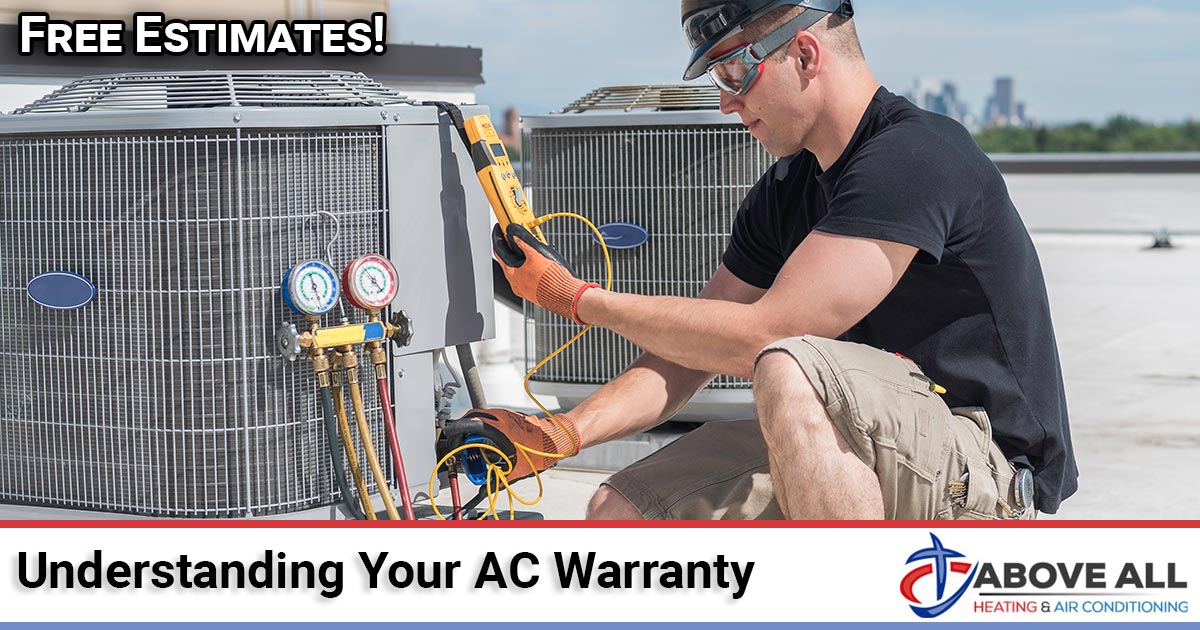
Buying a new air conditioning system is a significant investment, and most homeowners assume the warranty that comes with it will cover them if something goes wrong. In practice, an AC warranty is more specific than most people expect, and the details matter. What it covers, how long it lasts, and the steps you have to take to keep it valid can vary a lot from one manufacturer and one installation to the next.
At Above All Heating and Air, we regularly talk with homeowners who assume their system is still covered, only to find out a specific requirement wasn’t met, or that the repair they need falls into a gap the warranty doesn’t address. This guide walks through what a typical AC warranty actually covers, the difference between the manufacturer’s warranty and the installer’s workmanship warranty, how long coverage usually lasts, and the common mistakes that can void it before you ever need to use it.
What Does a Typical AC Warranty Cover?
Most new central air conditioning systems come with more than one layer of warranty coverage, and understanding which layer applies to a given problem is the first step in knowing what you’re actually protected against.
The manufacturer’s parts warranty covers the equipment itself, meaning the compressor, coils, and other internal components that fail due to a manufacturing defect. If a part fails within the warranty period for a covered reason, the manufacturer typically supplies the replacement part at no cost. This is the warranty most homeowners think of first, and it’s usually the longest-lasting piece of coverage that comes with a new system.
Separately, the installer’s workmanship warranty covers the labor and installation work itself, not the equipment. If a system was installed incorrectly, for example a refrigerant line that wasn’t properly sealed or a component that wasn’t wired correctly, the workmanship warranty is what covers the cost of correcting that installation error. This warranty is provided by the installing contractor, not the manufacturer, and its length and terms can vary significantly between HVAC companies.
Some manufacturers also offer an extended or upgraded warranty tier, often requiring online registration within a set window after installation, which can extend parts coverage well beyond the standard baseline period. Knowing which of these layers applies matters, because a homeowner assuming full coverage under one warranty when the issue actually falls under another can be caught off guard by an unexpected bill.
Manufacturer Warranty vs. Workmanship Warranty: Why the Distinction Matters
It’s worth restating this distinction because it’s the source of a lot of confusion. If a compressor fails on its own due to a manufacturing defect, that’s a manufacturer’s parts issue. If a system runs into a problem traceable back to how it was installed, that’s a workmanship issue, and it’s the installing company’s responsibility to correct it, separate from whatever the manufacturer covers.
In many cases, both warranties are still in effect and a repair only involves one of them: replacing a failed part under the manufacturer’s warranty typically still involves a labor charge for the technician’s time, unless a labor warranty from the installer or an extended plan also covers that portion. This is one of the more common surprises homeowners run into: a “covered” part replacement that still comes with a labor bill, because the parts warranty and the labor warranty are two separate things.
How Long Does an AC Warranty Last?
Warranty lengths vary by manufacturer, equipment tier, and whether the warranty was registered, but a few general patterns are common across the industry. Standard manufacturer parts warranties on residential AC equipment commonly run somewhere in the five-to-ten-year range, with higher-tier or registered warranties sometimes extending further. Compressor warranties are occasionally treated separately from the rest of the system’s parts warranty, sometimes running longer since the compressor is one of the more expensive components to replace.
Workmanship warranties from the installing contractor are typically shorter, often measured in one to a few years, though this varies by company. At Above All Heating and Air, we go over the specific manufacturer and workmanship warranty terms with every installation so homeowners know exactly what’s covered and for how long before the job is finished, not after a problem comes up.
What’s Typically Not Covered Under a Standard AC Warranty
A warranty is not the same thing as an all-purpose insurance policy for your AC system, and there are categories of issues it generally doesn’t address.
Normal wear items, like filters, and routine maintenance costs are not covered under a manufacturer’s parts warranty; those are ongoing homeowner responsibilities regardless of warranty status. Damage from something other than a manufacturing defect, such as physical damage, electrical surges from outside the system, flooding, or pest damage, typically falls outside standard coverage as well. Problems caused by improper maintenance, unauthorized repairs, or unapproved modifications are also commonly excluded, which is one of the more frequent reasons a claim gets denied even when the part itself would otherwise have been covered.
Labor is the other major gap. As mentioned above, many manufacturer parts warranties cover the replacement part itself but not the technician’s time to install it, unless a separate labor warranty applies. Reading the specific terms that came with your system, rather than assuming “under warranty” means “free,” avoids an unpleasant surprise when a repair is needed.
Common Mistakes That Can Void an AC Warranty
Warranty terms are specific, and a handful of common homeowner actions can void coverage even on equipment that would otherwise still be within its warranty period.
Skipping professional maintenance is the most common one. Many manufacturers require documented proof of annual professional maintenance, performed by a licensed technician, to keep a parts warranty valid. If a claim is filed and there’s no maintenance record on file, the manufacturer can deny it, even if the failure itself had nothing to do with the missed service. Attempting a DIY repair on a covered component, or having an unlicensed or unauthorized person work on the system, is another common way coverage gets voided, since manufacturers generally require repairs to be performed by a licensed HVAC professional. Failing to register the warranty within the manufacturer’s required window, when registration is required to activate the full coverage tier, can also mean a homeowner ends up with a shorter base warranty than they expected. Using unapproved parts or refrigerant, or modifying the system outside of manufacturer specifications, is another common trigger for a denied claim. Finally, not keeping documentation, meaning the original installation paperwork, maintenance records, and any warranty registration confirmation, can make it difficult to prove a claim even when the underlying issue is legitimately covered.
The pattern across all of these is documentation and process. Manufacturers aren’t looking for reasons to deny legitimate claims, but they do require proof that the system was installed, maintained, and repaired the way the warranty terms specify.
Registering Your AC Warranty
Many manufacturers require online registration of a new system within a specific window after installation, often 60 to 90 days, to activate the full warranty term. Without registration, some manufacturers default to a shorter base warranty period instead of the full advertised coverage. Registration is usually a straightforward online form requiring the model and serial numbers along with installation details, and it’s a step worth confirming was completed rather than assuming it happened automatically.
At Above All Heating and Air, we handle warranty registration as part of every new installation we perform, so homeowners don’t have to track down that paperwork themselves after the fact.
Warranty and Maintenance: Why They’re Linked
Because so many manufacturer warranties tie coverage to documented annual maintenance, an AC maintenance plan does double duty for homeowners. Beyond catching small problems early, a maintenance plan creates the ongoing service record that protects your warranty if you ever need to file a claim. A single tune-up booked occasionally and inconsistently generally doesn’t create the same reliable paper trail that an annual plan does, which is one of the reasons we recommend one to nearly every homeowner with a system still under warranty.
Warranty Considerations When Financing a New System
If you’re weighing whether to pay cash or use AC unit financing for a new system, it’s worth knowing that how you pay for a system has no bearing on its warranty coverage. Manufacturer and workmanship warranties are tied to the equipment and the installation itself, not to the payment method, so a financed system carries exactly the same warranty terms as one purchased outright. The two decisions, how to pay and what warranty terms apply, are separate conversations, though it’s reasonable to ask about both at the same time when getting a quote for a new installation.
What to Do If You Think You Have a Warranty Claim
If your system develops a problem you believe should be covered, the first step is contacting the company that installed it, since they can typically confirm what’s covered, pull your registration and maintenance records, and coordinate directly with the manufacturer on a parts claim. Having your model and serial numbers, installation date, and any maintenance records on hand speeds up that process considerably. If the installing company is no longer in business or unreachable, most manufacturers have a process for homeowners to file a claim directly, though it typically still requires an authorized technician to diagnose the issue and confirm it qualifies.
How Above All Heating and Air Handles Warranties
At Above All Heating and Air, we walk every homeowner through the specific manufacturer and workmanship warranty terms that come with their new installation, handle registration as part of the job, and keep service records on file so that warranty documentation isn’t something you have to track down yourself years later. If you’re not sure what warranty coverage applies to your current system, or you’re comparing installation options and want to understand the warranty terms before choosing equipment, our team is glad to walk through it with you.
Serving Homeowners Throughout Southern California
Above All Heating and Air installs and services air conditioning systems for homeowners throughout Murrieta, Temecula, Menifee, Wildomar, Hemet, Lake Elsinore, and the surrounding Southern California communities we serve. A clear understanding of your warranty coverage, paired with consistent maintenance, is one of the most effective ways to avoid an unexpected repair bill on a system that should still be protected. Visit our homepage to learn more about the full range of services we provide, or contact our team with any questions about warranty coverage on your current system or a new installation. If you’re ready to get started, you can also request a free AC service quote.
Frequently Asked Questions About AC Warranties
What does a typical AC manufacturer’s warranty cover?
A typical manufacturer’s warranty covers replacement of internal components, such as the compressor and coils, that fail due to a manufacturing defect within the warranty period. It generally does not cover normal wear items, routine maintenance, or damage from causes outside the equipment itself.
Does a warranty cover labor, or just parts?
Usually just parts. Many manufacturer parts warranties cover the replacement component itself but not the technician’s time to install it, unless a separate labor warranty from the installer or an extended plan also applies.
What common mistakes can void an AC warranty?
The most common are skipping required professional maintenance, attempting a DIY or unauthorized repair, failing to register the warranty within the required window, using unapproved parts or refrigerant, and not keeping installation or maintenance documentation on file.
Does skipping professional maintenance affect warranty coverage?
Yes, in many cases. A number of manufacturers require documented proof of annual professional maintenance to keep a parts warranty valid, and a missing maintenance record is one of the more common reasons a claim gets denied.
Does Above All Heating and Air register warranties for new installations?
Yes. We handle manufacturer warranty registration as part of every new AC installation we perform, so homeowners don’t need to track down that paperwork themselves afterward.
How long does a typical AC manufacturer’s warranty last?
Standard residential parts warranties commonly run somewhere in the five-to-ten-year range, with some manufacturers offering longer terms on higher equipment tiers or when the system is registered within the required window.
What’s the difference between a manufacturer’s warranty and an installer’s workmanship warranty?
The manufacturer’s warranty covers the equipment itself against defects. The workmanship warranty, provided by the installing contractor, covers the labor and installation work, such as correcting a wiring or refrigerant line error traceable to the installation itself.
Do I need to register my AC warranty, or does it register automatically?
Many manufacturers require online registration within a set window, often 60 to 90 days after installation, to activate the full warranty term. Without registration, some manufacturers default to a shorter base coverage period instead.
Does moving into a home with an existing AC system mean I still have warranty coverage?
It depends on the manufacturer and the original registration terms. Some manufacturer warranties transfer to a new homeowner, while others are tied to the original purchaser; checking the model and serial number with the manufacturer is the most reliable way to confirm current status.
Are AC warranties transferable if I sell my home?
Transfer policies vary by manufacturer and by the specific warranty terms, so if this matters to you as a seller or buyer, it’s worth confirming directly with the manufacturer or the installing contractor before closing.
What happens if I use a different company for maintenance than the one that installed my system?
This is usually fine as long as the maintenance is performed by a licensed HVAC professional and properly documented. What typically matters to the manufacturer is that qualified, licensed maintenance occurred and was recorded, not necessarily which company performed it.
Does a DIY repair void my AC warranty?
Often, yes. Manufacturers generally require repairs to be performed by a licensed HVAC professional, and a DIY repair or modification on a covered component is a common way coverage gets voided.
What’s typically not covered under a standard AC warranty?
Normal wear items like filters, routine maintenance costs, damage from causes outside the equipment such as electrical surges or physical damage, and problems caused by improper maintenance or unauthorized repairs are generally excluded from standard coverage.
Does an extended warranty make sense for a new AC system?
It can, particularly for homeowners who want longer coverage on major components like the compressor. Whether it’s worth the added cost depends on the specific terms and how long you plan to stay in the home, and it’s worth discussing during your installation quote.
How do I file a warranty claim if something goes wrong?
Start by contacting the company that installed your system, since they can confirm what’s covered, pull your registration and maintenance records, and coordinate with the manufacturer on the claim. Having your model and serial numbers on hand speeds up the process.
Does financing a new AC system affect my warranty coverage?
No. Manufacturer and workmanship warranties are tied to the equipment and the installation, not to how the system was paid for, so financing a system doesn’t change its warranty terms.
Can a maintenance plan help protect my warranty?
Yes. Because many manufacturer warranties require documented annual maintenance, an ongoing maintenance plan creates the consistent service record that protects your warranty, in addition to catching small problems early.
Does Above All Heating and Air handle warranty claims on installations we performed?
Yes. If a covered issue comes up on a system we installed, we help coordinate the manufacturer’s parts claim and can confirm what’s covered under both the manufacturer’s warranty and our own workmanship warranty.
Schedule an Appointment Today
Get in touch with Above All Heating and Air Conditioning by calling us or filling out the form. We look forward to working with you.
