
AC Running Constantly and Won’t Shut Off? Here’s Why
CONTACT US
Contact Us

Our
SERVICEs
AC Running Constantly and Won’t Shut Off? Here’s Why
Above All Heating And Air Conditioning / September 14, 2026 / AC Repair, Air Conditioner Repair, Air Conditioning, Air Conditioning Service
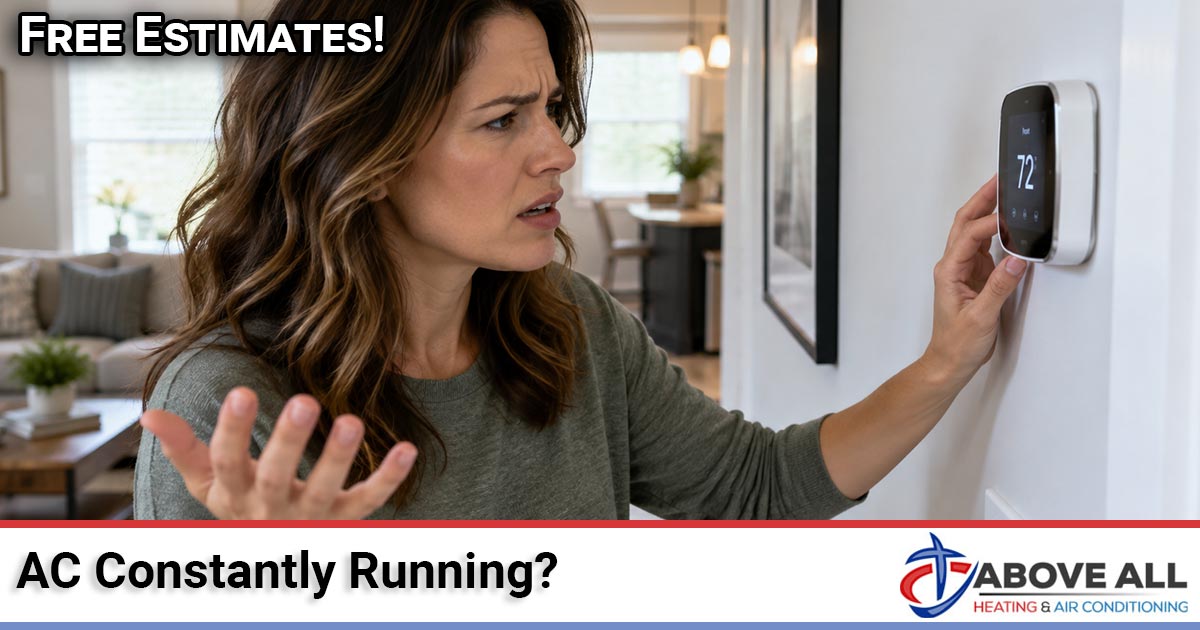
Most air conditioners are supposed to cycle. The system kicks on, cools the house down to the temperature you’ve set, and shuts off until the indoor air warms up enough to call for cooling again. That on-and-off rhythm is normal, and on an average day you might not even notice it happening.
So when your AC stops shutting off entirely — running for hours on end, or seemingly all day and night without ever satisfying the thermostat — it’s a different problem than most homeowners expect. It doesn’t always mean the system is broken outright. But a unit that runs constantly is almost always trying to compensate for something, and the longer that goes on, the more strain it puts on the equipment and the more it costs on your electric bill. At Above All Heating and Air, we get calls from homeowners across Temecula, Murrieta, Menifee, and the surrounding Inland Empire who describe the exact same thing: the outdoor unit never seems to stop, the indoor air handler is running nonstop, and the house either isn’t cooling down or is cooling down but the system won’t back off. Below, we walk through why this happens, what it means for your system, and when it’s time to call in a professional.
What “AC Won’t Turn Off” Actually Means
Before troubleshooting, it helps to separate two symptoms that sound similar but point in different directions. If your AC is turning on and off rapidly — running for a few minutes, shutting off, then starting again shortly after — that’s AC short cycling, a distinct problem with its own set of causes. What we’re covering here is the opposite symptom: a system that starts and then simply doesn’t stop, running continuously for long stretches without ever cycling off, even once the house feels cool.
A system running constantly on the hottest afternoon of the year isn’t necessarily a red flag by itself — AC systems are designed to run for longer stretches during peak heat. The concern is when the system never shuts off regardless of outdoor temperature, when it runs nonstop for days at a time, or when it’s running constantly but the house still isn’t reaching the temperature on the thermostat.
Common Reasons an AC Won’t Shut Off
1. A Thermostat Problem
The thermostat is the control center that tells your AC when to start and stop. If it’s miscalibrated, has a loose wire, is placed somewhere that doesn’t reflect the actual temperature of the home (near a sunny window, a supply vent, or a heat-generating appliance), or has simply failed, it can keep calling for cooling long after the house has actually reached the target temperature. This is one of the most common causes we find, and often one of the least expensive to fix.
2. A Dirty or Clogged Air Filter
A filter that’s overdue for replacement restricts airflow through the system. With less air moving across the evaporator coil, the system struggles to satisfy the thermostat efficiently, so it keeps running in an attempt to catch up. This is a simple maintenance item that a surprising number of “my AC won’t shut off” calls trace back to.
3. An Undersized AC Unit
If the AC installed in your home is too small for the square footage, ceiling height, window exposure, and insulation of the house, it will run nonstop trying to keep up with the cooling demand and still may not reach the set temperature. This is especially common in homes that have had additions, upgraded windows, or a system replaced without a proper sizing assessment. The only way to know for certain whether a unit is correctly sized is a professional AC load calculation, which accounts for the home’s square footage, insulation, orientation, window area, and local climate data rather than guessing based on the old unit’s tonnage.
4. Low Refrigerant
Refrigerant is what actually carries heat out of your home. When a system is low — almost always due to a leak somewhere in the line set or coils — it loses the capacity to remove heat efficiently. The system runs longer and longer trying to reach the setpoint, sometimes without ever getting there. Low refrigerant is a repair issue, not something that can be “topped off” as a permanent fix, since the underlying leak has to be located and sealed.
5. A Dirty Outdoor Condenser Coil
The outdoor unit needs to release the heat that’s been pulled out of your home, and it does that through the condenser coil. When that coil is coated in dust, pollen, grass clippings, or debris, heat transfer slows down significantly. The system compensates by running longer, since it’s working with a coil that can’t do its job efficiently.
6. A Failing Contactor or Relay
The contactor is the electrical switch that controls power to the outdoor unit. If it becomes pitted or stuck in the closed position, the outdoor unit can keep running even after the thermostat has stopped calling for cooling, or the system can fail to cycle off the way it’s supposed to. This is an electrical component issue that should be diagnosed and replaced by a licensed technician rather than something to troubleshoot yourself.
7. Extreme Heat and High Cooling Demand
On the hottest days of the Southern California summer, particularly during a heat wave, it’s normal for a properly sized system to run for very long stretches, sometimes appearing to run almost continuously for several hours. If the house is still cooling gradually and eventually reaches the setpoint once temperatures drop in the evening, this may simply be the system working as designed under a heavy load rather than a malfunction.
Why This Is Especially Common in Southern California
Homeowners in Temecula, Murrieta, Menifee, and the rest of the Inland Empire deal with long stretches of triple-digit heat every summer, which means local AC systems are already working harder and longer than systems in milder climates. That’s part of why it can be hard to tell, on your own, whether a system running nonstop is simply keeping up with the season or is genuinely struggling with an underlying problem. An older system nearing the end of its service life, a unit that was undersized when the home was built or when an addition was added later, or a system that’s overdue for a tune-up are all more likely to hit that tipping point during a heat wave than a well-maintained, correctly sized system would. This is also why fall and spring — when temperatures ease up and the system finally gets a break — are a good time to schedule maintenance and catch smaller issues before they show up again as a system that won’t shut off next summer.
Is a Constantly Running AC Bad for the System?
Occasional long runtimes during peak heat aren’t inherently damaging. But a system that runs nonstop for days, or that never reaches the setpoint no matter how long it runs, puts real strain on the equipment. The compressor — the most expensive single component in the system — wears down faster under continuous operation, especially if the root cause is something like low refrigerant or a dirty coil that’s forcing it to work harder than it should. Motors and bearings also see more cumulative wear, and a system that’s constantly running is a system that’s more likely to experience a breakdown at the worst possible time, like the middle of a heat wave.
There’s also the cost side. An AC system that runs continuously instead of cycling normally consumes significantly more electricity, and that shows up directly on the monthly bill. Homeowners are often surprised at how much a constantly running system adds to summer energy costs compared to a system cycling normally.
What to Check Before Calling for Repair
A few things are safe and worth checking yourself before scheduling a service call:
- Confirm the thermostat is set to “cool” and the setpoint is actually a few degrees below the current indoor temperature.
- Check whether the air filter is visibly dirty or overdue for replacement, and swap it if so.
- Make sure nothing is blocking supply or return vents throughout the house.
- Walk outside and check whether the condenser coil (the fins around the outdoor unit) is visibly caked in dirt or debris.
If those checks don’t resolve it, or if you notice ice on the refrigerant lines, a burning smell, unusual noises, or the house still isn’t cooling despite the system running nonstop, it’s time to call a professional rather than keep letting the system run.
When to Call Above All Heating and Air
A system that won’t shut off is rarely something that fixes itself, and the longer it runs under strain, the more likely you are to end up with a bigger repair bill or a full breakdown. If you’ve checked the basics and your AC is still running nonstop, our technicians can diagnose whether the issue is the thermostat, a refrigerant leak, an undersized system, a failing electrical component, or simple maintenance the system is overdue for. We serve homeowners throughout Temecula, Murrieta, Menifee, Lake Elsinore, Wildomar, and the surrounding communities, and we’re happy to walk you through what we find before any repair work begins.
If your system is running constantly and you’re not sure why, request a free AC service quote or contact our team to schedule a diagnostic visit. You can also learn more about how Above All Heating and Air serves Southern California homeowners on our homepage.
Frequently Asked Questions
1. Why would my AC run constantly without shutting off?
The most common causes are a miscalibrated or misplaced thermostat, a dirty air filter restricting airflow, an undersized unit that can’t keep up with the home’s cooling load, low refrigerant from a leak, a dirty outdoor condenser coil, or a failing electrical contactor that’s stuck closed.
2. Could an undersized AC unit cause this?
Yes. If the system installed in your home is too small for its square footage, insulation, and window exposure, it will run nonstop trying to reach the thermostat’s setpoint and may never actually get there. A professional AC load calculation is the only reliable way to confirm whether a unit is properly sized.
3. Is a thermostat problem a common cause?
It’s one of the most common causes we see. A thermostat that’s miscalibrated, wired incorrectly, or placed somewhere that doesn’t reflect the true temperature of the home can keep calling for cooling long after the house has actually reached a comfortable temperature.
4. Does an AC that never cycles off wear out faster?
Extended, continuous operation puts more cumulative strain on the compressor, motors, and bearings than a system that cycles normally. Over time, that added strain increases the likelihood of a breakdown and can shorten the system’s overall lifespan.
5. How much extra does a constantly running AC add to the electric bill?
A system that runs nonstop uses substantially more electricity than one cycling normally throughout the day, and most homeowners notice the difference clearly on their next summer utility bill.
6. Is it normal for an AC to run for hours during a heat wave?
Yes, to a point. On the hottest days of the year, a properly sized system may run for very long stretches, sometimes for hours at a time, simply because the cooling demand is high. This becomes a concern when the system never shuts off at all, regardless of outdoor temperature, or never actually reaches the thermostat’s setpoint.
7. Can a dirty air filter really cause the system to run nonstop?
Yes. A clogged filter restricts airflow across the evaporator coil, which makes it harder for the system to remove heat efficiently. The system compensates by running longer, and in some cases it never fully catches up.
8. What’s the difference between AC short cycling and an AC that won’t turn off?
Short cycling is a system turning on and off repeatedly in quick succession, often every few minutes. A system that won’t turn off is the opposite symptom: it starts and then keeps running continuously without shutting off at all. They have different underlying causes and are diagnosed differently.
9. Could low refrigerant cause my AC to run constantly?
Yes. When refrigerant levels are low, usually due to a leak, the system loses much of its capacity to remove heat from the home. It runs longer and longer trying to reach the setpoint, sometimes without success, which is a sign that a professional leak diagnosis is needed.
10. Should I turn my AC off if it won’t shut off on its own?
If the house has reached a comfortable temperature and the system is still running, or if you notice ice on the refrigerant lines, unusual noises, or a burning smell, it’s reasonable to switch the system off at the thermostat and call a professional rather than let it continue running under strain.
11. Can a dirty outdoor condenser coil cause this problem?
Yes. The outdoor coil is responsible for releasing the heat your system pulls out of the house. When it’s covered in dirt, pollen, or debris, that heat transfer slows down, and the system has to run longer to compensate.
12. What is a contactor, and how does it relate to an AC that won’t shut off?
The contactor is an electrical switch that controls power to the outdoor unit. If it becomes pitted or stuck closed, the outdoor unit can keep running even after the thermostat stops calling for cooling. This is an electrical issue that needs a licensed technician to diagnose and replace safely.
13. My AC is running constantly but the house still isn’t cool. What does that mean?
This is one of the clearest signs of a real problem rather than normal peak-heat operation. It usually points to an undersized system, low refrigerant, a dirty coil, or restricted airflow, and it’s worth having a technician diagnose rather than waiting it out.
14. Does Above All Heating and Air offer AC diagnostic service?
Yes. Our technicians diagnose the underlying cause of a system that won’t shut off, whether that’s the thermostat, refrigerant levels, airflow, sizing, or an electrical component, and explain what we find before any repair work begins.
15. Can thermostat placement really affect how long the AC runs?
Yes. A thermostat mounted near a sunny window, a supply air vent, or a heat-generating appliance can read a temperature that doesn’t match the rest of the house, which causes the system to keep running even after the home has actually cooled down.
16. How urgent is it to fix an AC that won’t turn off?
It’s worth addressing promptly. Beyond the higher electric bill, continuous operation adds wear to the compressor and other components, and the underlying cause — whether it’s low refrigerant, a failing contactor, or restricted airflow — typically doesn’t resolve on its own and can lead to a full system failure if ignored.
17. Can regular AC maintenance help prevent this issue?
Routine maintenance, including filter changes, coil cleaning, and a check of electrical components like the contactor, addresses several of the most common causes of a system that won’t shut off before they become full breakdowns.
18. Does Above All Heating and Air service AC systems throughout Southern California?
Yes. We serve homeowners throughout Temecula, Murrieta, Menifee, Lake Elsinore, Wildomar, and the surrounding Inland Empire communities for AC repair, maintenance, and installation.
Schedule an Appointment Today
Get in touch with Above All Heating and Air Conditioning by calling us or filling out the form. We look forward to working with you.
