
AC Not Cooling? 9 Common Causes and What to Do First
CONTACT US
Contact Us

Our
SERVICEs
AC Not Cooling? 9 Common Causes and What to Do First
Above All Heating And Air Conditioning / October 7, 2026 / AC Repair, Air Conditioner Repair, Air Conditioning, Air Conditioning Service, HVAC Accessories, HVAC Services
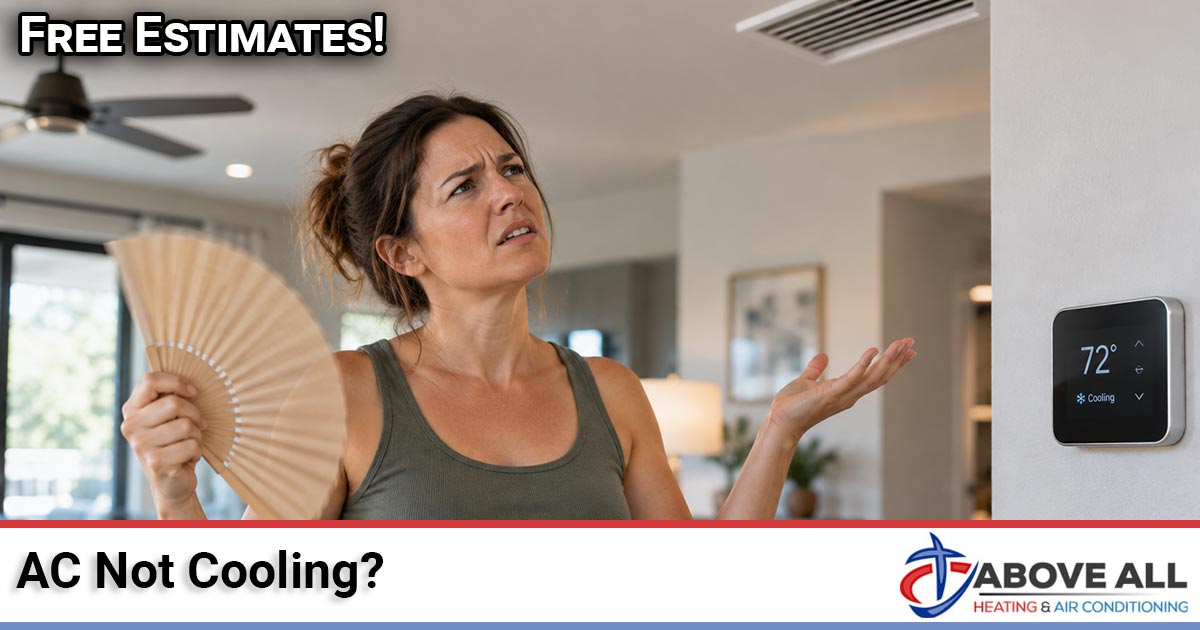
If your AC is not cooling, work through the likely causes in this order: thermostat settings, a tripped breaker, a dirty air filter, and restricted airflow at the outdoor unit, since those four cause the majority of no-cool calls and homeowners can usually check them in minutes. If those check out, the problem is typically low refrigerant, a failing capacitor or contactor, a weak compressor, or a frozen evaporator coil, and those need a licensed technician to diagnose safely.
An air conditioner that’s running but not actually cooling your home is one of the most common calls we get at Above All Heating and Air, and it’s also one of the most confusing for homeowners, because the system often looks and sounds like it’s working normally. The fan runs, the thermostat shows a cooling call, and air still comes out of the vents — it just isn’t cold. Below, we walk through the nine most common reasons this happens, in the order a technician would actually check them, so you can rule out the simple stuff yourself before deciding whether it’s time to call for repair.
Quick Reference: Symptom to Likely Cause
Before getting into each cause in detail, this table gives you a fast starting point based on what you’re actually experiencing.
| What You’re Noticing | Most Likely Cause | Can You Check It Yourself? |
|---|---|---|
| Thermostat display is correct, but air is warm | Mode or fan setting, dirty filter, or frozen coil | Yes |
| No air movement at all from vents | Tripped breaker, dead thermostat batteries, or blown fuse | Yes, partially |
| Weak airflow, warmer in some rooms than others | Dirty filter, blocked return, or duct leak | Yes, partially |
| Ice visible on the indoor coil or outdoor line set | Frozen evaporator coil (airflow or refrigerant issue underneath) | Shut off and thaw, then call us |
| Outdoor unit humming but not starting | Failing capacitor or contactor | No — call a technician |
| Cooling has gotten gradually worse over weeks | Refrigerant leak | No — call a technician |
| System short cycles or trips the breaker repeatedly | Compressor or electrical component failure | No — call a technician |
| Outdoor fan not spinning at all | Condenser fan motor or capacitor failure | No — call a technician |
Start Here: What You Can Safely Check Yourself
Work through these five checks in order before assuming you need a repair visit. Most AC not cooling calls we get turn out to be one of the first two.
- Check the thermostat. Confirm it’s set to “Cool,” not “Heat,” “Off,” or “Fan Only,” and that the setpoint is at least a couple of degrees below the current indoor temperature. Also confirm the fan is set to “Auto” rather than “On” — in the “On” position, the blower runs constantly even when the system isn’t actively cooling, which feels identical to warm air blowing.
- Check the breaker. Central air conditioners typically run on a dedicated 240-volt breaker, often labeled “AC” or “Condenser.” If it’s tripped, it will usually sit in a middle position rather than fully flipped. Switch it off, then back on. If it trips again immediately, stop resetting it and call a professional, since a breaker that won’t hold points to a short or a failing component.
- Pull the air filter and inspect it. Hold it up to a light. If you can’t see light passing through clearly, it’s restricting airflow enough to reduce cooling performance, and in more severe cases it can cause the indoor coil to freeze over entirely.
- Walk outside and look at the condenser. Clear away any leaves, grass clippings, or overgrown landscaping within roughly two feet of the unit. A condenser that can’t expel heat efficiently will struggle to cool your home no matter how well the rest of the system is working.
- Look for ice on the indoor coil or outdoor line set. If you see any, that’s a sign of a frozen evaporator coil, and running the system any further at that point can cause more expensive damage. Shut it down using the steps below before doing anything else.
If you’ve gone through all five of these and the system still isn’t cooling, the cause is likely one of the component failures below, which require a licensed technician to diagnose and repair safely.
Causes That Need a Technician
1. Low Refrigerant From a Leak
Refrigerant carries heat out of your home, and a sealed system shouldn’t lose its charge under normal operation. If your AC is low on refrigerant, it’s because refrigerant is escaping somewhere in the line set, coil, or connections. Cooling performance typically gets worse gradually over days or weeks rather than failing all at once, and you may notice a hissing or bubbling sound near the indoor or outdoor unit, or ice forming on the line set. Our guide on low refrigerant signs, causes, and repair costs covers this in more depth. Refrigerant work requires EPA certification and specialized equipment, so this isn’t a DIY repair.
2. A Failing Capacitor
The capacitor stores and releases the electrical charge the compressor and outdoor fan motor need to start and keep running. A weakening capacitor often shows up as a humming outdoor unit that won’t start, a noticeable delay before the system kicks on, or the system shutting off shortly after starting. We cover this failure pattern in detail, including why it clusters late in the cooling season, in our guide to AC capacitors going bad.
3. A Worn Contactor
The contactor is the electromechanical switch that sends power to the compressor and outdoor fan whenever the thermostat calls for cooling. Contactors wear out from repeated daily cycling, and the contacts can pit, burn, or stick. A stuck-open contactor will prevent the outdoor unit from running at all, while a stuck-closed contactor can cause the system to run constantly without ever being told to.
4. A Failing Compressor
The compressor is often called the heart of the system, and it’s also the most expensive component to replace. A struggling compressor may run intermittently, hum without engaging, or trip the system’s internal safety protections repeatedly. By the time a compressor is failing outright, it’s usually because an earlier issue — low refrigerant, a bad capacitor, or restricted airflow — went unaddressed long enough to damage it.
5. A Condenser Fan Motor Problem
The outdoor fan pulls air across the condenser coil so the system can reject the heat it’s removed from your home. If that fan isn’t spinning — whether from a failed motor, a seized bearing, or a bad capacitor — the condenser can’t release heat properly, and cooling performance drops even though the compressor itself may still be running.
6. Ductwork Leaks or Blockages
If ductwork running through your attic, garage, or crawlspace has gaps, disconnected sections, or poor insulation, cooled air can escape before it reaches your living space, and hot attic air can get pulled into the return side of the system. This typically shows up unevenly, with rooms farthest from the air handler feeling noticeably warmer, even though the system runs the same as always. A full duct assessment is usually a job for a technician with the right tools to test airflow and pressure.
What Is the Frozen Evaporator Coil Doing to Your Cooling?
A frozen indoor coil deserves its own explanation because it’s one of the more common reasons an AC runs but doesn’t cool, and because it’s almost always a symptom of something else rather than a standalone problem. Once ice forms on the coil — usually from restricted airflow (a dirty filter, closed vents, a dirty coil) or low refrigerant — it blocks the very airflow the coil needs to function, and the problem compounds on itself. Our full guide to frozen AC coils, why they happen, and how to fix them safely walks through the complete thaw process step by step. The short version: turn the thermostat off, set the fan to “on” so air continues circulating, and give it several hours (up to about 24 for a heavily iced coil) before running the system again.
The 3-Minute Rule and Safe Reset Steps
If you’ve shut your AC off — whether because of a breaker trip, a power outage, or to let a frozen coil thaw — wait at least three minutes before turning it back on. This is widely known among HVAC technicians as the 3-minute rule, and according to Hunker’s explanation of the rule, it exists specifically to protect the compressor. When the system powers down, pressure inside the refrigerant circuit needs time to equalize before the compressor restarts. Restarting too soon can force liquid refrigerant back into the compressor instead of the vapor it’s built to handle, a condition called “slugging” that can cause real internal damage. Most newer thermostats and outdoor units have a built-in delay that enforces this automatically, but it’s worth following manually any time you’ve cut power to the system yourself.
A safe reset generally looks like this:
- Set the thermostat to “Off” and, if you reset a breaker, switch it off, then on.
- Wait at least three minutes before switching the thermostat back to “Cool.”
- Give the system a few minutes to start the compressor and begin a normal cooling cycle before judging whether it’s working.
- If it trips the breaker again, shuts off on its own, or still isn’t cooling after a full cycle, stop troubleshooting and call for a diagnostic visit.
When to Turn the System Off to Prevent Further Damage
A few situations call for shutting the system down completely rather than continuing to run it while you wait for service: visible ice anywhere on the indoor coil or outdoor line set, a hissing or bubbling sound suggesting a refrigerant leak, a breaker that trips repeatedly, or any burning smell or visible scorching near the outdoor disconnect. Continuing to run an AC in any of these conditions typically turns a moderate repair into a significantly more expensive one, since components like the compressor bear the brunt of that extra strain.
What a Diagnostic Visit Costs and Includes
Across the industry, an AC diagnostic or service call typically runs $75 to $250, and that fee is usually credited toward the repair if you move forward with the work the same visit, according to cost data compiled by PickHVAC and Fixr. During that visit, a technician checks refrigerant pressure, electrical components (capacitor, contactor, and wiring), airflow across both coils, and the condition of the compressor and fan motors, then explains what’s actually wrong and what it will cost to fix before any repair work begins.
What you pay beyond the diagnostic fee depends entirely on the cause. Based on the same cost guides, a capacitor replacement typically runs $100 to $450, a refrigerant leak repair can range from $200 to $1,600 depending on the leak’s location and how much refrigerant needs replacing, and a full compressor replacement — the most expensive single-component repair — typically falls between $800 and $2,800. Rather than quote a single number that doesn’t reflect your specific system, our technicians diagnose the exact cause first and provide clear, itemized pricing before starting any repair.
Why This Happens So Often in the Inland Empire
Southern California’s Inland Empire and Temecula Valley put a different kind of strain on air conditioning systems than milder climates do. Our cooling season runs long — often from April through October — which means far more start-stop cycles on compressors, capacitors, and contactors than a system in a shorter-summer climate ever sees. Sustained triple-digit heat during peak summer months also raises the operating temperature inside the outdoor unit well above ambient air temperature, which accelerates the wear on electrical components like capacitors. On top of that, dust and occasional Santa Ana wind events can load up air filters and outdoor condenser coils faster than homeowners expect, restricting the airflow both the indoor and outdoor halves of the system depend on. None of that means a system is doomed to fail — it just means the checks in this guide, especially the filter and condenser airflow steps, are worth doing more often here than the manufacturer’s general guidance might suggest.
Related Problems Worth Ruling Out
If what you’re experiencing doesn’t quite match “running but not cooling,” a couple of related guides may fit your situation better. If your system blows air that’s clearly warm rather than just weak, our guide to AC blowing warm air covers that pattern in more detail. If your system shows no signs of life at all — no fan, no hum, nothing — our guide on AC not turning on walks through that scenario instead.
Get a Same-Day Diagnosis
If you’ve worked through the checks above and your AC still isn’t cooling, don’t keep guessing at the cause or running a system that could be compounding the damage. Above All Heating and Air provides prompt AC repair service throughout Temecula, Murrieta, Menifee, Lake Elsinore, Hemet, and Wildomar, and we typically offer same-day diagnostic visits during peak cooling season. Visit our homepage to learn more about our team, contact us to schedule a visit, or request a free service quote to get started.
Frequently Asked Questions
Should I turn off AC if it’s not cooling?
Yes, if you see ice on the coil or lines, hear hissing or bubbling, or smell anything burning. Continuing to run the system in those conditions can turn a moderate repair into a more expensive one, so shut it off and call for a diagnostic visit.
How to reset AC if not cooling?
Set the thermostat to off, reset the breaker if it tripped, wait at least three minutes for pressure to equalize, then switch the thermostat back to Cool. If the system trips again or still won’t cool after a full cycle, stop and call a technician.
Why is my AC blowing air but not getting colder?
This usually points to a dirty filter restricting airflow, low refrigerant, a frozen evaporator coil, or a failing compressor. The fan running normally while the air stays warm is the key clue that separates this from a power or electrical issue entirely.
What is the 3 minute rule for air conditioners?
It’s the practice of waiting at least three minutes after shutting an AC off before turning it back on, which gives refrigerant pressure time to equalize and protects the compressor from being flooded with liquid refrigerant on restart.
Why is my AC not cooling but the fan is running?
A running fan with no real cooling almost always traces back to the refrigerant circuit or the compressor — low refrigerant, a frozen coil, or a compressor that’s struggling to engage — rather than anything wrong with the blower itself.
Why is my AC suddenly weak?
A sudden drop in cooling strength is most often caused by a developing refrigerant leak, a coil that’s starting to ice over, or a capacitor that’s losing its ability to keep the compressor and fan running at full strength.
What to do if AC is not starting?
Check the thermostat settings and batteries, check for a tripped breaker, and listen at the outdoor unit for a hum that suggests a capacitor issue. If the breaker trips again immediately or you hear humming with no movement, stop and call a professional rather than repeating the attempt.
How do I reset my air conditioner?
Turn the thermostat off, wait at least three minutes, and turn it back to Cool. For a breaker trip, switch the breaker fully off and then on, then wait the same three minutes before restarting the system at the thermostat.
Why is my AC running but not cooling?
This is the core symptom covered in this guide, and it usually comes down to one of nine causes: thermostat settings, a tripped breaker, a dirty filter, a blocked outdoor unit, a frozen coil, low refrigerant, a failing capacitor, a worn contactor, or a failing compressor or fan motor.
Why is AC not working suddenly?
A sudden failure is more often electrical — a tripped breaker, a failed capacitor, or a stuck contactor — than a gradual issue like a refrigerant leak, since those tend to show symptoms for days or weeks before a full failure.
What is the first thing to check when the AC stops working?
Start with the thermostat: confirm it’s set to Cool, the fan is on Auto, and the setpoint is below the current indoor temperature. That single check resolves a surprising number of no-cool calls before any tools come out.
What should I do if my AC is not cooling my house evenly?
Uneven cooling between rooms often points to a duct leak, a blocked return, or a system that’s undersized for part of the home, rather than a single component failure. A technician can test airflow and pressure room by room to pin down the cause.
Why is my AC unit not cooling at all?
A complete lack of cooling, as opposed to weak cooling, usually means either the compressor isn’t engaging (capacitor, contactor, or compressor failure) or the coil has iced over completely and is blocking airflow entirely.
What are the most common reasons an AC stops cooling?
In order of how often we see them: a dirty air filter, a thermostat set incorrectly, a tripped breaker, a frozen evaporator coil, low refrigerant from a leak, and a failing capacitor or compressor.
How much does an AC diagnostic visit typically cost?
Diagnostic fees generally run $75 to $250 industry-wide, and that fee is usually applied toward the repair cost if you move forward with the work during the same visit.
Does Above All Heating and Air offer same-day AC repair when my system won’t cool?
Yes. We prioritize no-cool calls, especially during peak summer heat, and typically offer same-day diagnostic visits throughout Temecula, Murrieta, Menifee, Lake Elsinore, Hemet, and Wildomar.
Schedule an Appointment Today
Get in touch with Above All Heating and Air Conditioning by calling us or filling out the form. We look forward to working with you.
