
Heat Pump vs. AC: Which Is Better for a Southern California Home?
CONTACT US
Contact Us

Our
SERVICEs
Heat Pump vs. AC: Which Is Better for a Southern California Home?
Above All Heating And Air Conditioning / October 20, 2026 / Air Conditioner Replacement, Air Conditioning, Air Conditioning Installation
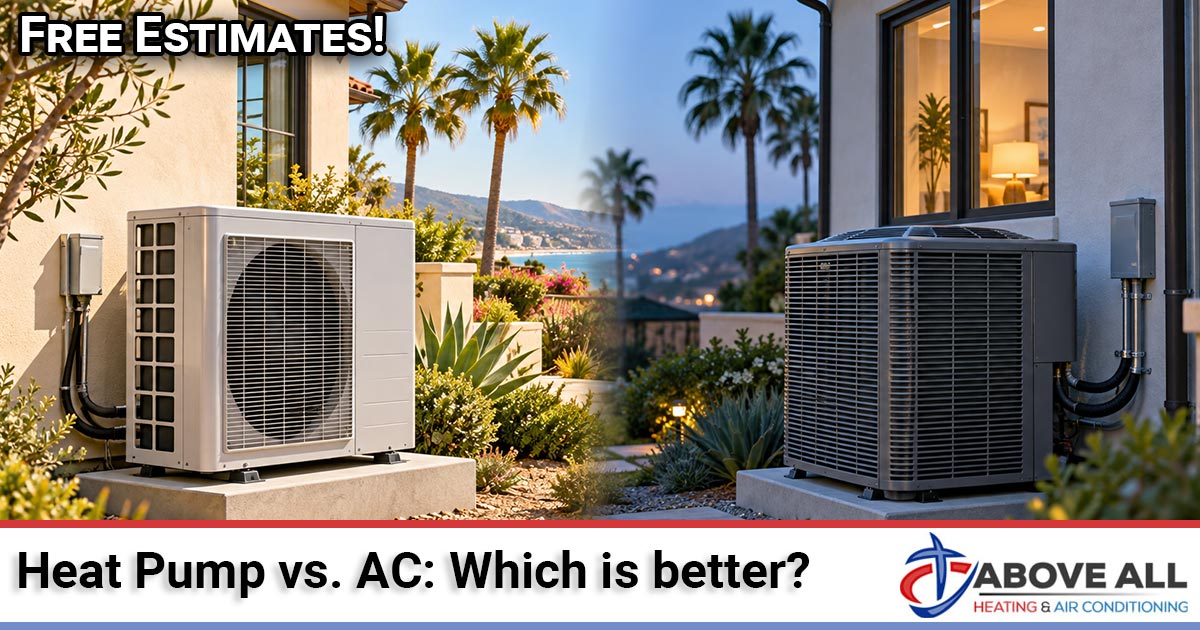
Heat pump vs AC: in summer there is no difference you would feel. A heat pump cools your home exactly the way a central air conditioner does, using the same refrigeration cycle. The difference is that a heat pump can also run that cycle in reverse to heat your home, so in a mild-winter climate like ours it can replace both your AC and your gas furnace.
That one difference changes a lot: what you pay up front, what your winter bills look like, how long the equipment lasts, and whether you still need a furnace at all. At Above All Heating and Air we install and service both systems across Murrieta, Temecula, Menifee and the rest of the Inland Empire, and we are asked this question on almost every replacement visit. This guide walks through how each system works, a side-by-side comparison, the honest drawbacks of heat pumps, when an AC with a gas furnace still makes more sense, and what to ask before you sign a quote.
Heat Pump vs AC: The Short Answer
If you only need cooling, a central air conditioner and a heat pump of the same size and efficiency will cool your home the same way. Carrier, one of the largest equipment makers in the country, puts it plainly: both systems “operate identically in cooling mode” (Carrier).
The choice comes down to heating. With a standard AC, your heat comes from a separate gas furnace (or, in some homes, electric resistance heat). With a heat pump, the outdoor unit does both jobs, and the indoor air handler or furnace only provides backup heat on the coldest mornings, if it is needed at all.
For most Southern California homes, the questions that decide it are:
- Does your home already have a gas furnace in good condition, or is the furnace also near the end of its life?
- Do you have natural gas service, and how do your gas and electric rates compare?
- Do you have, or plan to add, rooftop solar?
- How long do you plan to stay in the home?
How a Central Air Conditioner Works
A split-system air conditioner has two main parts: an outdoor condenser and an indoor evaporator coil, usually sitting on top of your furnace or inside an air handler. Refrigerant absorbs heat from your indoor air as it passes over the cold evaporator coil, the compressor pumps that refrigerant outside, and the condenser coil releases the heat into the outdoor air. The cooled air is pushed back through your ducts by the blower.
An AC only moves heat in one direction: from inside your house to outside. It has no way to warm your home, so it is always paired with something else for heat. In the Inland Empire, that is almost always a gas furnace, which burns natural gas to create heat and uses the same blower and ductwork to distribute it.
How a Heat Pump Works
A heat pump uses the same parts as an air conditioner (outdoor coil, indoor coil, compressor, refrigerant lines) plus one key component: a reversing valve. In summer, it works exactly like an AC. In winter, the reversing valve switches the direction the refrigerant flows. Now the outdoor coil absorbs heat from the outside air, and the indoor coil releases it into your home.
It sounds strange that there is heat to collect from 45-degree air, but there is, and a heat pump is very good at gathering it. Because a heat pump moves heat instead of creating it from fuel, it can be remarkably efficient. According to the U.S. Department of Energy, an air-source heat pump can deliver up to three times more heat energy to a home than the electrical energy it consumes.
Heat pumps also have a defrost cycle. On cold, damp mornings, frost can form on the outdoor coil while it is collecting heat. The system briefly switches to cooling mode to melt it, which is why you may occasionally see steam coming off the outdoor unit in winter. That is normal.
Heat Pump vs Air Conditioner: Side-by-Side Comparison
Here is how the two setups compare for a typical Southern California home. The “AC” column assumes a central air conditioner paired with a gas furnace, since that is what most homes in our area have.
| Factor | Central AC + Gas Furnace | Heat Pump (with air handler or furnace backup) |
|---|---|---|
| Cooling | Yes | Yes, identical to an AC of the same size and efficiency |
| Heating | Gas furnace burns fuel | Outdoor unit moves heat indoors; electric heat strips or a furnace as backup |
| Cooling efficiency rating | SEER2 and EER2 | SEER2 and EER2 |
| Heating efficiency rating | AFUE (furnace) | HSPF2 |
| Federal minimums (Southwest region, split systems) | 14.3 SEER2 under 3.5 tons; 13.8 SEER2 at 3.5 tons and above | 14.3 SEER2 and 7.5 HSPF2 |
| Fuel | Electricity for cooling, natural gas for heat | Electricity for both |
| Upfront cost | Usually lower for the outdoor unit alone | Usually higher than a comparable AC, but can replace a furnace |
| Operating cost | Depends on gas and electric rates | Depends on electric rates; strong fit with rooftop solar |
| Hours of use per year | Cooling season only | Cooling and heating seasons |
| Typical lifespan | Often outlasts a heat pump by a few years | About 10 to 15 years; longer with good maintenance |
| Maintenance | AC tune-up plus separate furnace check | One system, serviced before cooling and heating seasons |
The federal minimums above come from the Department of Energy’s 2023 regional standards, summarized by Baker Distributing. Lifespan figures are from EnergySage, which notes that heat pumps usually last about 10 to 15 years and that a conventional AC and furnace will probably outlast a heat pump by a few years because the work is split between two units. For more on what the ratings mean, see our guide to SEER2 ratings.
Why Mild Inland Empire Winters Favor Heat Pumps
Heat pumps lose some heating efficiency as outdoor temperatures drop, because there is less heat in the air to collect. That is the main reason heat pumps were once a hard sell in places like Minnesota or Maine. It is also the main reason they make so much sense here.
Winter in Murrieta, Temecula, Menifee, Wildomar and Lake Elsinore is short and mild. Most winter days are cool rather than cold, and the coldest hours tend to be early mornings before the sun warms things up. Those are exactly the conditions where a heat pump works well. Carrier describes heat pumps as “generally better for moderate climates” because of their dual heating and cooling ability (Carrier).
Our summers matter too. Long, hot cooling seasons are where an air conditioner earns its keep, and since a heat pump cools exactly like an AC, you give up nothing in July and August. In practice, the heat pump does its heavy lifting from May through October as an air conditioner, then handles the lighter heating load on winter mornings and evenings.
A few local factors are worth thinking about:
- Rooftop solar. Many homes in our area already have solar. When your heating runs on electricity instead of gas, more of your annual energy use can be covered by panels you already own.
- Dust and Santa Ana winds. A heat pump’s outdoor coil works year-round, so dust, leaves and debris blown in during Santa Ana events affect it in more months of the year. Keeping the coil clean matters more with a heat pump than with an AC that sits idle all winter.
- Higher elevations. Homes in the foothills and higher neighborhoods see colder winter nights than homes on the valley floor. A properly sized heat pump with backup heat still works well there, but sizing and backup heat deserve extra attention.
When an AC and Gas Furnace Still Makes Sense
A heat pump is not automatically the right answer. We still recommend a straight AC replacement in plenty of situations:
- Your furnace is newer and in good shape. If you replaced the furnace a few years ago and only the AC has failed, a matching AC is often the most cost-effective repair-to-replace path. You can revisit a heat pump when the furnace reaches the end of its life.
- Your gas rates are low compared with electric rates. Operating cost depends on what you pay for each fuel. If gas is inexpensive relative to electricity in your home’s utility territory and you have no solar, a gas furnace may cost less to run.
- Your electrical panel is at capacity. A heat pump with electric backup heat can add electrical load. If a panel upgrade would be needed, that cost belongs in the comparison.
- You strongly prefer the feel of gas heat. Furnace air comes out of the vents hotter than heat pump air. Heat pump heat is steady and even, but some homeowners simply prefer the blast of warm air from a furnace.
- Budget is the deciding factor today. If the goal is to restore cooling at the lowest upfront cost, an AC-only replacement usually gets you there.
The same idea applies in reverse: if your furnace and AC are both 15 or more years old, replacing them separately can cost more over time than moving both jobs to a single heat pump. That is one of the most common situations where we recommend at least pricing a heat pump.
The Honest Disadvantages of Heat Pumps
We want you to choose with clear eyes, so here are the real drawbacks:
- Higher upfront cost than an AC alone. Carrier notes that “heat pumps typically cost more upfront than a comparable air conditioner.” The comparison changes if a heat pump lets you skip a furnace replacement.
- More running hours. Because a heat pump works in summer and winter, it accumulates more operating hours each year. That is the main reason heat pumps often have a somewhat shorter service life than an AC that rests all winter.
- Cooler supply air in heating mode. Heat pump air feels warm, not hot. Homes stay comfortable, but it is a different feel than a gas furnace.
- Less efficient in deep cold. Heating capacity drops as outdoor temperatures fall. Here that mostly matters on the coldest mornings, and backup heat covers it. Cold-climate models exist for much harsher regions, but most Inland Empire homes do not need them.
- Installation details matter more. A heat pump needs correct sizing, a compatible indoor coil and air handler, the right thermostat and control wiring, and properly set backup heat. A careless install can lead to high bills or uneven comfort.
- Winter defrost cycles. Brief defrost cycles are normal, but they can surprise homeowners the first winter.
None of these is a reason to rule out a heat pump. They are reasons to choose your installer carefully and to make sure the quote covers the details.
Dual Fuel: The Middle Ground
A dual-fuel (or hybrid) system pairs a heat pump outdoors with a gas furnace indoors. The heat pump handles all of the cooling and most of the heating. When it gets cold enough that the furnace would be more economical, the system automatically switches to gas. Carrier describes this approach as relying “on the heat pump for mild days” and switching “to the furnace only when temperatures plunge.”
Dual fuel can make sense when:
- Your furnace is still in good condition but your AC needs replacing. Instead of a new AC, you install a heat pump and keep the furnace as backup.
- Your home is at a higher elevation with colder winter nights.
- You want to use less gas without giving it up entirely.
The trade-off is complexity: two heat sources, a thermostat that can manage both, and a furnace that still needs annual service.
Heat Pump vs AC Cost: What Drives the Price
We do not publish one-size-fits-all prices, because a number pulled from a national average does not reflect what a system costs to install in the Inland Empire, and every home is different. What we can tell you is what moves the price up or down on any quote, whether it is for an AC or a heat pump:
| Cost Factor | Why It Matters |
|---|---|
| System size (tonnage) | Larger homes and homes with more sun exposure need more capacity. A proper load calculation sets the size, not a rule of thumb. |
| Efficiency tier | Entry-level systems meet federal minimums. Mid-tier and high-efficiency (often variable-speed or inverter) systems cost more up front and less to run. |
| What is replaced | Outdoor unit only, outdoor unit plus indoor coil, or a full system with a new furnace or air handler. |
| Backup heat | Electric heat strips, an existing furnace (dual fuel) or a new furnace each change the price. |
| Electrical work | Some homes need a new circuit, disconnect or panel upgrade. |
| Ductwork | Leaky, undersized or damaged ducts may need repair or replacement for the system to perform as rated. |
| Refrigerant lines and refrigerant type | New systems use newer refrigerants such as R-454B, which can affect whether existing line sets can be reused. |
| Permits, thermostat and add-ons | Permits, a compatible thermostat, surge protection and air quality add-ons all show up on a full quote. |
Because a heat pump can replace both an AC and a furnace, compare the right things. If you would otherwise replace both pieces of equipment, compare a heat pump system against an AC plus a new furnace, not against an AC alone. For a deeper breakdown, see our AC replacement cost guide, and if you would rather spread out payments, our post on financing a new AC system covers the options. The fastest way to get real numbers for your home is a free quote.
Rebates and Incentives in 2026
Incentives for heat pumps have changed a lot recently, so here is where things stand:
- The federal heat pump tax credit has ended. The Energy Efficient Home Improvement Credit (Section 25C) offered up to $2,000 per year for a qualifying heat pump, but the One Big Beautiful Bill Act ended it for equipment placed in service after December 31, 2025 (EnergySage). If you installed a qualifying heat pump in 2025, you may still be able to claim it on your 2025 return; ask your tax professional.
- California’s statewide single-family heat pump rebates are fully reserved. TECH Clean California reports that single-family HEEHRA rebates are fully reserved statewide, with new requests placed on a waitlist in case more funding becomes available (TECH Clean California).
- Utility and manufacturer programs come and go. Local utility rebates and manufacturer promotions open and close throughout the year. We check what is available when we prepare your quote, so you are not guessing.
For new construction, California’s 2025 Energy Code, which took effect January 1, 2026, uses energy budgets that encourage heat pumps for home heating and cooling (California Energy Commission). If you are building an addition or an ADU, ask about code requirements early in the design.
Is a Heat Pump the Same as a Mini Split?
Many ductless mini splits are heat pumps. They use the same reversing-valve technology but deliver air through wall-mounted indoor heads instead of ducts. That makes them a good fit for garage conversions, room additions and homes without ductwork. If that sounds like your situation, our ductless mini split installation guide explains how they compare with a central system.
How Our Technicians Help You Decide
When you ask us to compare a heat pump and an AC for your home, here is what we look at:
- Your existing equipment. The age and condition of your AC, furnace or air handler, and whether the indoor coil and blower are compatible with a new outdoor unit.
- A load calculation. We size the system to your home’s square footage, insulation, windows, sun exposure and duct layout.
- Your ducts. We check for leaks, crushed runs and undersized returns that would hold back any new system.
- Your electrical service. We confirm the panel and circuits can handle the equipment and any backup heat.
- Your utility costs and solar. We talk through your gas and electric use, and whether you have or plan to add solar.
- Your plans. How long you expect to stay and what matters most to you: lowest upfront cost, lowest monthly bills, or the most even comfort.
From there, we can quote both options side by side so you can compare them directly. You can learn more about our air conditioning installation and heating services, or read our tips on green AC and heating and saving energy.
Questions to Ask on a Heat Pump or AC Quote
- Was a load calculation done, and what size system does it call for?
- What are the SEER2, EER2 and (for a heat pump) HSPF2 ratings of the exact model and indoor coil combination?
- Is the indoor coil or air handler being replaced, and is the combination matched and rated together?
- What backup heat is included, and at what outdoor temperature does it turn on?
- Is the thermostat compatible with a heat pump or dual-fuel system?
- Does the quote include electrical work, permits, line set replacement and duct repairs, or are those extra?
- What are the parts and labor warranties, and does the manufacturer warranty require registration?
- What maintenance does the system need, and how often?
Warranty terms matter as much as the equipment. Ask for both in writing before you sign.
Frequently Asked Questions
Do I need AC if I have a heat pump?
No. A heat pump is a complete air conditioner that can also heat, so you do not need a separate AC. In summer it cools your home the same way a central air conditioner does. Some homes keep a gas furnace as backup heat in a dual-fuel setup, but the heat pump handles all of the cooling.
Is a heat pump as good as an air conditioner?
For cooling, yes. A heat pump and an air conditioner of the same size and efficiency rating cool identically, because they use the same refrigeration cycle. The heat pump simply adds heating. Cooling quality depends far more on correct sizing, ductwork and installation than on whether the unit is a heat pump or an AC.
Can a heat pump cool a house in 100 degree weather?
Yes. A heat pump in cooling mode is an air conditioner, so it handles triple-digit days just as well as a comparable AC. As with any system, it has to be sized correctly for your home with a load calculation. An undersized unit of either type will struggle on the hottest afternoons in the Inland Empire.
What are the disadvantages of heat pumps?
The main drawbacks are a higher upfront cost than an AC alone, more running hours each year, cooler supply air in heating mode than a gas furnace, and reduced heating efficiency in very cold weather. In our mild climate the cold-weather issue is minor, and backup heat covers the coldest mornings.
What is the major disadvantage of a heat pump?
For most homeowners, the biggest disadvantage is upfront cost: a heat pump usually costs more than a comparable air conditioner. That gap can shrink or disappear when the heat pump also replaces an aging furnace. In very cold regions, reduced heating capacity is the bigger concern, but that rarely applies to Southern California.
Why don’t contractors like heat pumps?
Most contractors do not dislike heat pumps; some are simply less familiar with them. Heat pumps need careful sizing, matched indoor equipment, correct thermostat wiring and properly set backup heat, and a poor install leads to callbacks. Our technicians install and service heat pumps and will tell you honestly whether one fits your home.
How much does a heat pump cost to install?
It depends on system size, efficiency tier, whether you need a new air handler or furnace, backup heat, electrical work and ductwork. National averages do not reflect Inland Empire installation costs, so we do not quote a range sight unseen. A free in-home quote gives you a real price, and we can price an AC option side by side.
What is the $5000 rule for HVAC?
The $5,000 rule is a quick repair-or-replace test: multiply your system’s age by the estimated repair cost. If the result is more than $5,000, replacement is usually the better value; if it is less, repair usually makes sense. Trane describes this rule of thumb. It is a starting point, not a substitute for an inspection.
What is a heat pump?
A heat pump is a heating and cooling system that moves heat instead of creating it. In summer it pulls heat out of your home like an air conditioner. In winter a reversing valve flips the process, collecting heat from the outdoor air and bringing it inside. It runs entirely on electricity.
How does a heat pump work?
A heat pump circulates refrigerant between an indoor coil and an outdoor coil. In cooling mode, the indoor coil absorbs heat and the outdoor coil releases it. In heating mode, a reversing valve switches the flow so the outdoor coil absorbs heat from outside air and the indoor coil releases it into your home.
How do I know if I have a heat pump?
Check your thermostat for an emergency heat or EM heat setting, which usually means a heat pump. You can also look at the outdoor unit’s label for the words heat pump in the model description, or notice whether the outdoor unit runs in winter when the heat is on. An air conditioner’s outdoor unit stays off in heating mode.
What does a heat pump look like?
A heat pump’s outdoor unit looks almost identical to a central AC condenser: a metal cabinet with coils on the sides and a fan on top. The difference is inside, where a reversing valve lets it heat as well as cool. Indoors, it connects to an air handler or a furnace, just like an AC.
How long does a heat pump last?
Most heat pumps last about 10 to 15 years, according to EnergySage, and some well-maintained units last longer. Because a heat pump runs in both summer and winter, it usually logs more hours than an air conditioner, which can shorten its life slightly. Twice-a-year maintenance helps it reach the upper end of that range.
Is a heat pump gas or electric?
A heat pump is electric. It uses electricity to run the compressor and fans, and it moves heat rather than burning fuel. In a dual-fuel system, a heat pump is paired with a gas furnace that takes over in colder weather, but the heat pump itself does not use gas.
What size heat pump do I need?
The right size comes from a load calculation, not square footage alone. A technician accounts for insulation, windows, sun exposure, ceiling height, ductwork and how many people live in the home. Heat pumps are sized in tons, just like air conditioners, and a properly sized unit cools and heats more evenly and efficiently.
When should I use emergency heat on a heat pump?
Only when the heat pump itself has stopped working, such as when the outdoor unit is damaged or not running. Emergency heat turns off the heat pump and relies entirely on backup heat, which typically costs much more to run. If you need it, call for service so the heat pump can be repaired.
Is a mini split a heat pump?
Most ductless mini splits sold today are heat pumps, meaning they both heat and cool. Some models are cooling-only, so check the model specifications. A mini split delivers air through indoor wall or ceiling units instead of ducts, which makes it a good fit for additions, garage conversions and homes without ductwork.
Get a Side-by-Side Heat Pump and AC Quote
Whether a heat pump or a new AC is the better fit comes down to your home, your existing equipment and your utility costs. Our technicians will look at all of it and price both options so you can compare them directly, with no pressure either way. Contact Above All Heating and Air or request your free quote today, or visit our homepage to see everything we do for homeowners across the Inland Empire.
Schedule an Appointment Today
Get in touch with Above All Heating and Air Conditioning by calling us or filling out the form. We look forward to working with you.
