
Carbon Monoxide Detector Placement: Where to Put CO Alarms in a California Home
CONTACT US
Contact Us

Our
SERVICEs
Carbon Monoxide Detector Placement: Where to Put CO Alarms in a California Home
Above All Heating And Air Conditioning / November 11, 2026 / Furnace Service, HVAC Services, hvac tips
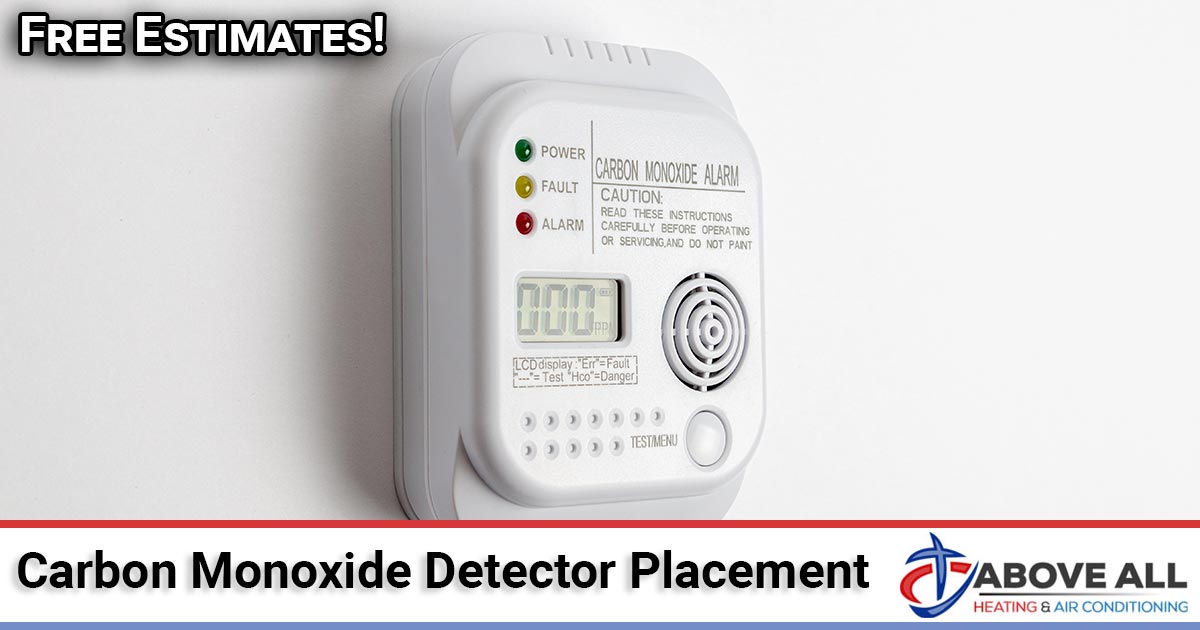
Good carbon monoxide detector placement starts with three locations: outside every sleeping area, on every level of the home, and inside any bedroom that has a fuel-burning appliance in it or its bathroom. Mount each alarm where the manufacturer’s instructions say, keep it a short distance away from the furnace, water heater and fireplace rather than right beside them, and put one just inside the door from an attached garage. Those are the same locations the California Residential Code uses for CO alarms.
At Above All Heating and Air, we work on gas furnaces, wall heaters and heat pumps across the Temecula Valley and Inland Empire, and we see CO alarms in every kind of spot: behind the couch, in the garage, next to the water heater, and sometimes in a box still waiting to be opened. This guide covers where to put carbon monoxide detectors in a California home, what state law requires, where not to install them, how to test and replace them, what to do if one goes off, and how your heating system fits into the picture.
Why Carbon Monoxide Detector Placement Matters
Carbon monoxide is a colorless, odorless gas made whenever fuel burns. You cannot see it or smell it, so an alarm is the only practical early warning most households have. According to the CDC, more than 400 Americans die from unintentional CO poisoning not linked to fires each year, more than 100,000 visit an emergency department, and more than 14,000 are hospitalized. The CDC also notes that people who are asleep can die before they ever feel symptoms.
That last point is why placement matters as much as owning an alarm. A detector in the garage or at the far end of the house may not wake anyone in time. A detector right beside the furnace may chirp with nuisance alarms until someone takes the battery out. The goal is simple: put alarms where they will sample normal room air and where everyone in the home can hear them, especially at night.
Where to Put Carbon Monoxide Detectors: The Short Answer
If you only remember one list, make it this one. These locations come from the California Residential Code requirements for CO alarms (summarized in this City of Perris building handout) and from manufacturer guidance:
- Outside each separate sleeping area, in the hallway near the bedrooms.
- On every occupiable level of the home, including basements.
- Inside a bedroom if a fuel-burning appliance (such as a wall heater or gas fireplace) is in that bedroom or its attached bathroom.
- Just inside the door from an attached garage, on the house side, not in the garage itself.
- In the general area of fuel-burning appliances, but not right next to them.
Most single-story homes need at least one alarm in the bedroom hallway, plus another if the living areas or a second group of bedrooms are far away. Two-story homes need at least one on each floor, with the bedroom floor as the priority. If your bedrooms are split, such as a primary suite on one side of the house and kids’ rooms on the other, each sleeping area needs its own alarm.
Carbon Monoxide Detector Placement Room by Room
Here is how we suggest homeowners think through each part of the house. Always check your alarm’s instruction manual, because mounting height and spacing can vary by model.
| Location | Recommended? | Placement notes |
|---|---|---|
| Hallway outside bedrooms | Yes, required | The most important spot. Place it in the hallway that serves the bedrooms so the alarm is loud enough to wake sleepers behind closed doors. |
| Each level of the home | Yes, required | At least one per occupiable floor, including a finished basement or a lower-level bonus room. |
| Bedroom with a fuel-burning appliance | Yes, required | If a wall furnace, gas fireplace or other fuel-burning appliance is in the bedroom or its bathroom, an alarm goes inside that bedroom. |
| Near the door to an attached garage | Yes | Mount inside the house near the garage entry door. Car exhaust and temperature swings make the garage itself a poor location. |
| Living room or family room | Recommended | Useful on a level without bedrooms, or where people nap or watch TV in the evening. Avoid placing it directly in front of a fireplace. |
| Near the furnace or water heater closet | In the general area | Carrier recommends keeping alarms at least 15 feet from furnaces, stoves and fireplaces to avoid nuisance alarms from small start-up puffs of CO. |
| Kitchen | Nearby, not in it | Gas ranges and cooking can trigger nuisance alarms. A hallway or adjoining room usually works better. |
| Garage | No | Exhaust, dust and heat can cause false alarms and shorten sensor life. |
| Bathroom | No | Steam and humidity can damage the sensor. |
| Unfinished attic | No | CPSC advises against attic and basement placement unless the space includes a sleeping area. An attic furnace is covered by alarms in the living space below. |
Should Carbon Monoxide Detectors Be Placed High or Low?
This is the most common placement question we get, and the honest answer is: follow your alarm’s manual. Unlike smoke, which rises to the ceiling, carbon monoxide mixes with room air. First Alert says CO alarms do not need to be near the floor because CO mixes evenly with indoor air. Carrier notes that CO is slightly lighter than air and favors breathing-height placement for some models.
In practice, that means:
- Plug-in alarms are designed for outlet height and are fine there, as long as furniture or curtains do not block them.
- Wall-mounted alarms should go at the height the manufacturer lists, usually somewhere between a light switch and just below the ceiling.
- Ceiling-mounted and combination smoke/CO alarms go on the ceiling, because the smoke sensor needs to be up high and the CO sensor works there too.
The mistake to avoid is not “too high” or “too low.” It is putting the alarm in a dead-air spot, such as a tight corner where the wall meets the ceiling, behind a bookshelf, or behind a curtain, where room air does not circulate well.
Where Not to Put a Carbon Monoxide Detector
A detector in the wrong spot can either miss a problem or go off so often that someone disables it. Based on guidance from First Alert, Carrier and the U.S. Consumer Product Safety Commission, avoid these locations:
- Directly next to a furnace, water heater, fireplace or gas range. Fuel-burning appliances can release a small amount of CO at start-up, which can cause nuisance alarms.
- Inside the garage. Put the alarm inside the house by the garage door instead.
- Bathrooms, laundry rooms and other humid spaces. Moisture can damage the sensor.
- Directly in front of supply registers, return grilles, ceiling fans or open windows. Moving air can dilute CO at the sensor and delay the alarm.
- Dead-air spaces, such as corners, inside cabinets or behind furniture.
- Direct sunlight or spots that get very hot or very cold.
- Dusty, greasy or chemical-heavy areas, such as right above a workbench where you spray paint.
Also, never paint over an alarm or cover it with decorations. First Alert specifically warns against painting or covering CO alarms.
California Carbon Monoxide Detector Requirements
California has required CO alarms in existing homes for more than a decade. Here is what the rules say in plain English. This is general information, not legal advice; your local building department has the final word on what a specific project needs.
The Carbon Monoxide Poisoning Prevention Act
Under California Health and Safety Code Section 17926, part of the Carbon Monoxide Poisoning Prevention Act of 2010, the owner of a dwelling that has a fossil fuel burning heater or appliance, a fireplace, or an attached garage must install a carbon monoxide device approved and listed by the State Fire Marshal. Existing single-family homes had to comply by July 1, 2011, and other existing dwelling units by January 1, 2013. The devices must be installed according to the building standards for new construction or the manufacturer’s instructions, where technically feasible.
That covers most homes in our area: a gas furnace, gas water heater, gas range, gas dryer, fireplace or attached garage each brings the home under the requirement. SoCalGas summarizes the law as requiring an approved CO alarm for each sleeping area and on every level of the home.
California Residential Code placement rules
The California Residential Code spells out where CO alarms go. As summarized in the City of Perris handout for the 2022 code:
- Alarms go outside each separate sleeping area near the bedrooms, on every occupiable level including basements, and inside any bedroom where a fuel-burning appliance is located in that bedroom or its attached bathroom.
- Where more than one alarm is required, they must be interconnected so that one sounding sets off all of them. Listed wireless alarms that all sound together can meet this.
- CO alarms must be listed to UL 2034, and combination smoke/CO alarms to both UL 2034 and UL 217.
- When you add onto a home, or add a fuel-burning heater, appliance or fireplace, CO alarms are required if the home did not already need them. Exterior-only work such as roofing, siding and windows is generally exempt.
The code’s power and interconnection rules for new construction (hardwired primary power with battery backup) can differ from what an older home needs, so ask your building department or contractor what applies when you pull a permit. Section numbers can also change from one code edition to the next.
Selling or renting a home
Because the requirement falls on the owner, CO alarms often come up during home sales and rental turnovers. Section 17926 treats a violation as an infraction with a fine of up to $200 after a 30-day notice to correct. Landlords and sellers should confirm alarms are in place, working and in the right locations; tenants should report a missing or failed alarm to the owner.
How Furnaces, Water Heaters and Wall Heaters Produce CO
Any appliance that burns natural gas or propane makes some carbon monoxide. The CDC lists gas furnaces, water heaters, gas ranges, fireplaces, portable generators, cars and small engines among common sources. In a properly working, properly vented appliance, those combustion gases go up the flue and outside. Problems start when something interrupts that path or the burn itself:
| Appliance | How CO can get into the home | What a technician checks |
|---|---|---|
| Gas furnace | Cracked heat exchanger, blocked or disconnected flue, poor combustion from dirty burners or wrong gas pressure, missing burner door | Heat exchanger inspection, venting and draft, gas pressure, burner flame, CO in flue and supply air |
| Gas water heater | Backdrafting from a blocked or poorly sloped vent, rusted vent connector, sealed closet with no combustion air | Vent connection and draft, combustion air, burner condition |
| Wall furnace (older homes) | Worn heat exchangers and vents, furniture blocking the unit, poor maintenance | Heat exchanger, venting, pilot and burner flame, clearances |
| Fireplace | Closed or partly closed damper, blocked chimney | Damper operation, chimney condition (often a chimney sweep’s job) |
| Gas range and oven | Using the oven to heat the home, poor ventilation, burner problems | Burner flame, range hood use; never use a gas oven for heat |
| Car or generator | Running in an attached garage, generator near a window, door or vent | Not an HVAC item: never run either in a garage |
A CO alarm is a last line of defense, not a substitute for keeping these appliances in good shape. The CDC recommends having your heating system, water heater and other fuel-burning appliances serviced by a qualified technician every year.
How a heating tune-up checks for CO problems
During a heating tune-up, our technicians inspect the furnace heat exchanger for cracks, rust and heat stress; check the flue and draft inducer for blockages and loose joints; measure gas pressure; look at the burner flame; confirm the burner and blower doors fit properly; and test for carbon monoxide in the flue and around the furnace. If we find a cracked heat exchanger or a venting problem, we will explain what we found and whether the furnace is safe to run before any repair is discussed.
How to Prevent Carbon Monoxide Problems at Home
Good alarm placement works best alongside a few everyday habits:
- Schedule a yearly heating inspection for your furnace or wall heater, ideally in early fall.
- Keep the area around the furnace and water heater clear. Do not store boxes, paint, cleaners or other combustible items in the furnace closet or around garage appliances; they can block airflow and are a fire risk.
- Check your furnace filter monthly during heating season and replace it when it is dirty. A clogged filter makes the furnace run hot.
- Put the furnace door back on correctly after changing a filter. Running a furnace with the front panel loose or missing can upset how it draws combustion air and vents exhaust.
- Keep vents and registers clean and free of dust and lint buildup.
- Never use a gas oven or range to heat your home, and never run a car, generator or grill in a garage, even with the door open.
How to Install a Carbon Monoxide Detector
Battery and plug-in CO alarms are a reasonable homeowner project. Hardwired alarms connect to household wiring and should be installed by an electrician or a qualified contractor. For a battery or plug-in unit:
- Map your home. Mark each sleeping area, each level, the attached garage door and any bedroom with a fuel-burning appliance.
- Check what you already have. Many homes have combination smoke/CO alarms on the ceiling. Look for “CO” or “carbon monoxide” on the label and check the manufacture date on the back.
- Read the manual for your model. Note the mounting height, distance from appliances and any locations to avoid.
- Choose a spot with normal airflow, away from registers, fans, windows, humid rooms and direct sunlight.
- Mount or plug in the alarm, and write the install date on it with a marker.
- Press the test button to confirm it sounds and that you can hear it from the bedrooms with doors closed.
- Set reminders for monthly tests, battery replacement and the alarm’s end-of-life date.
Testing, Batteries and Replacing Your CO Alarms
An alarm only protects you if it works. The CPSC recommends testing smoke and CO alarms monthly and replacing batteries once a year. The CDC suggests checking batteries when you change your clocks in spring and fall. First Alert adds testing after installing a new alarm, after replacing a battery, after a power outage for plug-in or hardwired models, and at the start of the colder season.
CO sensors wear out. The CDC says to replace detectors according to the manufacturer’s instructions or every five years; many sealed models are rated for longer. For example, Kidde rates one of its plug-in CO and explosive gas alarms for a 7-year life. Check the date on the back of each alarm, and replace any unit past its rated life or one that still fails its test after a fresh battery.
It also helps to know how a listed alarm decides when to sound. Under the UL 2034 standard, as BRK (First Alert’s professional brand) explains, an alarm must sound within 60 to 240 minutes at 70 parts per million, 10 to 50 minutes at 150 ppm, and 4 to 15 minutes at 400 ppm. Higher levels trigger it faster. That is another reason to place alarms near where people sleep: a slow, low-level leak overnight is exactly the situation they are designed to catch.
What to Do If a Carbon Monoxide Alarm Goes Off
Treat every CO alarm as real until a professional says otherwise. Do not try to find the source yourself first.
- Get everyone out, including pets, into fresh air.
- Call 911 from outside if anyone has symptoms such as headache, dizziness, nausea or confusion, or if the alarm keeps sounding.
- Do not go back inside until firefighters or the gas company say it is safe.
- Have the appliance inspected. SoCalGas advises contacting SoCalGas at 1-800-427-2200 or a qualified professional to inspect the suspected appliance, and not using it again until it has been inspected, serviced and found safe.
- Call us for the furnace or heater. Once the home is cleared, our technicians can inspect the furnace, wall heater or water heater venting and find the cause.
If you smell gas (a rotten-egg odor), that is a different emergency. Leave the home right away without flipping switches or using anything that could spark, and call SoCalGas at 1-800-427-2200 from a safe location, or 911 if anyone may be in danger.
Signs of Carbon Monoxide in a House
Because CO cannot be seen or smelled, symptoms in people and pets are often the first sign when there is no alarm. The CDC lists headache, dizziness, weakness, upset stomach, vomiting, chest pain and confusion as the most common symptoms, and notes they are often mistaken for the flu. Infants, older adults and people with heart disease, anemia or breathing problems are more likely to become seriously ill.
Warning signs worth taking seriously:
- Several people in the home (or pets) feel sick at the same time.
- Symptoms improve when you leave the house and come back when you return.
- Symptoms show up mainly when the heat is running.
- A furnace or water heater flame looks yellow, orange or lazy instead of mostly blue.
- Soot or scorch marks around a furnace, water heater, wall heater or fireplace.
- Stuffy, stale air or heavy condensation on windows near a fuel-burning appliance.
Those appliance clues do not prove CO is present, but they are reasons to have the system checked. If anyone has symptoms, leave the home and call 911 first.
CO Detector Placement in Inland Empire and Temecula Valley Homes
The basic rules are the same everywhere in California, but a few things about homes in Murrieta, Temecula, Menifee, Wildomar and the surrounding area are worth calling out:
- Attached garages are common. Many local tract homes have a two- or three-car garage with a door into the kitchen, laundry room or hallway. That door is a key alarm location, and it is one reason the state requirement applies to so many homes.
- Furnaces in attics, hall closets and garages. An attic furnace is out of sight and easy to forget. A hall-closet furnace may sit a few steps from the bedrooms. In that case, the hallway alarm is still required, but place it a reasonable distance from the closet door rather than right beside it.
- Long idle periods. Our heating season is short. Furnaces and wall heaters often sit unused from spring until the first cold nights of late fall, then run every evening. That first start-up is a good time to test every CO alarm, the same week you change the furnace filter.
- Older homes with wall furnaces. Some older homes and additions still use gas wall heaters, sometimes in or near bedrooms. A wall heater in a bedroom or its bathroom means an alarm is required in that bedroom.
- Power outages and generators. Windy fire-weather days can bring power outages. If you use a portable generator, follow the CDC’s advice: run it outdoors, more than 20 feet from windows, doors and vents, never in a garage, and keep battery backup in your CO alarms.
- Dust and Santa Ana winds. Dust settles on alarms and in their vents. Wipe or gently vacuum the outside of each alarm a few times a year so air can reach the sensor.
If you are not sure your alarms are in the right spots, ask our technician during your next furnace visit. We are happy to point out locations that look off while we are already looking at the furnace and its venting.
When to Call Above All Heating and Air
Call us to schedule service if your CO alarm has gone off and the fire department or gas company has cleared the home, if you see soot, a yellow flame, rust or water around your furnace, or if your furnace has not been inspected in more than a year. Our heating services team handles furnace and wall heater inspections and repairs, our HVAC maintenance plans keep yearly safety checks on schedule, and if something is wrong with a furnace in the Murrieta area, our furnace repair technicians can diagnose it. If your heater smells unusual on its first run of the season, our guide to why a heater smells like burning explains which smells are normal and which are not.
Frequently Asked Questions
Should carbon monoxide detectors be placed high or low in the home?
Follow the manufacturer’s instructions for your model. Carbon monoxide mixes with room air rather than settling or rising like smoke, so plug-in units at outlet height, wall units at the listed height and ceiling combination alarms all work when installed as directed. Avoid dead-air spots such as corners and spots behind furniture.
Should you have a carbon monoxide detector on each level of your house?
Yes. The California Residential Code calls for a CO alarm on every occupiable level of a home, including basements, plus one outside each sleeping area. A two-story home needs at least one alarm per floor, with the bedroom floor as the priority.
Where is the best place in a house for a carbon monoxide detector?
The hallway outside the bedrooms is the most important location, because CO is most dangerous while people sleep. After that, add an alarm on every other level, just inside the door from an attached garage, and inside any bedroom that has a fuel-burning appliance in it or its bathroom.
Where not to put a carbon monoxide detector?
Do not install a CO alarm directly next to a furnace, water heater, fireplace or gas range, inside a garage, in a bathroom or other humid room, in front of vents, fans or open windows, in direct sunlight, or in dead-air spots behind furniture or curtains. Those locations cause nuisance alarms or slow the alarm’s response.
Should you put a carbon monoxide detector near your furnace?
Put one in the general area, but not right beside it. Carrier recommends keeping CO alarms at least 15 feet from furnaces, stoves and fireplaces, because these appliances can release a small puff of CO at start-up. In a hallway with a furnace closet, mount the alarm a reasonable distance from the closet door.
What are two warning signs of carbon monoxide in a house?
Two of the clearest signs are several people or pets feeling sick at the same time, and symptoms such as headache, dizziness or nausea that improve when you leave the house. Appliance clues include a yellow or lazy burner flame and soot around a furnace, water heater or fireplace. If anyone has symptoms, get outside and call 911.
How long does a carbon monoxide detector take to detect?
It depends on how much CO is in the air. Under the UL 2034 standard, a home CO alarm must sound within 60 to 240 minutes at 70 ppm, 10 to 50 minutes at 150 ppm, and 4 to 15 minutes at 400 ppm. Alarms respond to the total exposure over time, which is why low levels take longer to trigger them.
Can a cell phone detect carbon monoxide?
No. Phones do not have a carbon monoxide sensor, and apps that claim to detect CO cannot measure it. A phone can receive alerts from a connected smart CO alarm, but the detection has to come from a listed CO alarm installed in the home.
Will a carbon monoxide detector detect a gas leak?
A standard CO alarm does not detect a natural gas or propane leak; it only senses carbon monoxide. Some combination units, such as Kidde’s CO and explosive gas alarm, include a separate sensor for natural gas or propane. If you smell rotten eggs, leave the home and call SoCalGas at 1-800-427-2200 from a safe location.
What to do if carbon monoxide detector goes off?
Get everyone, including pets, outside into fresh air right away, and call 911 from outside, especially if anyone has symptoms. Do not go back in until responders say it is safe. Then have the suspected appliance inspected by SoCalGas or a qualified technician before using it again.
Why is my carbon monoxide detector beeping?
A loud, repeating pattern of beeps usually means the alarm has detected CO, so treat it as an emergency and get outside. A single short chirp every minute or so usually means a low battery or an alarm that has reached the end of its life. Check your model’s manual, because beep patterns differ by brand.
How does a carbon monoxide detector work?
Most home CO alarms use a sensor that reacts chemically to carbon monoxide and measures its concentration in parts per million over time. When the exposure reaches the levels set by the UL 2034 standard, the alarm sounds. That time-weighted design is meant to warn you before CO levels become dangerous, while avoiding alarms for brief, tiny amounts.
Do I need a carbon monoxide detector if I don’t have gas?
Under California law, CO alarms are required in homes with a fossil fuel burning heater or appliance, a fireplace, or an attached garage. An all-electric home with no fireplace and no attached garage may not fall under the requirement, but an alarm is still inexpensive protection against outside sources such as a generator running near a window.
Are carbon monoxide detectors required in California?
Yes, for most homes. California Health and Safety Code Section 17926 requires owners of dwellings with a fossil fuel burning heater or appliance, a fireplace, or an attached garage to install a State Fire Marshal approved CO alarm. Existing single-family homes had to comply by July 1, 2011. This is general information, not legal advice.
How long does a carbon monoxide detector last?
Replace CO alarms according to the manufacturer’s instructions; the CDC says to replace them per the manufacturer or every five years. Many sealed models are rated longer, such as a Kidde plug-in CO and gas alarm rated for a 7-year life. Check the date on the back of each alarm.
How do you test a carbon monoxide detector?
Press and hold the test button until the alarm sounds, and listen from the bedrooms with the doors closed to make sure it is loud enough. The CPSC recommends testing monthly and replacing batteries once a year. Also test after a battery change, after a power outage and at the start of heating season.
How to test for carbon monoxide without a detector?
There is no reliable way for a homeowner to test for CO without a detector, because the gas has no color, smell or taste. Watch for symptoms and appliance warning signs, and have a technician test your furnace and water heater with a combustion analyzer. The safest step is to install a listed CO alarm right away.
Get Your Furnace and CO Safety Checked
The right carbon monoxide detector placement and a yearly furnace inspection work together: the inspection keeps combustion gases going out the vent, and the alarms warn you if something changes. Above All Heating and Air serves homeowners across Murrieta, Temecula, Menifee and the rest of the Inland Empire. To schedule a heating inspection or ask about your system, contact our team or request a free quote. You can also learn more about Above All Heating and Air and the services we offer.
Schedule an Appointment Today
Get in touch with Above All Heating and Air Conditioning by calling us or filling out the form. We look forward to working with you.
