
Heater Smells Like Burning? What’s Normal on the First Cold Night and What Isn’t
CONTACT US
Contact Us

Our
SERVICEs
Heater Smells Like Burning? What’s Normal on the First Cold Night and What Isn’t
Above All Heating And Air Conditioning / October 28, 2026 / Furnace Repair, HVAC Services, Heating Repair
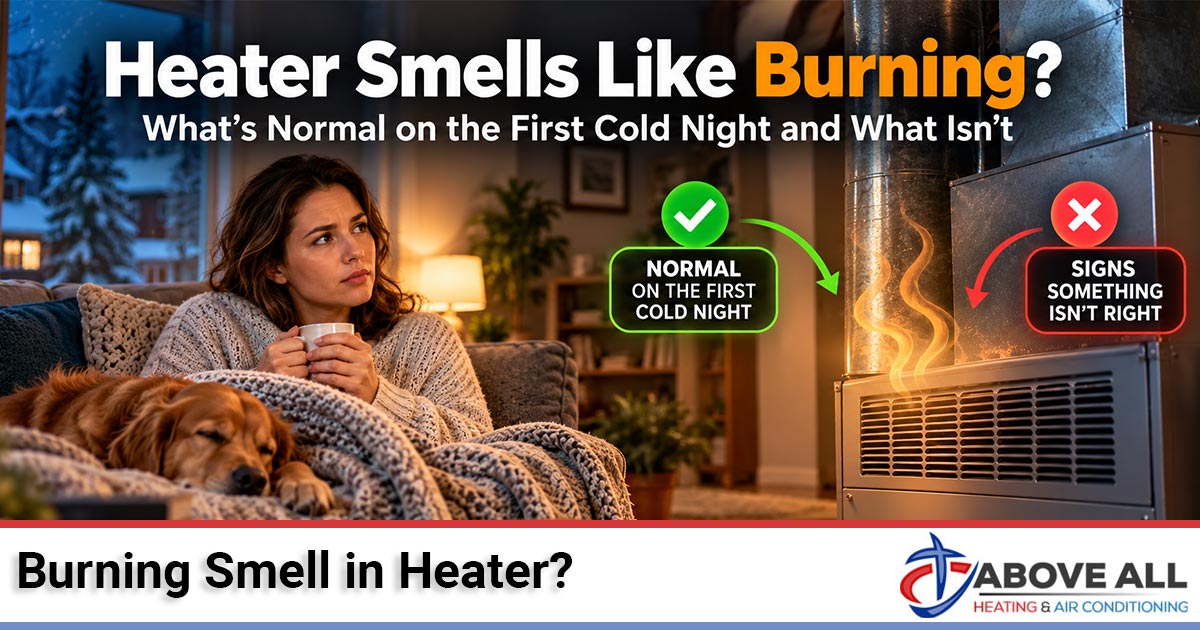
If your heater smells like burning the first time you turn it on for the season, it is usually dust burning off the heat exchanger, burners or electric heat strips, and the smell should fade within about 15 to 60 minutes. A smell of hot plastic, melting wires, burning rubber, chemicals or rotten eggs is not normal. Turn the system off and call a technician, and if you smell gas, leave the house first.
Every fall, the first cold night in the Temecula Valley brings a wave of calls to Above All Heating and Air from homeowners who switched on the heat and caught a whiff of something burning. Most of the time it’s harmless. Some of the time it’s an early warning that a motor, wire or safety part is failing. This guide explains how to tell the difference, what you can safely check yourself, and when to stop and call our technicians.
Why Your Heater Smells Like Burning When You First Turn It On
A furnace or heat pump in Southern California can sit idle from March or April until late October. During those months, a fine layer of household dust settles on everything inside the cabinet: the heat exchanger, the burners, the blower housing and, in electric furnaces and heat pumps, the resistance heat strips. When the system fires up, those surfaces heat quickly and the dust literally burns off. The result is a dry, dusty, slightly toasty smell that many people describe as “burning dust” or “like a hair dryer.”
This first-run smell has a few clear traits:
- It shows up in the first few minutes of the first heating cycle of the season.
- It smells dusty or toasty, not sharp, chemical or acrid.
- It fades noticeably within the first hour and is usually gone by the next heating cycle.
- There is no visible smoke, no unusual noise and no tripped breaker.
If all four of those are true, you are almost certainly dealing with normal burn-off. If any one of them isn’t, keep reading, because the smell is telling you something more specific.
What Different Burning Smells From a Heater Mean
The single most useful thing you can do when a heater smells like burning is to describe the smell accurately. Our technicians ask about it on every call, because each type of odor points toward a different part of the system.
| What you smell | Most likely cause | How serious | What to do |
|---|---|---|---|
| Dusty, toasty, “burning dust” | Dust burning off the heat exchanger, burners or heat strips after months of sitting | Normal if it fades within about an hour | Replace the filter, open a window, let it run, and watch that it fades |
| Hot plastic or melting wires | Overheating wiring, a failing control board, a motor overheating, or a plastic object near a register or burner | Serious, possible fire risk | Turn the heat off at the thermostat and the furnace switch, then call a technician |
| Burning rubber | A worn blower belt on older belt-drive units, or an overheating blower or inducer motor | Serious, part is failing | Shut the system off and schedule a repair |
| Oily or “burning oil” | Oil burner problems (rare in our area), lubricated motor bearings overheating, or residue from manufacturing on a brand-new furnace | Moderate to serious | New furnace: usually fades in a few days. Otherwise, call for service |
| Rotten eggs or sulfur | Natural gas leak (utilities add an odorant called mercaptan so you can smell it) | Emergency | Leave the home now and call SoCalGas or 911 from outside |
| Musty or mildew | Moisture in ducts, a dirty evaporator coil above the furnace, or a clogged condensate line | Not dangerous, but worth fixing | Change the filter and have the coil and drain checked |
| Chemical or formaldehyde-like | Cracked heat exchanger or venting problem letting combustion gases mix with house air | Serious, possible carbon monoxide risk | Turn the furnace off, check your CO alarms, and call a technician |
| Smoky or “campfire” | Blocked flue or vent, debris in the vent, or a fireplace backdrafting | Serious | Turn the heat off and have the venting inspected |
If you are unsure which description fits, treat the smell as the more serious option. It costs far less to have a technician confirm that a smell is harmless than to keep running a furnace with a failing part.
Electrical and burning plastic smells
An electrical smell is sharper than dust. People describe it as hot plastic, burning wire insulation or a “fishy” odor (some electrical components give off a fish-like smell when they overheat). In a furnace, the usual sources are a blower motor that is overheating because its bearings are wearing out, a capacitor that is failing, a loose wire connection that is arcing, or a control board with a burned component. In an electric furnace or heat pump with backup heat strips, a strip or its wiring can overheat if airflow is restricted.
Burning plastic can also come from something that doesn’t belong near the system: a toy that fell through a floor register, a plastic bag stored too close to a closet furnace, or a dryer sheet stuck to a return grille. Look around before assuming the worst, but if you can’t find a cause, don’t keep running the heat.
Burning rubber smells
Most newer furnaces use a direct-drive blower with no belt, so a rubber smell in a modern system usually means a motor is running hot. Older belt-drive furnaces, which still turn up in some older homes, can have a fan belt that is slipping, cracked or rubbing. Either way, a rubber smell means something mechanical is wearing out and should be looked at before it fails completely.
Rotten egg smells
Natural gas has no smell on its own. Gas utilities add an odorant so leaks are easy to notice, and it smells like rotten eggs or sulfur. A heater does not normally produce this smell. If you notice it, follow the gas safety steps below immediately. Don’t try to find the leak yourself.
Stop and Call: When a Burning Smell Is an Emergency
Some situations shouldn’t wait for an appointment. Act right away if any of these apply:
- You smell gas (rotten eggs). SoCalGas tells customers to immediately evacuate the area and call SoCalGas at 1-800-427-2200 from a safe location, and to call 911 promptly from a safe location if lives or property could be threatened. Don’t flip light switches, use the thermostat, or start a car in an attached garage on your way out.
- A carbon monoxide alarm sounds. Get everyone, including pets, outside into fresh air and call 911. The CDC describes carbon monoxide as an odorless, colorless gas, so you may not smell anything at all. Don’t go back inside until responders say it’s safe.
- You see smoke or flames coming from the furnace, a register or the outdoor unit. Get out and call 911.
- Someone feels sick. The CDC lists headache, dizziness, weakness, upset stomach, vomiting, chest pain and confusion as common CO symptoms, often described as flu-like. If more than one person in the house feels this way and it gets better when you leave, treat it as a possible CO problem.
- The smell is electrical, plastic, rubber or chemical and doesn’t fade after you turn the system off. Turn the heat off at the thermostat, switch off the furnace service switch or breaker, and call a technician.
Carbon monoxide is the reason we take odd heating smells seriously. A burning smell itself is not carbon monoxide, but the problems that cause some chemical or smoky smells, like a cracked heat exchanger or a blocked vent, are the same problems that can let CO into the house. Every home with a gas furnace, gas water heater, gas wall heater, fireplace or attached garage should have working CO alarms. Our carbon monoxide poisoning prevention guide covers the basics.
What to Do When Your Heater Smells Like Burning: Step by Step
If the smell is dusty and none of the emergency signs above apply, here’s the order we recommend:
- Check the smell type. Dusty and toasty is normal at start-up. Anything electrical, plastic, rubber, chemical or gas means turn it off and call.
- Replace the air filter. A filter that has been in since spring is often loaded with dust, pet hair and pollen, and a clogged filter makes the furnace run hotter. Make sure the airflow arrow points toward the furnace. Our article on why furnace filter direction matters shows how to get it right.
- Clear the area around the furnace and registers. Move stored boxes, paint cans, cleaning products and anything plastic away from closet, garage and attic units. Make sure nothing is sitting on or inside floor registers.
- Crack a window or two and run the heat. Set the thermostat a few degrees above room temperature and let the system run through a full cycle so the dust burns off quickly.
- Time it. A normal burn-off smell should be clearly weaker within 15 to 30 minutes and mostly gone within an hour. If it is still strong after an hour, or comes back at full strength on the next cycle, stop and call.
- Watch and listen. Note any new noises (squealing, grinding, humming, clicking that repeats), a breaker that trips, or the system shutting itself off. Those details help our technician find the problem faster.
- Test your CO alarms. The start of heating season is a good time to press the test button and replace batteries if your alarms use them.
What you should not do: don’t open the burner compartment, bypass a safety switch, spray cleaners into the furnace, or keep resetting a system that keeps shutting down. Those safety controls are there to stop the furnace when something is wrong.
How Long Should a Heater Smell Like Burning?
For normal dust burn-off, the smell usually lasts from a few minutes up to about an hour on the first run of the season. In a home where the system has gone an unusually long time without being used, or where the filter hasn’t been changed in a long time, it can take a couple of heating cycles to fully clear. A brand-new furnace can give off an oily or “new appliance” smell for the first few days of use as manufacturing oils and coatings burn off.
What isn’t normal is a smell that stays strong all day, gets stronger over time, comes back every time the heat runs, or changes from dusty to electrical or chemical. Those are reasons to call even if nothing else seems wrong.
Why Inland Empire Heaters Smell More on the First Cold Night
Homes across Murrieta, Temecula, Menifee, Wildomar and the rest of the Inland Empire have a few things in common that make that first-start smell more noticeable than it might be in colder parts of the country:
- A short heating season and a long idle stretch. Our winters are mild, so most furnaces and heat pumps run for only a few months a year and sit for the rest. The longer a system sits, the more dust collects inside it.
- Dust and Santa Ana debris. Dry weather, construction in growing neighborhoods, and Santa Ana wind events push fine dust into homes, attics and garages. That dust ends up on furnace surfaces and in return ducts.
- Attic, closet and garage furnaces. Many local tract homes have furnaces in the attic, a hallway closet or the garage. Attic units collect attic dust, and garage and closet units often end up surrounded by stored items that shouldn’t be that close to a heat source.
- Older wall furnaces. Some older homes still use gas wall furnaces, which can collect a surprising amount of lint and dust in the grille and burner area and tend to give off a strong smell at first use.
- Heat pumps with backup heat strips. Many newer homes and replacement systems use heat pumps. When the auxiliary heat strips come on for the first time, dust on the strips burns off and creates the same dusty smell.
None of this means a local system is more dangerous. It simply means a dusty smell on the first cold night is very common here, and a fall heating tune-up and a fresh filter go a long way toward reducing it.
Furnace vs. Heat Pump vs. Wall Heater vs. Space Heater
The type of heating equipment in your home changes what a burning smell is likely to mean.
| Equipment | Common normal smell | Common problem smells | Notes |
|---|---|---|---|
| Gas furnace | Dust burning off the heat exchanger and burners | Electrical (blower or inducer motor, board), rubber (belt), gas, chemical or smoky (venting, heat exchanger) | Needs working CO alarms and an annual safety inspection |
| Electric furnace | Dust burning off the heating elements | Hot plastic or electrical from overheating elements, wiring or relays | No combustion, so no CO from the unit itself |
| Heat pump | Dust on backup heat strips when aux heat first runs | Electrical smells from the air handler, heat strips or outdoor unit | Outdoor unit can also give off steam during defrost, which is normal |
| Gas wall furnace | Lint and dust burning off the grille and burner area | Gas, smoky smells, soot around the grille | Older units benefit from an inspection before the first use each year |
| Portable space heater | Brief dust smell on first use | Melting plastic, scorched fabric, a hot plug or cord | Unplug immediately if the plug or cord is hot or discolored |
Space heaters deserve a special note, because a burning smell from a portable unit can mean something nearby is scorching. The U.S. Consumer Product Safety Commission advises keeping portable heaters at least three feet from drapes, furniture and bedding, and plugging electric space heaters directly into a wall outlet, never into an extension cord or power strip. The same CPSC notice estimates about 1,600 portable heater fires per year nationally from 2020 to 2022. If you rely on space heaters because part of the house never warms up, that is often a sign your central system or ductwork needs attention.
Burning Smell From the Heater vs. the AC
The same system that heats your home in winter usually cools it in summer, and the two seasons produce different smells. In heating mode, dust burn-off is common and usually harmless. In cooling mode, there is no heat source to burn dust, so a burning smell from an air conditioner is more likely to be electrical from the start. If you are noticing a burning smell when the AC runs, read our guide on what it means when your AC smells like burning, which covers capacitors, contactors and outdoor fan motors.
What Our Technicians Check When a Heater Smells Like Burning
When you call Above All Heating and Air about a burning smell, our technician starts with your description of the smell and when it happens, then works through the system in a logical order:
- Filter and airflow. A restricted filter or blocked return makes the furnace overheat and can trip the high-limit switch.
- Blower motor and capacitor. We check amp draw, bearing condition, wheel cleanliness and the capacitor rating, since an overheating blower is one of the most common sources of electrical smells.
- Wiring and control board. We look for discolored, melted or loose connections and signs of arcing on the board and at terminals.
- Burners and flame. On gas furnaces, we look at flame color and pattern, clean the burners if needed, and check the ignitor and flame sensor.
- Heat exchanger. We inspect the heat exchanger for cracks, rust-through or other damage, since a breach can let combustion gases mix with the air you breathe.
- Venting and draft. We confirm the flue and vent are intact, properly sloped and clear of blockages such as nests or debris, and that the inducer motor and pressure switch are working.
- Combustion and CO testing. We test for carbon monoxide at the furnace and in the living space when the equipment and situation call for it.
- Heat strips (electric and heat pump systems). We check elements, sequencers, relays and limits for overheating or damage.
If we find a failing part, we explain what it is, why it’s causing the smell, and your options before any work is done. You can learn more about our heating services in Murrieta and the surrounding area or our Murrieta furnace repair page if you already know something needs fixing.
What Affects the Cost of Fixing a Burning Smell
Because a burning smell can come from something as simple as a dirty filter or as involved as a failed motor or a damaged heat exchanger, there is no single price for this kind of repair. The main factors are:
- The cause. A filter change and burn-off check is a very different visit from replacing a blower motor or control board.
- The type of system. Gas furnace, electric furnace, heat pump and wall furnace parts and labor all differ.
- The age and brand of the equipment. Parts for some older or less common units cost more and can take longer to get.
- Access. Attic and tight closet installations take more time to work on than a furnace in an open garage.
- Warranty coverage. Some parts may still be covered by the manufacturer’s warranty, which can lower the cost of the part itself.
We give you a clear diagnosis and the repair options before we start any work, so there are no surprises.
Signs Your Furnace May Be Nearing the End
A burning smell on its own does not mean you need a new furnace. But if the smell comes with other warning signs, it is worth talking about repair versus replacement:
- The furnace is well into its second decade of service.
- You’ve needed several repairs in the last couple of seasons.
- Rooms heat unevenly or the system runs constantly to keep up.
- The burner flame on a gas furnace burns yellow or flickers instead of a steady blue.
- You see soot, rust or scorch marks around the furnace or vent.
- A technician has found a cracked heat exchanger.
- Your heating bills keep rising without a change in how you use the system.
If several of these apply, we can inspect the system and give you an honest recommendation. Sometimes a single repair buys years of reliable service. Sometimes replacement is the better long-term choice.
How a Fall Heating Tune-Up Prevents Burning Smells
Most first-night burning smells can be reduced or avoided with a pre-season tune-up. During a heating tune-up, our technician cleans dust from the burners and blower area, replaces or checks the filter, inspects electrical connections, tests safety controls, checks the heat exchanger and venting, and confirms the system is running the way it should. The CDC recommends having your heating system, water heater and other gas, oil or coal-burning appliances serviced by a qualified technician every year, and the CPSC gives the same advice for all fuel-burning heating systems.
For homeowners in our area, the best time to book is September through early November, before the first cold snap. When a tune-up is done before the heat is needed, the dust is cleaned out instead of burned off, small electrical problems are caught early, and you avoid the first-cold-night rush.
Frequently Asked Questions
Should I be worried if I smell burning?
A dusty burning smell for the first few minutes after your heater starts for the season is normal and should fade within about an hour. Be concerned if the smell is electrical, plastic, rubber, chemical or like rotten eggs, if it does not fade, or if you see smoke. In those cases, turn the heat off and call a technician. If you smell gas or a CO alarm goes off, leave the house first and call for help from outside.
Is there a smell before an electrical fire?
Often, yes. Overheating wiring and components usually give off a sharp hot-plastic or burning-insulation smell, and some parts smell oddly fishy, before anything ignites. If you notice that smell from a furnace, register, outlet or space heater, shut off the equipment and the breaker if you can do so safely, and have it inspected before using it again. If you see smoke or flames, get out and call 911.
Can you smell burning but there is no fire?
Yes. The most common example is dust burning off a furnace or heat pump the first time it runs each fall. An overheating motor or wire can also produce a burning smell well before any flame appears. That is why a burning smell that does not fade should be treated as a warning, not ignored just because nothing is visibly on fire.
Is electrical burning smell toxic?
Smoke and fumes from overheating plastic and wire insulation can irritate your eyes, nose and lungs, so it is best not to keep breathing them. Turn off the equipment, open windows to ventilate, and step outside if the smell is strong. The bigger concern is the fire risk behind the smell, so have the source found and repaired before you use that equipment again.
How long does electrical burning smell last?
Once the overheating part is turned off, the smell usually fades over a few hours with good ventilation, though it can linger in fabrics longer. If an electrical smell comes back every time the heater runs, the problem has not gone away. A part is still overheating and needs to be repaired.
What are the signs of a dying furnace?
Common signs include frequent repairs, rising heating bills, uneven heating, a yellow or flickering burner flame, soot or rust around the unit, unusual noises, and a furnace that is well into its second decade. A cracked heat exchanger is another major sign. If several of these apply, a technician can help you weigh repair against replacement.
Why does it smell like something is burning in my house but nothing is burning?
In fall and winter, the most common reason is dust burning off the heating system when it first runs. Other causes include an overheating motor or wire, something plastic touching a heat source, a dryer lint problem, or a fireplace that is backdrafting. Check whether the smell starts when the heat comes on. If it does and it is more than a brief dusty smell, turn the heat off and call a technician.
How to tell if your furnace is giving off carbon monoxide?
You usually cannot tell by smell, because the CDC describes carbon monoxide as odorless and colorless. The reliable way to know is a working CO alarm. Warning signs include flu-like symptoms that improve when you leave the house, soot around the furnace or vent, a yellow or unstable flame, and condensation on windows near the furnace. If a CO alarm sounds, get everyone outside and call 911.
Why does my heater smell like burning when first turned on?
After months of sitting unused, dust settles on the heat exchanger, burners or electric heat strips. When the system heats up, that dust burns off and creates a dusty, toasty smell. Replacing the filter and having a fall tune-up done before the first cold night greatly reduces this smell.
Is it bad if my heater smells like burning?
Not if it is a dusty smell that fades within about an hour of the first start-up. It is bad if the smell is electrical, plastic, rubber, chemical or like rotten eggs, or if it lasts or keeps coming back. Those smells point to a failing part, a fire risk or a gas leak, and the heater should be turned off until it is checked.
What to do if heater smells like burning?
Identify the smell first. For a dusty smell, replace the filter, clear the area around the furnace, open a window and let the system run for up to an hour. For any electrical, rubber, plastic or chemical smell, turn the heat off at the thermostat and the furnace switch and call a technician. For a rotten egg smell, leave the house and call SoCalGas at 1-800-427-2200 or 911 from outside.
How long should a heater smell like burning?
Normal dust burn-off usually lasts from a few minutes to about an hour on the first run of the season. A brand-new furnace may give off a light oily smell for the first few days. A smell that stays strong past an hour or returns at full strength every cycle is not normal and should be checked.
Can a dirty filter make my furnace smell like burning?
Yes. A clogged filter holds dust that can be pulled toward hot surfaces, and it restricts airflow so the furnace runs hotter than it should. Restricted airflow can also trip the high-limit switch and make the furnace cycle on and off. Replacing the filter is the first thing to do when a heater smells like burning.
Why does my heater smell like burning plastic?
A burning plastic smell usually means wiring, a control board or a motor is overheating, or that something plastic has fallen into a register or is stored too close to the furnace. Check registers and the area around the unit first. If you cannot find an outside cause, turn the system off and call a technician, because this smell can come before an electrical fire.
Is it safe to sleep with the heater on if it smells like burning?
Only if the smell was a brief, dusty start-up smell that has already faded. Do not go to sleep with the heater running if there is any electrical, plastic, rubber, chemical or gas smell. Make sure you have working smoke alarms and CO alarms outside sleeping areas, and never leave a space heater running unattended or while you sleep.
Does carbon monoxide have a smell?
No. Carbon monoxide is odorless and colorless, so a burning smell is not carbon monoxide. However, some problems that create smoky or chemical smells, like a blocked vent or cracked heat exchanger, can also release CO. That is why every home with gas appliances, a fireplace or an attached garage needs working CO alarms.
How often should I have my heater inspected?
Once a year, ideally in early fall before you need the heat. The CDC and CPSC both recommend having fuel-burning heating systems inspected by a professional every year. Heat pumps run in both seasons, so they benefit from a check in spring and again in fall.
Get Your Heater Checked by Above All Heating and Air
If your heater smells like burning and the smell isn’t fading, or you’d simply like peace of mind before winter sets in, our technicians are ready to help. Contact Above All Heating and Air to schedule a heating inspection or repair, or request a free quote online. You can also learn more about everything we do at Above All Heating and Air. If you ever smell gas, leave your home first and call SoCalGas or 911 from outside.
Schedule an Appointment Today
Get in touch with Above All Heating and Air Conditioning by calling us or filling out the form. We look forward to working with you.
