
AC Smells Like Burning? What It Means and Why You Shouldn’t Ignore It
CONTACT US
Contact Us

Our
SERVICEs
AC Smells Like Burning? What It Means and Why You Shouldn’t Ignore It
Above All Heating And Air Conditioning / September 28, 2026 / AC Repair, Air Conditioner Repair, Air Conditioner Replacement, Air Conditioning, Air Conditioning Replacement, Air Conditioning Service
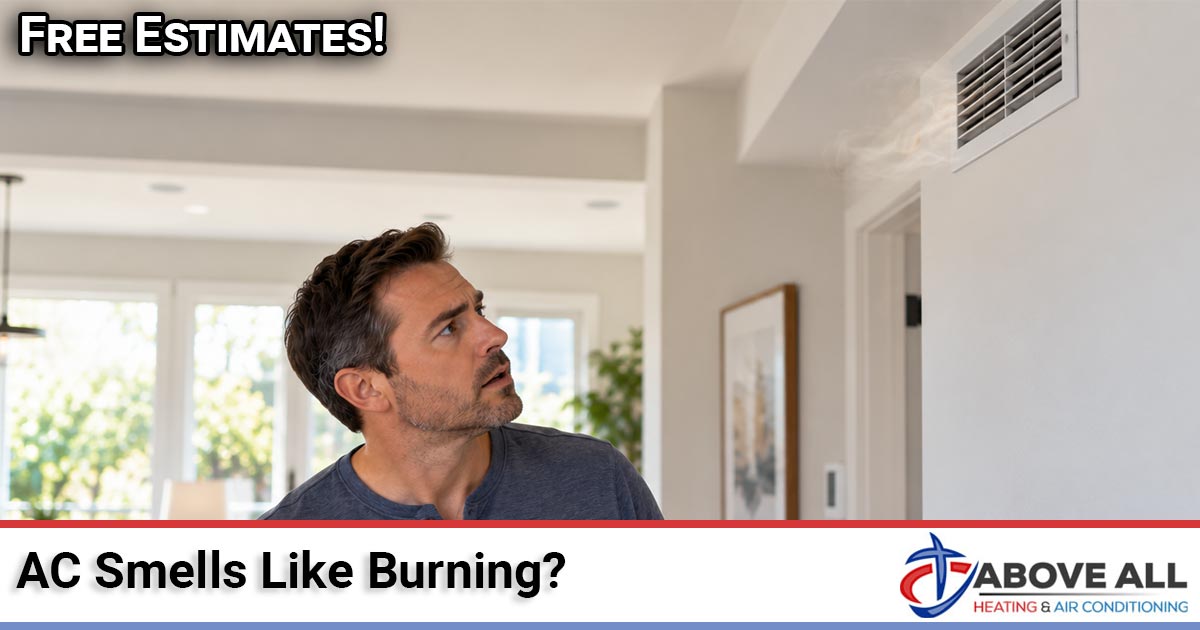
Most AC odors are a nuisance more than a warning. A musty smell usually points to moisture and mold somewhere in the system, and a dusty smell when the unit first kicks on after months of idle time is normal and fades within a few minutes. A burning smell is different, and it’s not something to explain away or wait out. At Above All Heating and Air, a reported burning smell is one of the few AC symptoms we treat as urgent every time, because it almost always points to an electrical component under stress, and electrical stress inside an appliance is exactly the kind of problem that can escalate quickly if it’s ignored.
This guide explains what a burning smell from your air conditioner usually means, why it’s different from the more common musty or dusty odors, which components are most often responsible, what to do in the moments after you notice it, and when the situation crosses from “call and schedule service” into “shut it off right now.”
Why a Burning Smell Is Different From Other AC Odors
Southern California homeowners get used to a handful of AC smells over the years. A musty smell, usually from moisture sitting in the ductwork or on the evaporator coil, is unpleasant but rarely dangerous on its own. A faint dusty smell for the first few minutes of the season’s first real cooling run is also normal, since it’s just dust burning off components that have been idle. Neither of those requires you to shut the system off immediately.
A burning smell is a different category entirely. It typically means one of two things is happening: an electrical component is overheating, arcing, or has already started to melt nearby plastic or insulation, or a mechanical component like a motor bearing is generating friction heat well beyond what it should. Both of those are active failures in progress, not lingering odors from something that already happened. That distinction is why we ask homeowners to treat a burning smell differently from almost every other AC symptom we field calls about.
What a Burning Smell From Your AC Usually Means
There isn’t a single cause behind every burning smell, but a handful of components are responsible for the overwhelming majority of the calls we get.
A Failing Capacitor
The start and run capacitors that give your compressor and fan motor the push they need to start can fail in a way that produces heat and, in some cases, a distinctly acrid or chemical burning smell as the internal components break down. A bulging, leaking, or visibly damaged capacitor is often accompanied by exactly this kind of odor. Our guide to an AC capacitor going bad covers the broader set of warning signs, including this one, in more detail.
A Failing Motor
The compressor motor or the outdoor fan motor can overheat when its bearings wear out, when it’s forced to work harder than designed because of a separate underlying issue, or when its windings begin to fail electrically. An overheating motor often produces a hot, slightly metallic or electrical burning smell well before it fails completely.
Electrical Wiring, Connections, or a Failing Contactor
Loose, corroded, or damaged wiring connections inside the outdoor unit’s disconnect box, the indoor air handler, or the electrical panel can arc or overheat, and a failing contactor (the relay that switches power to the compressor) can stick or arc in a way that generates real heat. This is one of the more serious causes on this list, since arcing wiring is a direct fire risk rather than just a symptom of a part wearing out.
An Overheating Blower Motor
Inside the indoor air handler, the blower motor pushes conditioned air through your ductwork continuously whenever the system runs. A blower motor with failing bearings can generate enough friction heat to produce a burning smell that’s often most noticeable near a supply vent rather than outside near the condenser.
Debris or Foreign Material Contacting Hot Components
Leaves, insulation, or other debris that ends up too close to a hot motor or electrical component inside the outdoor unit can produce a burning smell as it scorches, without necessarily indicating a failed part. It’s still worth having a technician confirm nothing more serious is happening, since debris that’s landed on one hot component could just as easily be a sign of another issue that let it get there.
Belt or Mechanical Friction
Less common in modern residential systems but still possible, a belt or other moving mechanical part rubbing against a stationary surface generates friction heat and a rubbery or burning smell as it wears.
Should You Shut the System Off?
In almost every case, yes, at least until a technician has had a chance to inspect it. A burning smell means something inside your AC system is actively generating more heat than it should, and continuing to run the system doesn’t give that problem a chance to resolve itself. It gives it more time to get worse.
If you can safely reach the thermostat, switch the system off there first. If the smell is strong, if you notice any visible smoke, scorch marks, or sparking, or if the smell is coming specifically from the electrical panel or the outdoor disconnect box, switch the system off at the breaker instead of just at the thermostat, and avoid touching the panel or the outdoor unit further until a professional arrives.
When a Burning Smell Is an Electrical Emergency
Most burning smells from an AC system warrant a same-day or next-day service call rather than a 911 response, but a few signs mean you should treat the situation as an active hazard:
- Visible smoke coming from the outdoor unit, the indoor air handler, or the electrical panel
- Sparks, or a crackling or popping sound accompanying the smell
- Scorch marks, melted plastic, or visible discoloration around the unit, an outlet, or the breaker panel
- The smell is strong, sudden, and clearly getting worse rather than a faint, steady odor
- The breaker has also tripped at the same time you noticed the smell
If you see any of these, shut the system off at the breaker if it’s safe to do so, evacuate the area if smoke or visible flame is present, and call 911 before calling for HVAC service. For everything short of that, shutting the system off and calling a licensed technician promptly is the right next step. If your breaker has been tripping alongside the smell, our guide on an AC that keeps tripping the breaker covers that related electrical safety pattern in more depth.
What to Do While You Wait for a Technician
Once the system is off and you’ve confirmed there’s no active fire risk, a few simple steps help keep you safe and make the service visit more efficient:
- Leave the system off. Don’t turn it back on to “see if it happens again” once you’ve smelled burning. Repeated attempts to restart a system with an active electrical or mechanical fault only increase the risk of further damage.
- Note where the smell was strongest. Whether it seemed to come from the outdoor unit, a specific supply vent, or the electrical panel helps a technician narrow down the likely cause before they even arrive.
- Avoid touching the outdoor unit or the panel. Electrical components involved in a burning smell can still carry a charge even when the system is switched off at the thermostat.
- Ventilate the area if the smell is noticeable indoors. Opening a window or two while you wait for service is a reasonable precaution if the odor is strong inside the home.
- Call for service rather than waiting to see if the smell fades. A burning smell that goes away on its own hasn’t necessarily resolved the underlying issue; it may simply mean the component involved has temporarily stopped drawing power.
How Above All Heating and Air Diagnoses a Burning Smell
When one of our licensed technicians responds to a burning-smell call, the visit typically starts with a visual inspection of the outdoor unit, the indoor air handler, and accessible wiring and connections for scorch marks, melted components, or obvious damage. From there, we test the capacitor’s output against its rated specification, check the contactor for arcing or pitting, measure amp draw on the compressor and both fan motors to identify one running hotter or harder than it should, and inspect wiring and connections inside the disconnect box, the air handler, and, where relevant, the electrical panel.
Once we’ve identified the source, we explain what we found in plain language, provide an upfront repair estimate, and in most cases complete the repair during the same visit, since components like capacitors, contactors, and common wiring hardware are typically stocked on our service vehicles.
Preventing Electrical and Motor Failures Before They Start
A number of the causes behind a burning smell are also things routine maintenance is specifically designed to catch before they progress this far:
- Scheduling seasonal maintenance so capacitors, contactors, and wiring connections are tested and inspected before they fail outright
- Keeping the outdoor condenser unit clear of leaves, debris, and vegetation that could contact hot components
- Replacing air filters on a consistent schedule so motors aren’t forced to work harder, and hotter, than designed
- Having an aging system evaluated before peak season, since capacitors, contactors, and motor bearings all wear out gradually over years of use
- Addressing a tripping breaker or unusual sounds promptly rather than letting a smaller electrical issue progress toward this point
Serving Homeowners Throughout Southern California
Above All Heating and Air provides AC electrical and mechanical diagnostics throughout Murrieta, Temecula, Menifee, Wildomar, Hemet, Lake Elsinore, and the surrounding Southern California communities we serve. Long, demanding cooling seasons put sustained strain on capacitors, motors, and electrical connections, which is exactly the kind of wear that can eventually produce the burning smell described in this guide. Catching it early, and treating it with the urgency it deserves, is the difference between a same-day component repair and a much larger problem.
To see the full range of cooling services we offer, visit our homepage, or if you’ve noticed a burning smell from your AC system, don’t wait it out. Contact Above All Heating and Air to schedule a diagnostic visit, or request a free service quote and one of our licensed technicians will identify the exact cause and walk you through clear, upfront repair options.
Frequently Asked Questions About a Burning Smell From Your AC
What usually causes a burning smell from an AC system?
Most often it’s an electrical component under stress, such as a failing capacitor, a struggling contactor, or worn wiring connections, or a motor whose bearings are generating friction heat well beyond what’s normal. Debris contacting a hot component is also possible.
Is a burning smell more urgent than other AC problems?
Yes. Unlike a musty smell, which usually points to moisture, a burning smell almost always means an electrical or mechanical component is actively overheating, which can escalate if the system keeps running.
Should I shut off the system if I smell burning?
In almost every case, yes. Switch the system off at the thermostat, or at the breaker if the smell is strong or seems to be coming from the electrical panel, and leave it off until a technician has inspected it.
Could a failing capacitor or motor cause this smell?
Yes. A capacitor that’s breaking down internally or a motor with worn bearings or failing windings are two of the most common sources of a burning smell from an AC system.
When does a burning smell mean an electrical fire risk?
Treat it as an emergency if you notice visible smoke, sparks, crackling or popping sounds, scorch marks, or melted plastic. Shut the system off at the breaker if it’s safe to do so and call 911 if there’s any sign of active fire or heavy smoke.
What’s the difference between a burning smell and a musty smell?
A musty smell usually comes from moisture and possible mold in the ductwork or on the evaporator coil, and it’s unpleasant rather than dangerous. A burning smell means something electrical or mechanical is actively overheating and needs prompt attention.
Can a dirty air filter cause a burning smell?
A severely clogged filter can force the blower motor and compressor to work harder than designed, which can contribute to overheating over time, though a dirty filter alone less commonly produces a burning smell on its own compared to a failing electrical component.
Could the smell be coming from the furnace instead of the AC?
It’s possible, especially in a system that shares ductwork and an air handler with a furnace. A technician can help determine whether the smell is coming from the cooling side, the heating side, or a shared component like the blower motor.
Is it safe to keep running the AC if I smell burning only occasionally?
No. An intermittent burning smell still means the underlying issue is present, even if it isn’t constant. Continuing to run the system gives the problem more opportunities to worsen rather than resolving it.
Can a burning smell mean the motor is overheating?
Yes. A compressor motor, an outdoor fan motor, or an indoor blower motor with worn bearings or electrical winding damage can all generate enough heat to produce a distinct burning odor before failing completely.
Should I call an electrician or an HVAC technician first?
In most cases, an HVAC technician is the right first call, since the majority of AC-related burning smells trace back to a component inside the AC system itself. If a technician determines the issue is in your home’s broader electrical panel rather than the AC circuit, they can advise you to bring in a licensed electrician as well.
How quickly can Above All Heating and Air respond to a burning-smell call?
Given the safety implications, we prioritize these calls whenever scheduling allows, and our technicians carry common replacement parts like capacitors and contactors so most repairs can be completed during the same visit.
Can a burning smell be caused by something stuck in the outdoor unit?
Yes. Leaves, insulation, or other debris that ends up too close to a hot motor or electrical component can scorch and produce a burning smell. A technician can confirm whether debris is the sole cause or a sign of another underlying issue.
Does a burning smell always mean a repair is needed?
In nearly all cases, yes. Even when the cause turns out to be something minor, like debris contacting a hot surface, it’s worth having a technician confirm there isn’t a more serious electrical or motor issue also present.
Can dust burning off a furnace heat exchanger explain the smell in an AC-only system?
That specific explanation applies to a furnace’s first heating cycle of the season, not to an AC system running in cooling mode, so a burning smell while your AC is cooling shouldn’t be attributed to that cause.
What should I do while waiting for a technician to arrive?
Leave the system off, avoid touching the outdoor unit or electrical panel, note where the smell seemed strongest, and ventilate the area if the odor is noticeable indoors.
Can routine maintenance help prevent this from happening?
In many cases, yes. Seasonal maintenance catches weakening capacitors, worn contactors, and motors under strain before they progress to the point of overheating and producing a burning smell.
Does Above All Heating and Air offer emergency service for burning smells?
Yes. Because of the safety implications, we treat burning-smell calls as a priority when scheduling allows, and our technicians are equipped to diagnose and, in most cases, repair the issue during the same visit.
Schedule an Appointment Today
Get in touch with Above All Heating and Air Conditioning by calling us or filling out the form. We look forward to working with you.
