
Heater Blowing Cold Air? 8 Causes and What to Check First
CONTACT US
Contact Us

Our
SERVICEs
Heater Blowing Cold Air? 8 Causes and What to Check First
Above All Heating And Air Conditioning / November 3, 2026 / Furnace Repair, HVAC Services, Heating Repair
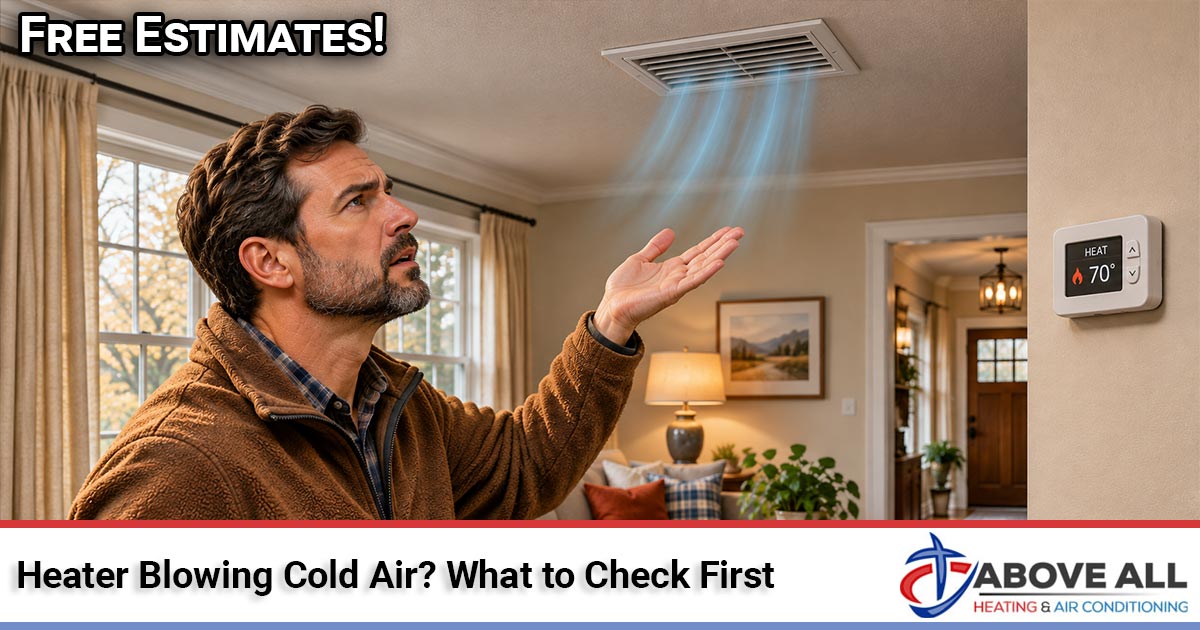
If your heater is blowing cold air, the most common causes are simple: the thermostat fan is set to ON instead of AUTO, the furnace is in its normal warm-up or cool-down cycle, or a clogged filter has made the furnace overheat and shut its burners off while the blower keeps running. If those check out, the problem is usually ignition (a dirty flame sensor or failed ignitor), the gas supply, a blocked condensate drain, a heat pump issue, or leaky ducts.
At Above All Heating and Air, a “heat is on but the air is cold” call is one of the most common we get on the first cold nights of the year. Some causes take a homeowner 30 seconds to fix. Others involve gas, high voltage or safety controls and need a technician. This guide walks through the eight causes we see most, the order to check them, what is different for furnaces, heat pumps, electric furnaces and wall heaters, and the points where you should stop and call.
Why Is My Heater Blowing Cold Air? The Quick Answer
A forced-air heating system has two separate jobs: making heat (burners, heat strips or a heat pump) and moving air (the blower). Cold air at the vents means the blower is running but the heat source is not, or the heat is not reaching you. Almost every cause on this list fits one of three patterns:
- The system was never asked to heat. A thermostat setting tells the blower to run without calling for heat.
- The system tried to heat and a safety control stopped it. The furnace overheated, the flame was not detected, or a drain backed up, so the burners shut off while the blower kept going.
- The heat is being made but lost or diluted. A heat pump is in defrost, refrigerant is low, or warm air is leaking out of ducts in the attic.
Knowing which pattern you are in tells you whether it is a quick fix or a service call.
8 Common Causes of a Heater Blowing Cold Air
The table below matches what you notice to the most likely cause. Use it to narrow things down before you start checking.
| What you notice | Most likely cause | Can you check it? |
|---|---|---|
| Cool air blows constantly, even when the house is at temperature | 1. Thermostat fan set to ON | Yes, switch the fan to AUTO |
| Cool air for a minute at start-up, or for a minute or two after the heat shuts off | 2. Normal warm-up and cool-down cycle | Yes, this is expected |
| Warm air at first, then cold air for several minutes, then warm again | 3. Dirty filter or blocked return making the furnace overheat (high-limit switch) | Yes, replace the filter and open vents |
| Furnace clicks, tries to light, burners come on for a few seconds then go out | 4. Dirty flame sensor, failed ignitor or ignition lockout | Partly; a reset is fine once, repairs are for a pro |
| No flame at all on an older furnace or wall heater; other gas appliances also off | 5. Pilot out or gas supply issue | Check the gas valve position only |
| High-efficiency furnace stops heating; water near the unit or a gurgling sound | 6. Clogged condensate line or trap tripping a safety switch | Sometimes; see below |
| Heat pump blows cool air for a few minutes, outdoor unit steams or is quiet | 7. Heat pump defrost (normal) or low refrigerant, reversing valve or outdoor unit problem | Clear the outdoor unit; the rest is a pro job |
| Some rooms warm, others cold; attic feels warm; weak airflow at far vents | 8. Leaky, disconnected or uninsulated ducts | Look, but duct repair is a pro job |
1. The Thermostat Fan Is Set to ON
This is the cause we find most often, and the easiest to fix. Most thermostats have a fan setting of AUTO or ON. In AUTO, the blower only runs while the system is heating. In ON, the blower runs all the time, so between heating cycles it pushes room-temperature air through the vents, and that air feels cold on your skin. Switch the fan to AUTO and confirm the system mode is HEAT (not COOL or OFF) and the set temperature is a few degrees above the current room temperature. If the thermostat display is blank, replace the batteries.
2. Normal Warm-Up and Cool-Down Cycles
A gas furnace does not blow hot air the instant it turns on. The inducer fan starts, the ignitor heats, the burners light, and the heat exchanger has to warm up before the blower starts. Some systems start the blower a little early, so the first bit of air can feel cool. At the end of a cycle, the blower keeps running briefly after the burners shut off to pull the remaining heat out of the heat exchanger. That air cools off quickly. Short bursts of cool air at the start or end of a cycle are normal. Cold air that lasts more than a few minutes is not.
3. A Dirty Filter Is Making the Furnace Overheat
Every furnace has a high-limit switch that shuts the burners off if the heat exchanger gets too hot. The most common reason it trips is restricted airflow: a clogged filter, a filter installed backward, closed or blocked supply vents, or a blocked return grille. When the limit trips, the burners go out but the blower keeps running to cool the furnace down, so you get cold air. After it cools, the furnace relights and the cycle repeats. Repeated overheating stresses the heat exchanger, so this is worth fixing right away. Replace the filter (and check that the airflow arrow points toward the furnace, as we explain in our guide to why furnace filter direction matters), open all supply vents and clear anything blocking the return.
4. Ignition Problems: Dirty Flame Sensor or Failed Ignitor
Modern furnaces light the burners with a hot surface ignitor or spark, then use a flame sensor to confirm the flame is there. If the flame sensor is coated with residue, it cannot “see” the flame, so the control board shuts off the gas after a few seconds as a safety step. The furnace may try several times and then lock out, and if the blower runs during that time you feel cold air. A cracked or worn ignitor causes a similar pattern, except the burners never light at all. Our post on what to do when your furnace is not igniting covers the ignition sequence in more detail. Cleaning a flame sensor or replacing an ignitor means removing panels on a gas appliance, so we recommend leaving it to a technician.
5. Pilot Light Out or Gas Supply Problem
Older furnaces and many gas wall heaters use a standing pilot. If the pilot goes out, the main burner cannot light and the fan (if there is one) blows unheated air. On any gas furnace, the burners also cannot light if the gas valve on the supply line is turned off, if the gas service to the home is interrupted, or if a gas valve inside the furnace has failed. You can check that the handle on the gas shutoff next to the furnace is parallel to the pipe (open). Relighting a pilot should only be done by following the instructions on the appliance label, and never if you smell gas.
6. Clogged Condensate Line on a High-Efficiency Furnace
High-efficiency (condensing) furnaces pull so much heat from the exhaust that water condenses inside them. That water drains through a trap and a condensate line, sometimes to a small pump. If the trap or line clogs with sludge, a float or pressure switch stops the furnace from firing to prevent water damage. The blower may keep running, so the air comes out cold. Signs include water around the furnace, a full condensate pump, or a gurgling sound. In attic installs, this is also a leak risk for the ceiling below, so turn the system off at the thermostat and call if you see water.
7. Heat Pump Defrost, Low Refrigerant or a Stuck Reversing Valve
A heat pump moves heat from outdoor air into your home instead of burning fuel, so its supply air is warm rather than hot and can feel cooler than air from a gas furnace even when it is working correctly. According to Lennox, when frost builds up on the outdoor unit the heat pump switches into defrost mode and “temporarily blows cooler air,” which is normal. You may see steam rising from the outdoor unit during defrost. Lennox also lists low refrigerant, a blocked outdoor unit and a faulty reversing valve as causes of a heat pump blowing cold air in heat mode. Cool air that lasts longer than a defrost cycle, or a heat pump that seems to run all the time without warming the house, needs a technician.
8. Leaky or Disconnected Ducts in the Attic
Sometimes the furnace is making heat and the ducts are losing it. ENERGY STAR says that in a typical house about 20 to 30 percent of the air moving through the duct system is lost to leaks, holes and poorly connected ducts, and it lists ducts in an attic, crawlspace or garage as a sign of poor duct performance. A duct that has come loose in the attic can dump warm air into the attic while the room at the end of that run gets only a trickle of cool air. If one or two rooms are cold while others are fine, ducts are a likely suspect.
What to Check First: A Step-by-Step Order
Work through these steps in order. Each one takes a few minutes and none requires opening the furnace.
- Check the thermostat. Mode on HEAT, fan on AUTO, set temperature at least 3 degrees above room temperature, fresh batteries if the display is dim or blank.
- Wait through one full cycle. Give the furnace 5 to 10 minutes after it starts. Note whether the air turns warm and whether it goes cold again partway through.
- Replace the air filter. If it is gray or clogged, replace it with the correct size and point the airflow arrow toward the furnace.
- Open supply vents and clear the return. Closed vents in unused rooms and furniture over return grilles both restrict airflow.
- Check power. Look for a tripped breaker for the furnace or air handler and make sure the service switch near the furnace (it looks like a light switch) is on.
- Check the blower door. Most furnaces have a safety switch that stops the burners if the lower panel is not seated properly. Make sure it is closed firmly.
- Check the gas valve. The handle on the gas line at the furnace should be parallel to the pipe.
- Look for water. On a high-efficiency furnace, check for water around the unit or a full condensate pump.
- Read the status light. Many furnaces have a small window with a blinking LED. Count the blinks and match them to the code chart on the inside of the furnace door. Write down the code for your technician.
- Heat pump owners: check the outdoor unit. Clear leaves, debris or anything stacked against it, and give it time to finish a defrost cycle.
If the air is still cold after these steps, or if a step points to an ignition, gas, drain or refrigerant problem, it is time for a service call.
Furnace vs. Heat Pump vs. Electric Furnace vs. Wall Heater
The same symptom has different likely causes depending on what heats your home.
| System | How it makes heat | Most common cold-air causes |
|---|---|---|
| Gas furnace | Burners heat a heat exchanger; blower moves air across it | Fan set to ON, dirty filter tripping the limit switch, flame sensor or ignitor, gas supply, condensate drain (high-efficiency models) |
| Heat pump | Moves heat from outdoor air using refrigerant; may have backup heat strips | Defrost mode (normal), thermostat in COOL, dirty filter, blocked outdoor unit, low refrigerant, reversing valve, backup heat not working |
| Electric furnace | Electric heating elements (heat strips) warm the air | Tripped breaker for the heat strips, burned-out element, failed sequencer or relay, limit switch tripped by a dirty filter |
| Gas or electric wall heater | A single in-wall unit with a burner or element and a small fan | Pilot out, thermostat or control knob setting, dust-clogged element or fan, failed thermostat or limit switch, worn element |
Electric Furnaces
An electric furnace has no flame, so ignition and gas causes do not apply. Instead, it uses several heating elements that turn on in stages through sequencers or relays. Electric heat strips often have their own large breaker, separate from the blower circuit, so the blower can run while the heat strips have no power. That gives you cold air with no obvious failure. A failed element or sequencer can also cause lukewarm air because only some of the elements are heating. Because these circuits carry high current, checking anything beyond the breaker panel is a job for a technician.
Wall Heaters
Many older Inland Empire homes and additions still use gas or electric wall heaters. On a gas wall heater, a pilot that has gone out is the most common reason for no heat. On an electric wall heater, a heavy layer of dust on the element or fan, a worn element, or a failed built-in thermostat or limit switch are common. If a wall heater smells strongly of burning dust for more than the first few minutes of the season, makes a buzzing or popping sound, or the fan runs with no heat, turn it off and have it inspected.
Stop and Call: Safety Lines You Should Not Cross
Most cold-air problems are not dangerous, but heating equipment involves gas, combustion and high voltage. Stop troubleshooting and call when any of these apply:
- You smell gas (a rotten-egg odor). SoCalGas says to evacuate the area immediately and call SoCalGas at 1-800-427-2200 from a safe location, and to call 911 promptly if the situation may endanger life. Do not turn lights or appliances on or off, light a flame, or use anything that could spark, and do not try to fix the leak yourself.
- A carbon monoxide alarm sounds. Get everyone outside to fresh air right away and call 911. The CDC lists headache, dizziness, weakness, upset stomach, vomiting, chest pain and confusion as common CO symptoms, and recommends having heating systems serviced every year.
- The breaker trips again after you reset it once. A breaker that trips repeatedly is protecting a wiring or component fault.
- You see scorch marks, smell burning plastic or electrical odors, or see soot around the furnace or vents.
- The furnace locks out repeatedly. Resetting it over and over can mask a safety problem. One reset is reasonable; after that, call.
- There is water in an attic or closet furnace. Turn the system off at the thermostat to limit damage.
What Our Technicians Do on a Cold-Air Service Call
When we come out for a heater blowing cold air, we start with the same basics you checked, because a fresh set of eyes sometimes catches a thermostat wiring issue or a filter rack problem. From there, the diagnosis depends on the system:
- Gas furnaces: we read the control board fault code, watch a full ignition sequence, test the ignitor, clean or test the flame sensor (including a microamp reading where the manufacturer specifies one), check gas pressure, test the limit and pressure switches, and inspect the inducer, venting and condensate system.
- Heat pumps: we check refrigerant pressures and temperatures, the reversing valve, defrost controls and sensors, outdoor fan and coil, and the backup heat strips.
- Electric furnaces and wall heaters: we test each element, sequencer or relay, the limit switches and the thermostat.
- Airflow and ducts: we measure temperature rise across the furnace, look for restrictions, and inspect accessible ductwork for disconnected or crushed runs.
We explain what we found and give you the repair options and pricing before any work begins. You can learn more about our furnace repair service in Murrieta and our full range of heating services.
Repair or Replace? Signs a Cold-Air Problem Points to a Bigger Decision
Most cold-air problems are fixed with a filter, a cleaned flame sensor, an ignitor, a cleared drain or a control part. A few situations raise the question of replacement instead:
- Age. Lennox says furnaces typically last 15 to 20 years with proper care. A furnace near or past that range that needs a major part deserves a repair-or-replace conversation.
- A cracked heat exchanger. If a limit switch has been tripping for years because of poor airflow, the heat exchanger may be damaged. A confirmed crack is a safety issue and usually means replacement.
- Repeated repairs. If you are calling for heat problems every winter, the total cost of repairs adds up.
- The $5,000 rule. As explained by CBS News, multiply the system’s age by the repair cost. If the result is over $5,000, replacement often makes more sense; under $5,000, repair usually does.
We will give you an honest recommendation either way. If replacement is worth considering, we can provide a free quote and walk you through equipment options.
Why the First Cold Night Brings So Many Cold-Air Calls in the Inland Empire
In Murrieta, Temecula, Menifee and the rest of the Inland Empire, the heating season is short. Furnaces and heat pumps sit idle through a long, hot cooling season and then get asked to work on the first chilly evening of fall. That idle time is when problems build quietly: dust settles on flame sensors and burners, filters that were working hard all summer for the AC are already loaded, condensate traps dry out or collect sludge, and Santa Ana winds blow leaves and debris against outdoor heat pump units.
Many local tract homes have the furnace in the attic or a hall closet with ducts running through a hot attic. Attic ducts take a beating from summer heat, and a joint that loosened over the summer is often first noticed in fall as a cold room. Older homes with gas wall heaters have their own first-night issue: a pilot that went out over the summer. A fall heating tune-up catches most of these before the first cold night, and it is the best way to avoid a cold-air surprise. If you hear new rattles or bangs when the heat starts, our guide to a furnace making noise can help you narrow that down too.
Heater Blowing Cold Air vs. AC Blowing Warm Air
The heating and cooling versions of this problem share some causes: thermostat settings, dirty filters, airflow restrictions and leaky ducts show up in both. The differences are in the equipment. A heater blowing cold air usually points to ignition, gas, a safety limit or heat pump defrost. An AC blowing warm air more often points to the outdoor unit, refrigerant or a failed capacitor or compressor. If you have the opposite problem in summer, see our guide to an AC blowing warm air.
Frequently Asked Questions
Why is my heater blowing cold air in my house?
The most common reasons are a thermostat fan set to ON, a clogged filter that makes the furnace overheat and shut off its burners, or an ignition problem such as a dirty flame sensor. Gas supply issues, a clogged condensate drain, heat pump defrost and leaky ducts are the other usual causes.
Why is my HVAC blowing cold air but not warm air?
Your blower is running but the heat source is not. That happens when the thermostat is in COOL or the fan is set to ON, when a safety control stops the burners, or when a heat pump is defrosting or low on refrigerant. Check the thermostat and filter first, then call if it continues.
Why is my heater on but blowing cold air?
If the thermostat says HEAT and the air is still cold, the furnace is likely trying to heat and being stopped. A dirty filter tripping the high-limit switch, a flame sensor that cannot detect the flame, or a blocked condensate drain are the most common reasons. A status light blink code can confirm which.
Why is my heater turning on but not blowing hot air?
A heater that starts but never warms up usually has an ignition problem. The burners may fail to light because of a worn ignitor, or light briefly and go out because the flame sensor is dirty. On an electric furnace, a tripped heat-strip breaker or failed element causes the same symptom.
Why is cold air coming out when heat is on?
A short burst of cool air at the start or end of a heating cycle is normal while the heat exchanger warms up or cools down. Cold air that lasts more than a few minutes means the burners or heat strips are not running, usually because of a setting, a dirty filter or an ignition fault.
Why is my furnace running but not heating?
When the blower runs but the air stays cold, the furnace is not producing heat. The usual causes are a fan set to ON, an overheating furnace shutting off its burners, a failed ignitor or dirty flame sensor, a closed gas valve, or a clogged condensate line on a high-efficiency furnace.
How do you fix a furnace that blows cold air?
Start with the thermostat: set the mode to HEAT and the fan to AUTO. Then replace the filter, open supply vents, check the breaker and service switch, make sure the blower door is closed and the gas valve is open. If the air is still cold, a technician should check ignition, gas and safety switches.
What do I do if my heater is blowing cold air?
Check the thermostat settings and batteries, replace a dirty filter and wait through one full heating cycle. If cold air continues, note any blinking status light code, turn the system off if the furnace keeps cycling, and call a technician. Leave the house and call for help if you smell gas.
If my furnace is blowing cold air, should I turn it off?
If it is just the fan setting, switch it to AUTO and keep using it. If the furnace keeps lighting and shutting off, is leaking water, smells of burning or keeps locking out, turn it off at the thermostat and call for service. If you smell gas or a CO alarm sounds, get everyone outside and call for help.
Can a dirty filter cause a furnace to blow cold air?
Yes. A clogged filter restricts airflow, the furnace overheats, and the high-limit switch shuts off the burners while the blower keeps running, so the air turns cold. Repeated overheating can also damage the heat exchanger, so replace the filter right away and check that it is installed in the right direction.
Why is my electric heater blowing cold air?
On an electric furnace, the blower and the heating elements are often on separate breakers, so a tripped heat-strip breaker leaves the fan running with no heat. A burned-out element, a failed sequencer or relay, or a limit switch tripped by a dirty filter are the other common causes.
Is it normal for a heat pump to blow cold air on the heat setting?
For short periods, yes. A heat pump in defrost mode temporarily blows cooler air while it melts frost off the outdoor coil, and heat pump air is warm rather than hot. If the cool air lasts well beyond a defrost cycle, or the house is not warming, have the refrigerant, reversing valve and backup heat checked.
My wall heater isn’t heating. What could be the problem?
On a gas wall heater, the pilot light going out is the most common cause. On an electric wall heater, check the breaker and the control knob or thermostat setting, then look for a dust-clogged element or fan. A failed element, thermostat or limit switch needs a technician to test and replace.
Why is my fan heater not blowing hot air?
A portable fan heater or space heater that blows unheated air usually has a tripped internal safety cutoff from overheating or tipping, a failed heating element, or a dial set to fan only. Unplug it and let it cool before checking. A unit with a failed element is usually replaced rather than repaired.
How long can a house go without heat in the winter?
It depends on outdoor temperatures and insulation. In the mild Inland Empire climate, most homes stay safe for a day or more, but infants, older adults and anyone with health concerns need warmth sooner. Never use an oven, grill or generator indoors for heat, since those can cause carbon monoxide poisoning.
How much does it cost to fix a furnace blowing cold air?
It depends on the cause. A thermostat setting or filter costs little or nothing, while ignition parts, control boards, heat pump refrigerant or duct repairs cost more. Because national averages do not reflect Southern California service costs, we diagnose the problem and quote the repair before any work begins.
Can a heater blowing cold air be dangerous?
The cold air itself is not dangerous, but some causes are. A furnace that keeps overheating can crack its heat exchanger over time, and repeated ignition failures can point to gas or venting problems. That is why we recommend having a technician check any cold-air problem that a filter or thermostat change does not fix.
Get Your Heat Working Again
If your heater is still blowing cold air after the basic checks, our technicians can find the cause and get your home warm again. Contact Above All Heating and Air to schedule service, or request a free quote if you are weighing a repair against a new system. You can also learn more about us on our homepage.
Schedule an Appointment Today
Get in touch with Above All Heating and Air Conditioning by calling us or filling out the form. We look forward to working with you.
