
R-454B Refrigerant: What the R-410A Phase-Out Means for Your Next AC
CONTACT US
Contact Us

Our
SERVICEs
R-454B Refrigerant: What the R-410A Phase-Out Means for Your Next AC
Above All Heating And Air Conditioning / October 23, 2026 / Air Conditioner Replacement, Air Conditioning, Air Conditioning Installation
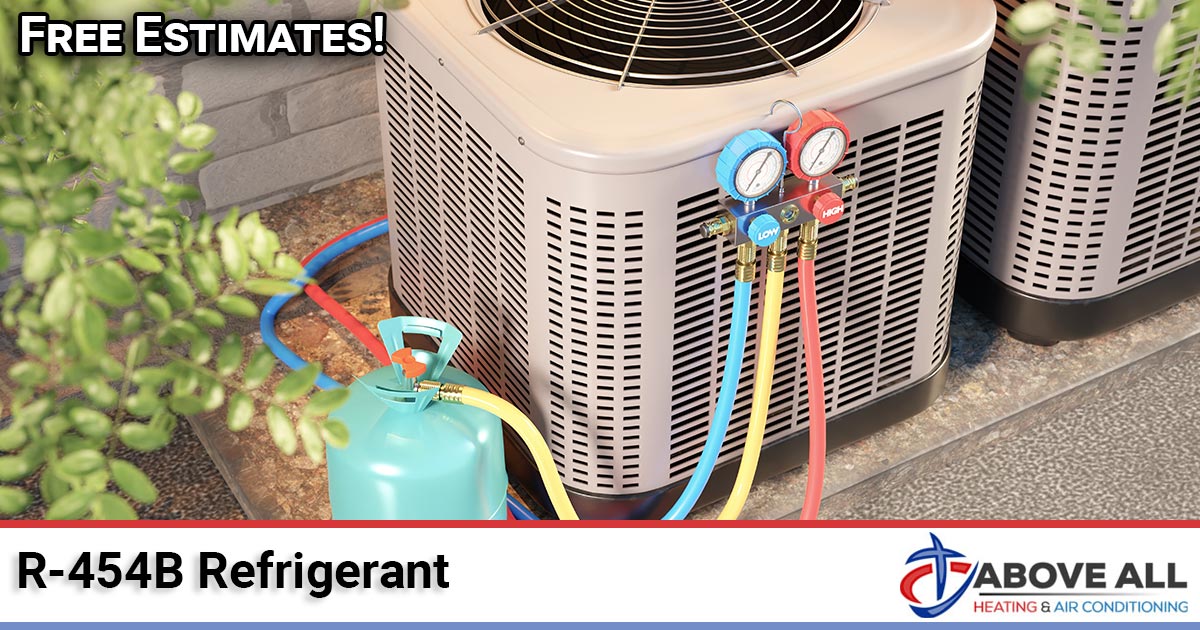
R-454B refrigerant is the lower-impact refrigerant that most major manufacturers now use in new central air conditioners and heat pumps in place of R-410A. Federal rules have required new residential split-system equipment made since January 1, 2025 to use a refrigerant with a global warming potential (GWP) of 700 or less, and R-454B comes in at 466 compared with 2,088 for R-410A. If your current R-410A system works, nothing changes for you today: you can keep using it and keep having it repaired.
If you have gotten a quote for a new AC recently, you have probably seen R-454B listed on the paperwork, sometimes under a brand name like Puron Advance. Homeowners ask us about it all the time: Is my old system now illegal? Will refrigerant for my current unit disappear? Is the new stuff safe? Why does everything seem to cost more? At Above All Heating and Air, we install and service both R-410A and R-454B equipment across the Temecula Valley and the Inland Empire, so this guide walks through what actually changed, what did not, and how the refrigerant switch should factor into your repair-or-replace decision.
What Is R-454B Refrigerant?
R-454B is a refrigerant blend made of about 68.9 percent R-32 and 31.1 percent R-1234yf, according to Carrier. It does the same job R-410A has done in home air conditioners since the late 2000s: it absorbs heat inside your home at the evaporator coil, carries it outside, and releases it at the condenser coil. Carrier describes R-454B as designed to provide similar performance to R-410A, which is why manufacturers picked it as the main replacement for central air systems.
The key difference is environmental. Global warming potential measures how much heat a gas traps compared with carbon dioxide. R-454B has a GWP of 466, while R-410A sits at 2,088, which Carrier calculates as a roughly 75 percent reduction. R-454B also has zero ozone depletion potential, the same as R-410A. You may also see it listed under brand names, such as Carrier’s Puron Advance, but the refrigerant is the same.
Why the R-410A Phase-Out Happened
The change traces back to the American Innovation and Manufacturing (AIM) Act of 2020. According to the EPA, the AIM Act mandates a phasedown of hydrofluorocarbons (HFCs), the family that includes R-410A, by 85 percent from historic baseline levels by 2036. That is a production and import limit, not a ban on using what is already in your home. Each year, less new R-410A can be made or brought into the country.
The EPA then issued its Technology Transitions rule, which sets GWP limits for new equipment by category. For residential and light commercial air conditioners and heat pumps, the EPA Technology Transitions fact sheet lists a GWP limit of 700, with a manufacturing and import compliance date of January 1, 2025. Because R-410A is far above that limit, manufacturers retooled their residential lines around R-454B and, in some cases, R-32.
The May 2026 EPA update on installing older R-410A equipment
The original rule also set a January 1, 2026 deadline for installing new split systems built with R-410A, even if the equipment had been manufactured before 2025. That deadline changed. As reported by the National Association of Home Builders, the EPA published a final rule on May 26, 2026, effective July 27, 2026, that allows the continued installation of R-410A units manufactured or imported before January 1, 2025, until existing supplies run out. The ACCA notes that the AIM Act phasedown schedule itself did not change, which means R-410A refrigerant supply keeps shrinking on the original timeline. For the current federal details, the EPA keeps a technology transitions regulatory page.
California has its own refrigerant rules
Here in California, federal rules are only part of the picture. The California Air Resources Board (CARB) prohibits refrigerants with a GWP of 750 or greater in new air-conditioning equipment, residential and non-residential, as of January 1, 2025. California law also phases down bulk refrigerant sales: according to ACHR News, SB 1206 sets a bulk-sale GWP cap of 1,500 starting January 1, 2030, which covers R-410A, after which reclaimed refrigerant becomes the main option for servicing existing systems. Because state and federal rules can differ, we confirm what equipment can be installed in your home under current California requirements before we quote it. For new installations, we recommend current R-454B or R-32 equipment.
R-454B vs. R-410A vs. R-32: Side-by-Side Comparison
Most homeowners only need to know which refrigerant their system uses and whether it can be serviced. Here is how the three refrigerants you are most likely to hear about compare.
| Feature | R-410A | R-454B | R-32 |
|---|---|---|---|
| Global warming potential (GWP) | 2,088 | 466 | 675 |
| Composition | Blend of R-32 and R-125 | Blend of about 68.9% R-32 and 31.1% R-1234yf | Single compound |
| ASHRAE safety class | A1 (non-flammable) | A2L (lower toxicity, mildly flammable) | A2L (lower toxicity, mildly flammable) |
| Used in new residential split systems? | No new manufacturing since January 1, 2025 | Yes, the most common choice for central AC | Yes, common in mini splits and some central systems |
| Can existing systems be serviced? | Yes, with available and reclaimed refrigerant | Yes | Yes |
| Drop-in replacement for R-410A? | Not applicable | No | No |
GWP and composition figures come from Carrier and Lennox. Lennox notes R-32 has a GWP of 675, about one-third of R-410A, and that it is a single compound rather than a blend. Both R-32 and R-454B are classified A2L.
What the Phase-Out Means If Your R-410A System Still Works
This is the question we hear most, and the answer is reassuring. The EPA states that there are no requirements to stop using any specific equipment currently in use, that consumers can keep using their equipment until the end of its useful life, and that you can continue to repair your existing air conditioning and heat pump system, including major parts like a compressor or condensing unit.
What does change over time is supply. Since less new R-410A can be produced each year, refrigerant for older systems is expected to cost more and become harder to source as the phasedown continues. Trane expects supplies of R-410A to be available for years to come but cautions that recharge costs will likely rise as inventory shrinks. That makes three things more important than ever for R-410A owners:
- Fix leaks instead of topping off. A system that needs refrigerant every summer has a leak. Adding more each year gets more expensive as R-410A tightens. Our guide to signs your AC is low on refrigerant explains how leaks are found and repaired.
- Keep up with maintenance. Clean coils, good airflow and correct charge reduce strain on the compressor, which is the part you least want to replace on an aging R-410A system.
- Plan ahead. If your system is already 12 to 15 years old, it is worth budgeting for replacement on your own schedule instead of during a July breakdown.
Can You Put R-454B in an R-410A System?
No. R-454B is not a drop-in replacement. Carrier states plainly that R-454B cannot be used as a direct replacement for R-410A in an existing system, because R-454B systems need components, controls and safety features designed for that refrigerant. The reverse is also true: you cannot charge an R-454B system with R-410A.
The two refrigerants run at different pressures and properties, and A2L systems include leak detection and mitigation equipment that older systems do not have. Mixing refrigerants or charging the wrong one can damage the compressor, void manufacturer warranties and create a safety issue. If your R-410A system needs refrigerant, it gets R-410A. If you replace the outdoor unit, the indoor coil typically needs to be matched to the new refrigerant as well, which is one reason a full system change is often the cleaner path.
Is R-454B Safe? The A2L Classification Explained
You may have seen R-454B described as mildly flammable and wondered whether that should worry you. Here is the plain-English version. ASHRAE assigns refrigerants a safety class. The letter covers toxicity (A means lower toxicity) and the number covers flammability. R-410A is A1, meaning non-flammable. R-454B and R-32 are A2L: lower toxicity and lower flammability. The L means they are hard to ignite and burn slowly if they do.
Manufacturers designed R-454B equipment with that classification in mind. Carrier explains that its R-454B products include a refrigerant detection and dissipation system that can sense a leak and run the indoor fan to disperse the refrigerant. Carrier also notes R-454B does not contain propane. The real safety factor for homeowners is installation quality: A2L systems require technicians trained on the newer equipment, the correct tools and recovery cylinders, and the sensors installed and wired as the manufacturer specifies. That is one more reason a refrigerant system should never be a do-it-yourself project.
How R-454B Affects the Cost of a New AC
Homeowners often notice that new-system quotes are higher than what a neighbor paid a few years ago. The refrigerant change is part of that, along with efficiency standards and general equipment pricing. We do not publish one-size-fits-all prices, because a real quote depends on your home. Our AC replacement cost guide covers the full list of cost drivers. For the refrigerant side specifically, these are the factors that move the number:
| Cost factor | Why it matters with R-454B |
|---|---|
| Redesigned equipment | New R-454B lines include leak sensors, mitigation controls and redesigned components that older R-410A equipment did not have. |
| Matched indoor coil | An R-454B outdoor unit needs a compatible indoor coil, so most replacements change both sides of the system. |
| Line set condition | Existing copper lines may be reusable after inspection and flushing, or may need replacement depending on size, condition and routing. |
| Efficiency tier | Entry-level, mid-tier and high-efficiency systems all exist in R-454B; the SEER2 rating you choose has a bigger effect on price than the refrigerant itself. |
| Refrigerant price | A2L refrigerants are newer and the supply chain is still maturing, so per-pound pricing has been higher than legacy refrigerants. |
| Installation requirements | A2L-rated tools, recovery equipment, sensor setup and permit requirements add to labor. |
| Add-ons | Thermostat upgrades, duct repairs, electrical work and air quality equipment are separate from the refrigerant decision. |
Efficiency standards changed around the same time as the refrigerant rules, so it helps to understand both. Our guide to SEER2 ratings explains what the newer efficiency numbers mean on a quote. For a price on your home, the fastest route is a free air conditioning quote.
What About R-22 Systems?
If your system is very old, it may not use R-410A at all. Before R-410A, most home air conditioners used R-22, sometimes called Freon. According to the EPA, no new HCFC-22 has been made or imported into the United States since January 1, 2020. The EPA does not require homeowners to replace R-22 equipment, and reclaimed R-22 is still used for service. Supply is limited and shrinking, though, and Trane notes that new AC units stopped using R-22 starting in 2010.
Since new R-22 units stopped being made around 2010, any R-22 system still running today is more than 15 years old. A major refrigerant repair on one of these units is rarely a good long-term investment. If you are deciding between R-22 and R-410A while researching, the short version is that R-22 replaced older refrigerants, R-410A replaced R-22, and R-454B and R-32 are now replacing R-410A. Each step lowered environmental impact, and none of them can be swapped into another system.
How the Refrigerant Change Affects the Repair-or-Replace Decision
The refrigerant in your system should be one factor in a repair-or-replace decision, not the whole decision. When we evaluate a system with a homeowner, we work through it roughly in this order:
- Confirm the refrigerant. We check the outdoor unit’s nameplate to see whether it is R-22, R-410A or a newer refrigerant.
- Check the age and condition. System age, coil condition and repair history tell us how much useful life is left. Our post on AC compressor replacement cost explains why a compressor failure on an older unit often tips the balance.
- Look at the size of the repair. Small electrical repairs such as capacitors and contactors usually make sense on any system. Large refrigerant-side repairs, such as a compressor or a coil, deserve a closer look on older R-410A and R-22 units.
- Consider ongoing refrigerant cost. A system with a slow leak will keep needing R-410A, which is expected to keep getting more expensive.
- Compare against a new system. We price the repair and a replacement side by side so you can decide with real numbers for your home.
A newer R-410A system in good shape is worth repairing and maintaining. An older system facing a major refrigerant-side repair is often the time to move to R-454B on your terms.
What You Can Safely Check Yourself
You do not need tools to learn the basics about your system. Here is what a homeowner can safely do:
- Find your refrigerant type. Look for the metal nameplate on the side of the outdoor unit. It lists the refrigerant (R-22, R-410A or R-454B) and the factory charge. Your owner’s manual will also list it.
- Note the age. The manufacture date is often coded into the serial number. If you cannot read it, snap a photo of the nameplate and send it with your service request.
- Watch for leak signs. Ice on the refrigerant lines, warm air from the vents, a hissing sound, or a system that runs constantly without cooling can all point to low refrigerant.
- Keep the outdoor unit clear. Two feet of clearance around the condenser and a clean filter inside help any system run with less strain.
Stop and call a professional for anything involving refrigerant. Refrigerant work requires EPA certification, the system runs at high pressure, and both R-410A and R-454B require specific equipment. You cannot legally buy refrigerant for a home AC as an uncertified homeowner anyway, as explained in the FAQ below.
Why This Matters for Inland Empire and Temecula Valley Homes
Our climate puts more hours on an air conditioner than most of the country. Long cooling seasons from late spring into fall, triple-digit stretches inland, and dust and debris blown in by Santa Ana winds all add wear to compressors and coils. That means systems here tend to reach major repairs sooner, and a refrigerant leak gets noticed fast when it is 100 degrees outside.
Mild winters also mean many local homeowners are considering heat pumps when they replace, and new heat pumps use the same lower-GWP refrigerants as new air conditioners. If your R-410A system is aging, the off-season months of fall and winter are the best time to plan a replacement, compare options without pressure, and avoid making a rushed decision during the first heat wave of summer. Our air conditioning installation team can walk you through R-454B options that fit your home and budget.
What to Ask When Your Quote Lists R-454B
- Is the quote for a matched system, including a compatible indoor coil?
- Will the existing line set be reused, flushed or replaced, and why?
- Does the system include the manufacturer’s required leak detection and mitigation sensors, and are they part of the installed price?
- What SEER2 rating and efficiency tier is being quoted, and what are the alternatives?
- Are permits included, and does the installation follow current California requirements?
- What warranty applies, and does it require registration?
Frequently Asked Questions
What is R-454B refrigerant?
R-454B is a refrigerant blend of R-32 and R-1234yf that most manufacturers now use in new central air conditioners and heat pumps. It has a global warming potential of 466, compared with 2,088 for R-410A, and is designed to cool with similar performance. Brand names include Puron Advance and Opteon XL41.
What refrigerant is R-454B equivalent to?
R-454B is the main replacement for R-410A in residential central air systems and performs similarly, but it is not interchangeable with it. It is not a drop-in replacement and cannot be added to an R-410A system. R-32 is the other common R-410A replacement, especially in ductless mini splits.
Is R-410A going to be discontinued?
R-410A is being phased down, not banned outright. New residential split systems stopped being manufactured with it on January 1, 2025, and the AIM Act cuts HFC production and imports by 85 percent from baseline levels by 2036. Existing R-410A systems can legally keep running and be serviced.
What refrigerant is being phased out in 2026?
R-410A is the refrigerant in the middle of its phase-out for home air conditioners and heat pumps. No new R-410A residential split systems are being manufactured, and its supply keeps declining under the federal HFC phasedown schedule. R-22 was already phased out of new production and import on January 1, 2020.
Can you still sell 410A equipment in 2026?
Federally, yes, in limited cases. A May 2026 EPA rule allows R-410A split-system equipment manufactured or imported before January 1, 2025 to keep being installed until existing supplies run out. California has its own rule limiting the GWP of refrigerants in new air-conditioning equipment, so we confirm what can be installed in your home under current state requirements.
What are we going to use if R-410A is banned?
New residential systems use lower-GWP A2L refrigerants, mainly R-454B for central air and R-32 for many mini splits and some central systems. These refrigerants meet the federal limit of 700 GWP for new residential air conditioning and heat pump equipment.
Can you still get R-410A refrigerant?
Yes. Licensed technicians can still buy R-410A to service existing systems, and reclaimed R-410A will keep supporting repairs. Supply is shrinking each year, so prices are expected to rise over time. That makes repairing leaks more cost-effective than repeated recharges.
How long will R-410A compressors be available?
EPA rules do not restrict making or selling components needed to repair existing systems, so R-410A compressors and parts are still being made. The EPA has not set an end date for repair components. Availability for a specific model depends on the manufacturer, and as systems age some parts may get harder to find.
Can you replace R-454B with 410A?
No. R-454B and R-410A cannot be swapped in either direction. Each system is built with components, controls and safety features designed for its specific refrigerant. Charging the wrong refrigerant can damage the compressor and void the warranty.
Does 454B cool better than 410A?
R-454B is designed to cool about the same as R-410A rather than better. How well a new system cools depends far more on correct sizing, installation quality, ductwork and the SEER2 efficiency rating you choose.
What are the disadvantages of R-454B refrigerant?
The main drawbacks are mild flammability, which requires leak sensors and A2L-trained installers, and higher costs while the supply chain matures. It also cannot be used to retrofit older R-410A systems. For most homeowners, these are handled by the equipment design and a qualified installer rather than anything you need to manage.
Is R-454B refrigerant flammable?
R-454B is classified A2L, meaning lower toxicity and mildly flammable. It is hard to ignite and burns slowly, and residential R-454B systems include leak detection that runs the fan to disperse refrigerant if a leak is sensed.
Why is 454B refrigerant so expensive?
R-454B is a newer refrigerant with a supply chain that is still scaling up, and it requires A2L-rated handling, cylinders and tools. The equipment that uses it also includes added safety controls. On a typical replacement, refrigerant is a small part of the total; equipment tier, coil matching and installation work have a larger effect on price.
How much is 454B per pound?
Per-pound pricing varies by supplier, cylinder size and time of year, and it is set by distributors rather than published as a standard rate. Homeowners rarely buy it by the pound, because it is included in the charge of a new system. If a repair on an R-454B system needs refrigerant, we include it in the repair quote.
Can anyone buy R-454B refrigerant?
No. Under EPA rules, only Section 608 certified technicians, or employers of certified technicians, can buy refrigerant for stationary air conditioning systems. That includes R-454B and R-410A. Small cans sold for car air conditioning are a separate exception and do not apply to home systems.
Do you charge 454B as a liquid?
Yes. As a refrigerant blend, R-454B is generally charged as a liquid, following the equipment manufacturer’s charging instructions. This is technician work that requires EPA certification and A2L-rated equipment.
Which refrigerant is better, R-32 or R-454B?
Neither is better for every home. R-454B has the lower GWP (466 vs. 675) and is the most common choice for central air, while R-32 is a single-component refrigerant widely used in mini splits. The right choice depends on the equipment line that fits your home, and both are A2L refrigerants.
Get Straight Answers About Your System
Whether you have an R-410A system you want to keep running for years or you are weighing an R-454B replacement, we will tell you what your system actually needs and what your options cost. Contact Above All Heating and Air to schedule service, or request a free air conditioning service quote and we will help you plan your next step. You can also learn more about us on our homepage.
Schedule an Appointment Today
Get in touch with Above All Heating and Air Conditioning by calling us or filling out the form. We look forward to working with you.
