How Long Does a Furnace Last? Signs Yours Is Nearing the End
CONTACT US
Contact Us

Our
SERVICEs
How Long Does a Furnace Last? Signs Yours Is Nearing the End
Above All Heating And Air Conditioning / November 20, 2026 / Furnace Service, HVAC Services, Heating Repair
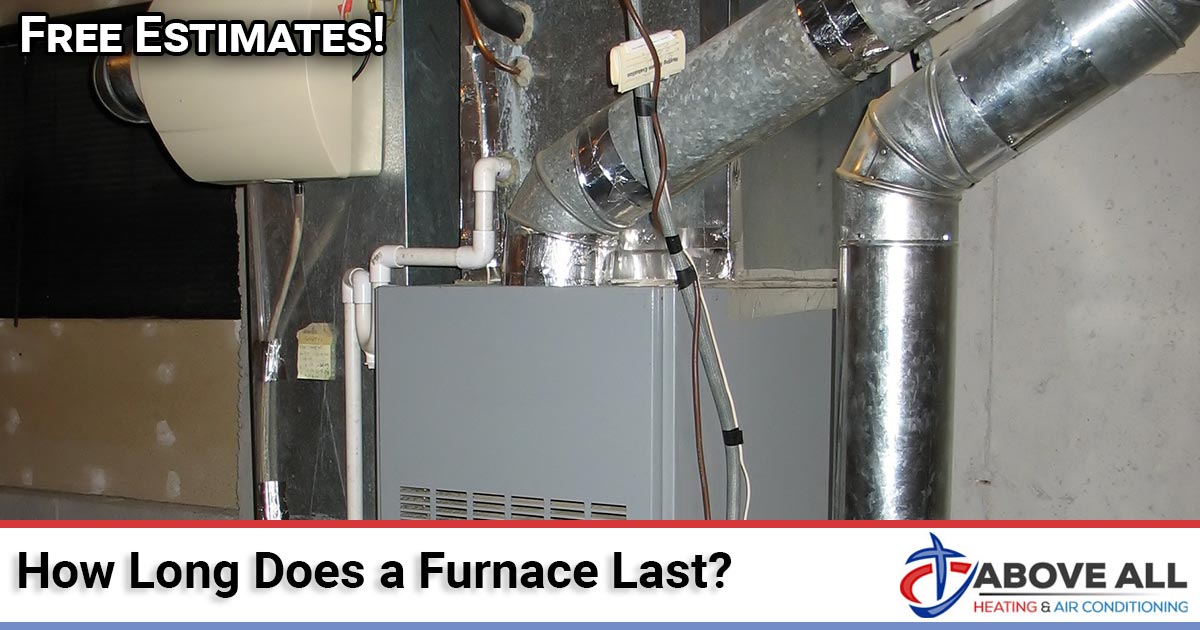
How long does a furnace last? Most gas furnaces last about 15 to 20 years, and a well-built, well-maintained unit can go longer. According to Carrier, a high-quality furnace can last up to 30 years, but age alone does not decide when to replace it: safety, repair frequency and how well it still heats matter more.
At Above All Heating and Air, we work on furnaces of every age across Murrieta, Temecula, Menifee and the rest of the Inland Empire. Some 25-year-old units are still running safely; some 12-year-old units are already worn out. This guide explains the typical furnace lifespan, what shortens or stretches it, the warning signs that a furnace is nearing the end, how to find your furnace’s age, and how to think through the repair-or-replace decision without guessing.
How Long Does a Furnace Last? The Short Answer
Manufacturers agree on a typical range. Trane says “the average furnace will last 15-20 years,” and Carrier says “most residential furnaces last 15 to 20 years on average,” adding that its ranges “are general guidelines, not guarantees.” Carrier lists these general ranges by furnace type:
| Furnace type | Typical lifespan (per Carrier) | What usually ends its life |
|---|---|---|
| Gas furnace | 15–20 years | Heat exchanger wear, failing ignition and controls, inducer or blower motor failure, rising repair frequency |
| Electric furnace | 20–30 years | Heating elements, sequencers and blower motors; no combustion, so no heat exchanger cracking |
| High-quality, well-maintained furnace | Up to 30 years | Eventually parts availability, efficiency and safety concerns outweigh repairs |
Two points matter for Southern California homeowners. First, Trane notes that “the same furnace will last longer in a milder climate” than in a cold northern state, because it simply runs fewer hours. Second, a lightly used furnace can still age out: rubber, wiring, gaskets and control boards break down over time, and dust and attic heat take a toll even when the burners are off. So a light-use furnace often outlives the national average, but it still needs inspection and maintenance to get there safely.
What Affects Furnace Lifespan
Carrier sums up the answer as depending on “four key variables: size, installation quality, maintenance habits, and usage patterns.” Here is what each one means in practice.
Sizing
An oversized furnace heats the house in short bursts and shuts off, then starts again a few minutes later. Every start is wear on the ignitor, inducer motor, gas valve and heat exchanger, which expands and contracts with each cycle. An undersized furnace runs nearly nonstop on cold nights. Either way, the furnace wears out sooner. A proper load calculation, the same process we describe in our AC load calculation guide, is the starting point for any replacement.
Installation quality
Trane puts it simply: “A furnace is only as good as its installation.” Undersized or leaky ductwork, poor venting, the wrong gas pressure, a badly pitched condensate line on a high-efficiency furnace, or a return that is too small all make the furnace work harder and run hotter than it was designed to.
Maintenance and filters
Dirty burners, a dirty flame sensor and a clogged filter are behind a large share of the no-heat calls we see. A restricted filter lets the heat exchanger overheat and trips the high-limit switch, and repeated overheating is one of the things that stresses the metal over time. Trane recommends “changing your HVAC air filters at least every 30-90 days,” and an annual heating tune-up catches wear before it becomes a breakdown.
Usage and environment
Hours of operation, thermostat habits and where the furnace sits all matter. A furnace in a hot attic, a dusty garage or a cramped hall closet lives a different life from one in a clean basement. Big thermostat swings that force long recovery runs add hours, too.
Furnace Lifespan in the Inland Empire: What’s Different Here
Our heating season is short. Most Temecula Valley and Inland Empire furnaces sit idle for months, then run hard on the first cold nights of fall and through the chilly evenings of winter. That pattern helps and hurts:
- Fewer run hours. A furnace here generally runs far less than one in a cold-winter state, which is why many local furnaces outlast the 15–20 year average.
- Attic heat. Many local tract homes have the furnace in the attic. In summer, attic temperatures can be extreme, which is hard on wiring, control boards, capacitors and the rubber hoses on high-efficiency furnaces, even when the furnace is off.
- Shared parts with the AC. In most split systems, the furnace blower also moves air for the air conditioner. That blower motor may run for long hours all summer, so it can wear out long before the burners do.
- Dust and Santa Ana debris. Dust settles on burners and the flame sensor while the furnace sits, and dirty filters after wind events restrict airflow.
- Older homes with wall furnaces. Some older Inland Empire homes still rely on gas wall furnaces that are decades old. Age, venting and parts availability make those worth a careful inspection.
The takeaway: a light-use furnace can reach 20 years or more here, but the blower and controls may need attention sooner, and the heat exchanger still needs a regular safety check.
Warning Signs Your Furnace Is Nearing the End
Age gives you a timeline, but the furnace itself tells you more. Trane says that if your furnace is more than 10 years old, you should “pay closer attention to how well it is heating your home.” These are the signs we look for:
| Warning sign | What it can mean | How urgent |
|---|---|---|
| Furnace is 15+ years old | Within or past the typical range; plan ahead rather than wait for a failure | Plan |
| Repairs every season | Several major parts wearing out at once; repair money may be better spent on replacement | Plan soon |
| Rising gas bills with no change in use | Lost efficiency from wear, dirty components or duct leaks | Have it checked |
| Uneven heat or rooms that never warm up | Airflow problems, a failing blower, duct issues or a furnace that can no longer keep up | Have it checked |
| Blowing cold air or cycling on and off | Ignition, flame sensor, limit switch or airflow problems | Have it checked |
| New loud noises (banging, screeching, rumbling) | Delayed ignition, motor bearings, a loose blower wheel | Call soon |
| Yellow or flickering burner flame | Incomplete combustion, which can produce carbon monoxide | Shut off and call |
| Soot or scorch marks around the furnace or registers | Combustion or venting problem | Shut off and call |
| CO alarm going off, or headaches and nausea that ease when you leave home | Possible carbon monoxide; see the safety section below | Get out and call 911 |
| Cracked heat exchanger confirmed by a technician | Combustion gases can escape into the airflow; usually means replacement on an older furnace | Do not run it |
One honest note about heat exchangers: a cracked heat exchanger is a real safety problem, but it should be shown to you, not just mentioned. Ask the technician to show the crack with a camera or mirror and explain the test they used. Our technicians document what they find so you can make the decision with the evidence in front of you.
How to Find Out How Old Your Furnace Is
You don’t need to guess. Here is how to find your furnace’s age:
- Turn the furnace off at the thermostat and, if you need to remove a panel to see the label, switch off the furnace service switch first.
- Find the rating plate. It is a metal or paper label, usually inside the upper or lower door, or on the side of the cabinet.
- Look for a manufacture date. Trane advises: “Look for the MFG Date. That’s the manufacturing date, and the furnace was installed likely the same year.”
- If there’s no date, write down the brand, model number and serial number. Most manufacturers encode the year (and often the week) in the serial number, and the manufacturer or a technician can decode it.
- Check your paperwork. Installation invoices, permits, home inspection reports and warranty registrations usually list the install date.
- Ask us. Our technicians can read the rating plate during any visit and tell you the age and model.
Write the age and model number on a note near your filter size. It saves time on every future service call.
Can a Furnace Last 30 Years?
Yes, some do. Carrier says a high-quality furnace “can potentially last up to 30 years” when it is properly installed and maintained, and we do see older furnaces still running in light-use Southern California homes. But a 30-year-old gas furnace raises fair questions:
- Efficiency. The U.S. Department of Energy notes that older fuel-burning furnaces had efficiencies in the range of 56% to 70% AFUE, while today’s high-efficiency models reach 90% to 98.5% (DOE Energy Saver).
- Parts. Control boards, inducer motors and gas valves for older models can be hard to find or need universal substitutes.
- Safety. Older furnaces may lack some of the safety controls newer units have, and metal fatigue in the heat exchanger builds up over decades.
A 30-year-old furnace that passes a combustion and heat exchanger inspection can keep running. It just deserves a closer look each year and a replacement plan, so you’re not deciding in a hurry on a cold night.
Repair or Replace? The $5,000 Rule and Other Ways to Decide
A common starting point is the $5,000 rule. As CBS News explains it, you multiply the age of your system by the estimated repair cost. “If the result of that formula is more than $5,000, a replacement is often considered the better long-term option.” If the result is less than $5,000, repairing may make more financial sense. CBS also calls it “simply a starting point,” not a replacement for a professional evaluation.
We use the rule as one input, along with these questions:
- Is it a safety repair? A cracked heat exchanger on an older furnace almost always points to replacement. A failed ignitor or flame sensor on a 10-year-old furnace usually does not.
- How many major parts are failing? One repair is normal. A blower motor this year, a control board next year and an inducer the year after is a pattern.
- Is the AC also near the end? If your air conditioner is the same age, replacing both together lets you match the system properly. Our guide on how long an AC unit lasts covers the cooling side, and Is It Time to Replace Your Heating & AC System? walks through the combined decision.
- Is comfort the real problem? Uneven rooms are sometimes a duct issue, not a furnace issue. Replacing the furnace won’t fix a crushed attic duct.
- Is the furnace still under warranty? A covered part can change the math. Check registration and maintenance records.
What Replacing a Furnace Involves
If the answer is replacement, the work usually looks like this:
- Load calculation and inspection of the ductwork, venting, gas line, electrical and the location (attic, closet or garage).
- Choosing efficiency and features: a standard 80% AFUE furnace that vents through the existing flue, or a 90%+ condensing furnace that needs PVC venting and a condensate drain; single-stage, two-stage or variable-speed blowers.
- Matching the AC coil so the furnace and air conditioner work together.
- Permits and inspection. Furnace changeouts in Riverside County require a permit, and we handle that.
- Installation, start-up and combustion testing, then haul-away of the old unit and warranty registration.
Most of the furnaces we install come from AC Pro. AC Pro’s 80G1 and 95G1 gas furnaces carry a 10-year parts limited warranty and a limited lifetime heat exchanger warranty with registration, according to AC Pro’s product brochures. We’ll go over which model fits your home and how the warranty registration works when we quote the job.
What Does a New Furnace Cost?
We don’t publish a one-size price, because national averages don’t reflect the Inland Empire market and the right number depends on your home. What moves the price:
- Size (BTU) based on a load calculation, not the old furnace’s label.
- Efficiency tier: entry-level 80% AFUE, mid-tier two-stage, or high-efficiency 90%+ condensing.
- Location and access: attic installs take more labor than garage or closet installs.
- Venting, gas line and electrical changes, especially when switching to a condensing furnace.
- Ductwork and plenum work, plus matching the AC coil.
- Permits, haul-away and add-ons such as a better filter cabinet or a smart thermostat.
Our furnace replacement cost guide explains each factor and how to read an itemized quote. For a number for your home, request a free quote.
How to Make Your Furnace Last Longer
- Change the filter on schedule, and check it after dusty Santa Ana wind events.
- Book a fall tune-up so burners, the flame sensor, the blower, venting and the heat exchanger are checked before the first cold night.
- Keep returns and registers clear of furniture and rugs.
- Keep the area around the furnace clear of storage, paint and chemicals, especially in garages and closets.
- Use moderate thermostat settings instead of big overnight swings that force long recovery runs.
- Fix small problems early. A noisy motor or a furnace that takes several tries to light gets more expensive the longer it runs that way.
Safety: When to Stop and Call
An aging gas furnace needs a clear safety line:
- If you smell gas (a rotten-egg odor), don’t operate switches or the furnace. SoCalGas says to “IMMEDIATELY EVACUATE THE AREA and call us from a safe location: 1-800-427-2200,” and to call 911 from a safe location if a leak may endanger life (SoCalGas emergency information).
- If a carbon monoxide alarm sounds, get everyone outside right away and call 911. Don’t go back in until responders say it’s safe. Our guide to carbon monoxide detector placement explains where alarms belong.
- If you see soot, a yellow flame, scorch marks or smoke, turn the furnace off at the thermostat and service switch and call us.
Never try to inspect or patch a heat exchanger, gas valve or vent yourself.
How Above All Heating and Air Can Help
Whether your furnace is 8 years old or 28, our technicians can tell you its age, check its safety, and give you a straight answer on whether a repair makes sense. When replacement is the better choice, our furnace installation service covers sizing, permits, installation and start-up.
Frequently Asked Questions
How long does a furnace last on average?
Most gas furnaces last about 15 to 20 years, according to both Carrier and Trane. Electric furnaces often last longer, and a high-quality, well-maintained furnace can reach 30 years. Light use in a mild climate like ours tends to push a furnace toward the longer end of the range.
How long does a gas furnace last?
A gas furnace typically lasts 15 to 20 years. The heat exchanger, ignition parts, inducer motor and blower are what usually wear out. Annual inspections matter more for gas furnaces than electric ones because combustion and venting have to be checked for safety.
How long does an electric furnace last?
Carrier lists electric furnaces at about 20 to 30 years. They have no burners, flue or heat exchanger to crack, so they tend to outlast gas furnaces. Heating elements, sequencers and blower motors are the parts that usually need replacing along the way.
How long does a high-efficiency furnace last?
A 90%+ AFUE condensing furnace generally falls in the same 15 to 20 year range as other gas furnaces when it is installed and maintained correctly. Condensate drains, traps and pressure switches need regular attention, and a clogged condensate line is a common cause of shutdowns on these models.
How long does a new furnace last?
A new furnace that is sized with a load calculation, installed correctly and maintained every year should be expected to last at least 15 to 20 years. Registering the warranty and keeping maintenance records also protects you if a covered part fails early.
Can furnaces last 30 years?
Yes, some do. Carrier says a high-quality furnace can last up to 30 years with proper installation and maintenance. A furnace that old should pass a combustion and heat exchanger inspection every year, and it will usually be far less efficient than a new one.
At what age should a furnace be replaced?
There is no fixed age, but Trane lists a furnace that is 15 or more years old as one of the top signs to consider replacement. Age is a signal to start planning; safety findings, repair frequency and comfort decide the actual timing.
Should you replace a 25 year old furnace?
Not automatically, but a 25-year-old furnace is past the typical range, so plan for it. If it passes a safety inspection and repairs are rare, it can keep running. If it needs a major repair or shows heat exchanger damage, replacement is usually the better choice.
Should a 40 year old furnace be replaced?
In most cases, yes. A 40-year-old gas furnace is likely far less efficient than current models, parts are hard to find, and decades of heating cycles stress the heat exchanger. If it is still running, have it inspected for safety and start getting replacement quotes.
Is it worth repairing a 15-year-old furnace?
It can be. A small repair like a flame sensor or ignitor on a 15-year-old furnace in good condition often makes sense. A large repair, such as a control board plus a motor, or any heat exchanger problem, usually points toward replacement. The $5,000 rule is a useful first check.
What is the $5000 rule for HVAC?
The $5,000 rule says to multiply the age of your system by the repair cost. If the result is more than $5,000, replacement is often the better long-term option; if it is less, repair may make more sense. CBS News calls it a starting point, not a substitute for a professional evaluation.
How do you know when your furnace needs to be replaced?
The main signs are age over 15 years, repairs every season, rising gas bills, uneven heat, new loud noises, and safety findings such as a yellow flame, soot or a confirmed cracked heat exchanger. A technician can confirm which of these apply to your furnace.
How do I find out how old my furnace is?
Check the rating plate inside the furnace door for a manufacture date. If there is none, write down the brand, model and serial number; most manufacturers encode the year in the serial number. Installation invoices, permits and warranty registrations also show the install date.
Does the brand affect how long a furnace lasts?
Less than most people think. Carrier, Trane and other manufacturers all quote similar 15 to 20 year ranges, and both point to sizing, installation quality and maintenance as the main factors. A well-installed mid-range furnace usually outlasts a poorly installed premium one.
How long does a furnace last in Southern California?
Often longer than the national range, because the heating season is short and the burners run fewer hours. Trane notes a furnace lasts longer in a milder climate. Attic heat, dust and a blower that also runs all summer for the AC can still wear parts out sooner.
What is the average cost of a new furnace?
It depends on furnace size, efficiency, location, venting and ductwork, so we don’t quote a one-size price; national averages don’t reflect Inland Empire costs. Entry-level 80% AFUE, mid-tier two-stage and high-efficiency condensing furnaces sit at different price points. A free in-home quote gives you a real number.
How much does it cost to replace a furnace for a 2000 sq ft house?
Square footage alone doesn’t set the price. A load calculation decides the furnace size, and attic access, venting changes, ductwork and the efficiency tier you choose all affect the cost. We provide free, itemized quotes so you can compare options for your specific home.
Get a Straight Answer on Your Furnace
If your furnace is getting older, making new noises or costing more to run, we can inspect it, tell you how much life it likely has left, and give you honest repair and replacement options. Contact Above All Heating and Air to schedule a visit, or request a free quote on a new furnace. You can also learn more about us on our homepage.
Schedule an Appointment Today
Get in touch with Above All Heating and Air Conditioning by calling us or filling out the form. We look forward to working with you.
