Furnace Short Cycling: Why Your Heat Keeps Turning On and Off
CONTACT US
Contact Us

Our
SERVICEs
Furnace Short Cycling: Why Your Heat Keeps Turning On and Off
Above All Heating And Air Conditioning / November 23, 2026 / Furnace Repair, HVAC Services, Heating Repair
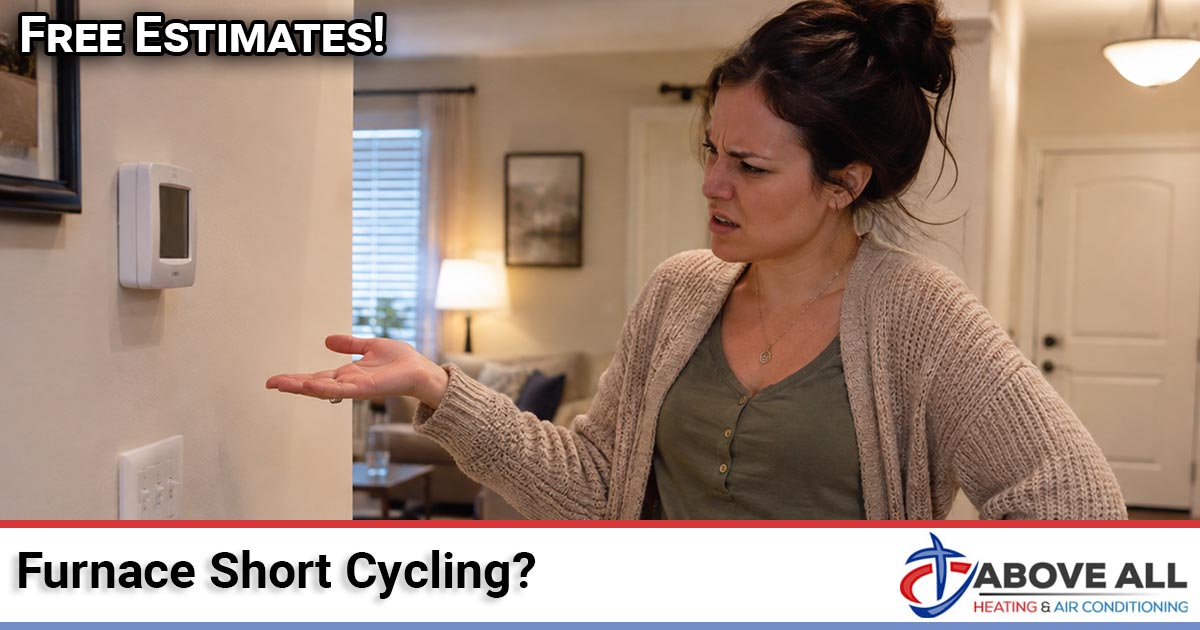
Furnace short cycling means your heater turns on and shuts off again after only a few minutes, before the house reaches the temperature on the thermostat. The most common causes are a clogged filter that makes the furnace overheat, a dirty flame sensor, a thermostat in the wrong spot, blocked vents, a venting or pressure switch problem, or a furnace that is too large for the home. Start with the filter and thermostat; if that doesn’t fix it, it’s time for a technician.
At Above All Heating and Air, short cycling is one of the most common heating calls we get once the first cold nights arrive in the Temecula Valley. The good news is that many causes are simple. The bad news is that a furnace that keeps starting and stopping wears out faster, wastes energy and, in some cases, is shutting itself down for a safety reason you shouldn’t ignore. This guide explains what normal cycling looks like, what causes furnace short cycling, what you can safely check yourself, and when to call us.
What Is Furnace Short Cycling?
Every furnace cycles. When the thermostat calls for heat, the furnace runs a startup sequence, heats the air, and shuts off once the house reaches the set temperature. It then rests until the temperature drops again. That on-and-off pattern is normal and healthy.
Short cycling is when those cycles become abnormally short. The furnace starts, runs for a minute or a few minutes, and stops, often without the house ever reaching the setpoint. Then it repeats. Carrier describes furnace short cycling as a unit that turns on and off repeatedly in cycles that are often less than 5 to 10 minutes, and Trane notes that a furnace cycle will be at least 7 minutes long under normal conditions.
Normal cycling vs. short cycling
How often a healthy furnace runs depends on how cold it is outside, how well the house holds heat, how the thermostat is set and how the system was sized. On a very cold night, frequent cycles can be normal. Trane makes the same point: frequent cycling during extreme cold may be fine, but a furnace that short cycles day and night, even in mild weather, has a problem.
| What you notice | Likely normal | Likely short cycling |
|---|---|---|
| Run time per cycle | Several minutes or longer, then a rest period | Shuts off after a minute or two, sometimes after only seconds |
| Reaches the thermostat setting | Yes, then shuts off | No, or only after many short starts |
| Weather | Runs more often on the coldest nights | Starts and stops constantly, even on mild days |
| Startup sequence | Inducer, ignition, flame, then the blower comes on and stays on | Burners light then go out, or the furnace stops before the burners light |
| Status light | Steady or normal-operation pattern | A blinking error code or lockout |
| Comfort | Even heat throughout the home | Cool rooms, hot and cold swings, a furnace that never seems to finish |
A simple way to tell: when the heat comes on, note the time on your phone. Watch through a few cycles. If the burners and blower are shutting off every couple of minutes while the house is still below the setpoint, your furnace is short cycling.
What Causes Furnace Short Cycling?
Short cycling is a symptom, not a diagnosis. The furnace is stopping early because something is either telling it to stop or forcing it to protect itself. Here are the causes our technicians find most often, roughly from most common to least.
| Cause | What happens | Typical clue | DIY or pro? |
|---|---|---|---|
| Dirty or clogged air filter | Low airflow lets the heat exchanger overheat, so the high-limit switch shuts the burners off | Filter is gray or matted; furnace runs a few minutes, shuts off, the blower keeps running, then it restarts | DIY: replace the filter |
| Blocked supply vents or return grilles | Same overheating problem as a dirty filter | Closed registers, furniture or rugs over vents, a blocked return | DIY: open and clear vents |
| Dirty flame sensor | The furnace can’t confirm the flame, so it shuts the gas off within seconds | Burners light, then go out after a few seconds; repeated retries; possible lockout code | Pro recommended |
| Thermostat location or settings | A thermostat near a supply vent, lamp, sunny window or kitchen satisfies too early | Thermostat reads warmer than the rest of the house | DIY check; pro to relocate |
| Thermostat problems | Weak batteries, loose wiring or incorrect cycle-rate settings can end calls for heat early | Blank or flickering display, erratic behavior | DIY batteries; pro for wiring and settings |
| Restricted flue or pressure switch fault | The pressure switch doesn’t prove a safe draft, so the furnace won’t light or shuts down | Inducer motor runs, then the furnace stops before ignition; blink code | Pro only |
| Faulty high-limit switch | A weak or failing limit switch trips even when temperatures are normal | Repeated limit trips with a clean filter and open vents | Pro only |
| Oversized furnace | Too much heat too fast; the house hits the setpoint quickly and the furnace shuts off | Short, blasting cycles, uneven rooms, has always behaved this way | Pro: load calculation |
| Failing control board or wiring | The board misreads signals or ends the cycle early | Erratic behavior, unusual or changing blink codes | Pro only |
| Cracked heat exchanger | Overheating and safety controls tripping; a serious safety concern | Found during inspection; sometimes soot or a CO alarm | Pro only, stop using the furnace |
Dirty filter and high-limit trips
This is the cause we see most. Your furnace needs a steady flow of air across the heat exchanger. When the filter clogs, airflow drops and the heat exchanger gets too hot. The high-limit switch is a safety control that shuts off the burners when that happens. The blower keeps running to cool things down, the limit resets, and the furnace fires again, only to overheat and shut off a few minutes later. Both Trane and Carrier list restricted airflow and dirty filters as leading causes, and both suggest checking 1-inch filters often and replacing them about every 1 to 3 months. Make sure the new filter faces the right way, too; our guide on why furnace filter direction matters shows how to read the arrow.
A dirty flame sensor
If you hear the burners ignite and then go out after a few seconds, the flame sensor is the first suspect. This small metal rod confirms that a flame is present. When it gets coated with residue, the control board can’t see the flame and shuts the gas valve for safety. The furnace may retry several times and then lock out. We cover signs, cleaning and replacement in detail in our furnace flame sensor guide.
Thermostat location and settings
Your thermostat only knows the temperature where it hangs. If it sits near a supply register, above a lamp or TV, in a sunny hallway or next to the kitchen, it warms up faster than the rest of the house and ends the heating call early. Trane recommends keeping the thermostat out of direct sunlight and away from vents and heat sources. Weak batteries, loose wires and incorrect cycle-rate settings on some programmable and smart thermostats can also cause short calls for heat.
Venting, inducer and pressure switch problems
Gas furnaces use an inducer motor to pull combustion gases out through the flue. A pressure switch confirms that draft before the burners are allowed to light. If the flue is restricted, the vent termination is blocked, the condensate drain on a high-efficiency furnace is backing up, or the switch or its tubing is failing, the furnace will start the inducer, fail to prove draft and shut down, often over and over. Our article on how a furnace pressure switch works explains this safety check. Venting problems are a carbon monoxide concern, so this is not a DIY repair.
An oversized furnace
Bigger is not better with heating equipment. A furnace sized by rule of thumb instead of a real heating load calculation can heat the home so quickly that it shuts off before air has circulated through every room. The U.S. Department of Energy notes that rules of thumb too often produce oversized systems, which leads to too-frequent on-and-off cycling that can compromise comfort and efficiency, and recommends sizing equipment with ACCA Manual J. Trane also points out that upgrades such as new insulation or windows can make a furnace that was once sized correctly too big for the home. If your furnace has short cycled since the day it was installed, sizing is a strong possibility. We explain how proper sizing works in our load calculation guide; the same principle applies to furnaces.
Control board, limit switch and heat exchanger problems
Less often, the cause is a failing component: a limit switch that trips too early, a control board that ends cycles incorrectly, or loose wiring. The most serious cause is a cracked heat exchanger, which Trane lists among the causes of short cycling. A cracked heat exchanger needs a professional assessment, and a furnace with one should not be operated until it’s evaluated.
How to Fix a Short Cycling Furnace: What You Can Safely Check
Before you call, these steps fix a good share of short cycling problems. None of them require opening the burner compartment or touching gas parts.
- Replace the air filter. Pull the filter and hold it up to a light. If light barely passes through, replace it with the correct size, arrow pointing toward the furnace. Then run the heat and time a few cycles.
- Open every supply register and clear the returns. Closing vents in unused rooms raises pressure and reduces airflow. Move furniture, rugs and boxes away from grilles.
- Check the thermostat. Replace the batteries, confirm the mode is set to Heat, and look at where it’s mounted. Is it near a vent, lamp, TV or sunny window? Note whether it reads noticeably warmer than other rooms.
- Look at the outdoor vent pipes. On high-efficiency furnaces with PVC vent pipes on a side wall or roof, check from the ground that nothing (leaves, a bird’s nest, debris blown in by Santa Ana winds) is blocking the openings. Don’t climb on the roof.
- Read the status light. Most modern furnaces have a small window with a blinking LED. Count the blinks and match them to the chart on the inside of the furnace door. Write the code down; it helps our technician.
- Watch one full startup. Note whether the furnace stops before the burners light, a few seconds after they light, or after several minutes of heating. That timing narrows the cause quickly.
- Don’t keep resetting it. Turning the power off and on may clear a lockout, but if the furnace locks out again, it’s protecting itself. Our guide on what to do when your furnace won’t turn on explains why repeated resets are a warning sign.
Stop and call: safety lines
- If you smell gas (a rotten-egg smell), leave the home right away. Don’t turn lights or appliances on or off, and don’t light anything. SoCalGas tells customers to evacuate and call SoCalGas at 1-800-427-2200 from a safe location, and to call 911 from a safe location if the leak may endanger life or property.
- If your carbon monoxide alarm sounds or anyone has headaches, dizziness, nausea or flu-like symptoms, get everyone outside and call 911. SoCalGas advises evacuating, calling 911 if anyone has symptoms, and not using the suspected appliance until it has been inspected.
- If you see soot, scorching, melted wiring or a yellow, lazy flame, or hear loud bangs at ignition, turn the furnace off at the thermostat and call a technician.
- If the furnace still short cycles after a new filter and open vents, the cause is inside the furnace, in the venting or in the sizing. That’s a job for a licensed technician.
Why Furnace Short Cycling Matters
It’s tempting to ignore a furnace that’s still producing some heat. Here’s why we recommend getting short cycling checked:
- Wear and tear. The startup sequence is the hardest part of a furnace’s job. Every start works the ignitor, inducer motor, gas valve, relays and blower. Carrier notes that short cycling accelerates wear on internal components, and Trane lists increased wear and potential heat exchanger damage among its effects.
- Wasted energy. A furnace is least efficient in the first minutes of each cycle. Lots of short cycles means more time in that inefficient warm-up phase.
- Comfort. Short bursts don’t circulate air long enough to even out temperatures, so some rooms stay cold while the thermostat area is warm.
- Safety. Repeated overheating stresses the heat exchanger. Carrier warns that, over time, this can lead to a cracked heat exchanger, which can leak carbon monoxide. Short cycling can also be the furnace telling you a safety control is tripping for a reason.
How Our Technicians Diagnose Furnace Short Cycling
When you call Above All Heating and Air for a short cycling furnace, our technician works through the system in order rather than guessing at parts:
- Listen to your description and read the error history. When it stops, how long it runs and any blink codes point us in the right direction.
- Check airflow. Filter, blower wheel, blower speed, static pressure, return sizing, closed or blocked registers, and the evaporator coil above the furnace, which can restrict airflow when dirty.
- Measure temperature rise. We compare the air temperature entering and leaving the furnace with the manufacturer’s rated range. Too high a rise points to an airflow or overheating problem.
- Test the flame sensor. We measure the flame signal with a meter, clean or replace the sensor, and check the ground.
- Verify draft and venting. We test the inducer, pressure switch and tubing, inspect the flue and vent terminations, and check condensate drains on high-efficiency furnaces.
- Test safety controls and the board. Limit switches, rollout switches, wiring and the control board.
- Inspect the burners and heat exchanger and test for carbon monoxide.
- Evaluate the thermostat and sizing. Location, wiring and settings, and, if everything else checks out, whether the furnace is oversized for your home’s heating load.
Once we find the cause, we explain it in plain English and give you options before any work begins. You can learn more about our furnace repair service.
Repair or Replace? When Short Cycling Points to a Bigger Problem
Most short cycling is fixed with a repair or maintenance: a filter, a cleaned flame sensor, a cleared vent, a new limit switch or a relocated thermostat. A few situations deserve a bigger conversation:
- The furnace is oversized. If a load calculation shows the furnace is well beyond what the home needs, short cycling will keep coming back no matter how many parts are replaced. Options may include thermostat and blower adjustments, duct improvements or, when the furnace is older, a properly sized replacement.
- The heat exchanger is cracked. This is a safety problem. Depending on age and warranty, replacing the heat exchanger or the furnace may be the right call.
- The furnace is older and needs repeated repairs. If short cycling is one of several recurring problems, weigh repair costs against the age of the system.
What a repair costs depends on the cause, the part, your furnace model, access (attic, closet or garage) and warranty coverage, so we quote after diagnosis rather than guess. If replacement makes sense, we’ll walk you through sizing and options on our heating services side, and you can always request a free quote.
Furnace Short Cycling in Inland Empire and Temecula Valley Homes
Short cycling has a few local twists here in Southwest Riverside County:
- Furnaces sit idle for months. Our heating season is short. A furnace that hasn’t run since spring often starts the season with a dirty flame sensor, dusty burners or a filter that loaded up during cooling season, since the furnace and AC share the same filter and blower.
- Big swings between day and night. Mild afternoons and chilly nights mean the furnace may run lightly during the day and harder after dark. Light daytime cycling on a mild day is normal; constant short cycles are not.
- Attic and closet furnaces. Many local tract homes have furnaces in attics or hall closets. Attic units can be hard to check, so filters and condensate lines get overlooked. Closet furnaces with restricted return air are prone to overheating and limit trips.
- Dust and Santa Ana winds. Dry, dusty conditions and wind-blown debris load filters faster and can partially block vent terminations on high-efficiency furnaces.
- Systems sized for cooling. In a cooling-dominated climate, furnaces are sometimes paired with equipment sized for summer loads. A furnace with more heating capacity than a mild-winter home needs is more likely to short cycle.
How to Prevent Furnace Short Cycling
- Change your filter on schedule. Check it monthly during heavy-use months and after dusty, windy stretches.
- Book a fall tune-up. Both Trane and Carrier recommend annual maintenance. A heating tune-up cleans the flame sensor and burners, checks safety controls and venting, and catches small problems before the first cold night.
- Keep vents and returns open. Don’t close registers to save energy; it usually backfires.
- Use steady thermostat settings. Carrier recommends keeping temperature settings consistent. Avoid big swings that force long recovery runs and frequent restarts.
- Size it right at replacement time. Insist on a heating load calculation instead of matching the old furnace’s size.
Short cycling also happens with air conditioners, often for related reasons such as airflow, thermostat and sizing problems. If you’ve noticed it in summer too, read our guide to AC short cycling.
Frequently Asked Questions
What is short cycling on a furnace?
Short cycling is when a furnace turns on and shuts off after only a few minutes, often before the house reaches the thermostat setting, and then repeats. Carrier describes it as cycles that are often less than 5 to 10 minutes. It is a symptom of an airflow, flame, venting, thermostat or sizing problem.
How long is considered a short cycling furnace?
As a rule of thumb, cycles that last only a few minutes, especially under about 5 to 10 minutes, while the house is still below the setpoint, point to short cycling. Trane notes a normal furnace cycle is at least about 7 minutes. Very frequent cycles on the coldest nights can still be normal.
How to tell if furnace is short cycling?
Time a few heating cycles with your phone. If the burners and blower shut off every couple of minutes while the house is still cold, or the furnace starts and stops all day even in mild weather, it is short cycling. A blinking error code on the status light is another clue.
Why is my furnace short cycling?
The usual causes are a dirty filter that makes the furnace overheat and trip its high-limit switch, a dirty flame sensor, a poorly located or failing thermostat, blocked vents or returns, a restricted flue or pressure switch fault, or an oversized furnace. Start with the filter and thermostat, then call a technician.
What is the most common cause of short cycling?
A dirty or clogged air filter is the most common cause we find. Low airflow lets the heat exchanger overheat, the high-limit switch shuts off the burners, and the furnace restarts a few minutes later. Replacing the filter and opening all vents fixes many cases.
How do I fix my furnace from short cycling?
Replace the filter, open every supply register, clear the return grilles, put fresh batteries in the thermostat and make sure it is not near a vent or heat source. Check that outdoor vent pipes are clear. If the furnace still short cycles, a technician needs to test the flame sensor, venting, safety controls and sizing.
Should I turn my furnace off if it is short cycling?
If you smell gas, see soot or scorching, or a CO alarm sounds, turn it off and get help right away. Otherwise, try a new filter and open vents first. If it keeps short cycling, limit use and schedule service, because repeated overheating and restarts add wear and can stress the heat exchanger.
Does short cycling damage a furnace?
Yes, over time. Every start works the ignitor, inducer, gas valve and blower, so frequent starts wear parts faster. Repeated overheating also stresses the heat exchanger. Carrier warns this can eventually lead to a cracked heat exchanger, which can leak carbon monoxide.
Is furnace short cycling dangerous?
Short cycling itself is usually more costly than dangerous, but the cause can be a safety issue. Venting problems, overheating and a cracked heat exchanger can all involve carbon monoxide risk. Make sure you have working CO alarms and have a technician find the cause rather than living with it.
Why does my furnace come on for a few seconds and then stop?
If the inducer motor runs and the furnace stops before the burners light, the pressure switch is often not proving draft because of a vent restriction, condensate backup or a failing switch. If the burners light and then go out within seconds, a dirty flame sensor is the most likely cause.
Why does my furnace keep turning on for 30 seconds and then turn off?
Burners that light and then shut off within several seconds usually mean the furnace cannot confirm the flame, most often because the flame sensor is dirty or poorly grounded. Gas pressure or wiring problems can cause the same pattern. A technician can measure the flame signal to confirm.
Why does my furnace keep turning on and off every 5 minutes?
Cycles of a few minutes usually point to overheating and high-limit trips from a dirty filter or blocked vents, or to a thermostat placed near a heat source. An oversized furnace can also satisfy the thermostat in a few minutes. Check the filter and vents first, then call for service.
Why is my furnace turning on and off every 20 minutes?
A furnace that runs, rests and restarts on a 20-minute pattern may be cycling normally, especially on a cold night or in a drafty home. It becomes a concern if it never reaches the setpoint, runs only briefly within that pattern, or shows an error code. Timing several cycles helps tell the difference.
Why won’t my furnace stay running?
A furnace that won’t stay running is usually being shut down by a safety control: the high-limit switch from overheating, the flame sensor when it cannot see a flame, or the pressure switch when draft is not proven. A blinking status light code on the furnace can tell a technician which one.
Why would the furnace not work for a few hours then come back on again?
Many furnaces go into a lockout after several failed ignition attempts or limit trips, then automatically retry after a set period, often around an hour depending on the control board. That pattern means something is repeatedly failing, such as the flame sensor, ignitor or venting, and it needs diagnosis.
How do I reset my furnace?
Most modern furnaces reset by turning off power at the furnace service switch or breaker for about 30 seconds, then turning it back on. If the furnace locks out again, stop resetting it, because it is shutting down to protect itself. Write down the blink code and call a technician.
Does Above All Heating and Air repair short cycling furnaces?
Yes. Our technicians diagnose and repair short cycling furnaces throughout Murrieta, Temecula and Southwest Riverside County. We check airflow, the flame sensor, venting, safety controls, the thermostat and sizing, then explain the cause and your options before any work begins.
Get Your Furnace Running Normally Again
If your furnace keeps turning on and off and a new filter didn’t fix it, Above All Heating and Air can find the cause and get your heat running full cycles again. Contact our team to schedule furnace service, or request a free quote. You can also learn more about us on our homepage.
Schedule an Appointment Today
Get in touch with Above All Heating and Air Conditioning by calling us or filling out the form. We look forward to working with you.
