
AC Drain Line Clogged? How to Unclog It Safely (and When to Call a Pro)
CONTACT US
Contact Us

Our
SERVICEs
AC Drain Line Clogged? How to Unclog It Safely (and When to Call a Pro)
Above All Heating And Air Conditioning / October 16, 2026 / AC Maintenance, AC Repair, Air Conditioning
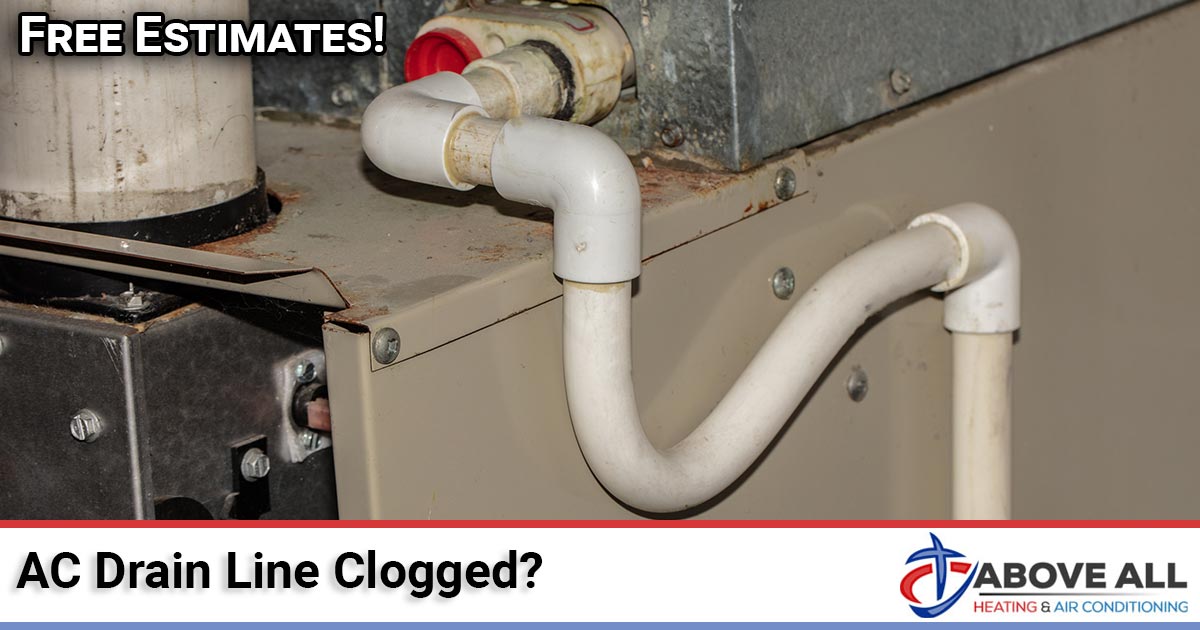
If your AC drain line is clogged, you’ll usually see water around the indoor unit, a full drain pan, a musty smell, or an air conditioner that suddenly shuts itself off. The safe fix is to turn the system off, pull the clog out from the outdoor end of the line with a wet/dry vacuum, then flush the line with distilled vinegar and clean water. If the line clogs again, the pan is cracked, or water has reached your ceiling or walls, it’s time to call a technician.
At Above All Heating and Air, a clogged AC drain line is a problem we see often in late summer and early fall. After months of nonstop cooling in the Inland Empire, the small pipe that carries water away from your air conditioner fills up with algae, sludge and dust. The good news: it’s one of the few AC problems a homeowner can often clear safely. Below we explain how the condensate system works, how to tell when the line is clogged, a step-by-step method to unclog an AC drain line, what not to pour into it, and when the problem is really something else.
How Your AC Condensate Drain System Works
Your air conditioner doesn’t just cool air. It also pulls moisture out of it. As warm indoor air passes over the cold evaporator coil, water vapor condenses on the coil the same way water beads on a cold glass. That water has to go somewhere, so every central AC system has a condensate drain system made of four main parts:
- Evaporator coil: the cold coil inside your air handler or furnace cabinet where the moisture forms. (Our guide to evaporator coils vs. condenser coils explains how it fits into the cooling cycle.)
- Primary drain pan: a pan directly under the coil that catches the dripping water.
- Condensate drain line: usually a 3/4-inch PVC pipe that runs from the pan to the outside of the house, to a nearby plumbing drain, or to a condensate pump. Most lines have a T-shaped access port with a cap near the indoor unit.
- Safety (float) switch: a switch in the pan, on the drain line, or in a secondary pan that shuts the system off if water backs up.
Many homes in our area have the air handler in the attic, which is why a secondary (emergency) pan sits under the unit, sometimes with its own drain line that ends somewhere visible, like over a window or under an eave. If you ever see water dripping from that spot, the primary line is clogged and the backup system is doing its job.
Why AC drain lines clog
The inside of a condensate line is dark, wet and fed a steady supply of dust, which makes it ideal for algae and bacterial slime. According to Daikin, clogs “rarely happen all at once. It is usually a slow build,” and algae “can form thick, slimy layers that significantly reduce the diameter of the pipe.” Dirty air filters make it worse, because more dust reaches the coil and washes down into the pan. Insect nests, rust flakes from an older metal pan, and debris at the outdoor end of the line are other common culprits.
Signs Your AC Drain Line Is Clogged
A clogged AC drain line usually shows itself in one of these ways:
| What you notice | What it usually means | How urgent |
|---|---|---|
| Water pooling around the indoor unit or furnace | Drain pan is overflowing because the line is blocked | Turn the AC off today |
| AC shuts off on its own and won’t restart | Float switch tripped on high water in the pan | Clear the clog before restarting |
| Water dripping from a pipe over a window or eave | Secondary pan is catching overflow from an attic unit | Address soon to avoid ceiling damage |
| Musty or mildew smell from the vents | Standing water and algae growth in the pan or line | Clean the line and pan |
| No water dripping outside on a hot, humid day | Water isn’t reaching the end of the line | Check the line |
| Water stains on a ceiling under an attic air handler | Overflow has gotten past the pans | Turn the AC off and call a pro |
| Gurgling or dripping sounds near the indoor unit | Restricted flow or a partial clog | Flush the line soon |
Carrier lists the same warning signs: musty odors, standing water near the indoor unit, water damage on nearby ceilings or floors, loss of cooling, and a system that shuts down or won’t start. If you’re seeing water but aren’t sure it’s the drain, our post on why an AC leaks water walks through the other causes.
Why the AC shuts off when the drain clogs
If your system has a float or overflow switch, a clogged drain will usually turn the whole AC off. Trane explains that when water reaches the switch’s trip point, it “will shut the outdoor compressor and condenser fan down” and “will also shut down the supply fan.” That’s a good thing. It’s protecting your ceiling and floors. But it also means the AC won’t come back on until the water drains and the switch resets. Not every system has one; Trane notes that some air handlers don’t include an overflow switch, and one can be added as an accessory.
How to Unclog an AC Drain Line: Step by Step
This is the method our technicians recommend for homeowners who are comfortable doing basic maintenance. You’ll need a wet/dry shop vacuum, duct tape or a rag, a cup of distilled white vinegar, a funnel, a flashlight, and some old towels.
- Turn off the AC at the thermostat and the breaker. Water and electricity don’t mix. Switch the thermostat to “off,” then turn off the breaker for the air handler or furnace (and the outdoor unit if you can find it). Lennox’s guidance starts the same way, noting that “working with water and electricity can be dangerous.”
- Find the drain line and the access port. Look for a PVC pipe coming out of the indoor unit near the coil, often with a T-fitting and a removable cap. Then follow the line, or look around the outside foundation near the outdoor unit, to find where it ends.
- Deal with standing water. If the pan is full, soak it up with towels or use the shop vac. Don’t let water spill onto electrical components or into the furnace burner area.
- Vacuum the clog from the outdoor end. Remove the filter from the shop vac (or use a wet-mode setup), then hold the hose over the end of the drain line and seal the gap with your hand, a rag or duct tape. Run the vac for one to two minutes. This pulls the clog out instead of pushing it deeper. Check the vac canister; you’ll often see a slug of green or gray sludge.
- Flush with vinegar. Remove the cap on the indoor access port and slowly pour in about a cup of distilled vinegar. Carrier suggests pouring a cup of distilled vinegar into the indoor access point to dissolve buildup, and Lennox recommends letting the solution sit “for 30 minutes or longer” before rinsing.
- Rinse with clean water. After the vinegar has had time to work, pour a few cups of clean water into the access port and watch the outdoor end. Water should flow out steadily. If it backs up at the access port, repeat the vacuum step.
- Clean the drain pan. Wipe out slime and debris. Look for rust, cracks or corrosion while you’re there. A damaged pan won’t be fixed by clearing the line.
- Replace the cap, restore power and test. Turn the breaker back on, set the thermostat to cool, and check after 20 to 30 minutes of run time. On a warm day, you should see water dripping from the outdoor end of the line, and the pan should stay mostly empty.
Safety lines: stop and call a pro if…
- You can’t reach the line or the air handler safely (for example, a cramped attic in summer heat).
- Water has reached drywall, insulation, wiring or the furnace burner compartment.
- The system still won’t restart after the line is clear and the pan is dry.
- The line clogs again within a few weeks.
- You see ice on the coil or refrigerant lines.
- The line drains into a condensate pump that isn’t running.
What Not to Pour Down an AC Drain Line
When the drain backs up, it’s tempting to grab whatever clears the kitchen sink. Please don’t. Here’s what to avoid and why.
Drano and other chemical drain openers
Products like Drano are made for household plumbing clogs such as hair and grease. They aren’t what AC manufacturers recommend for condensate lines. Lennox points homeowners to “diluted vinegar” or “an approved cleaner designed for use on PVC,” not caustic drain openers. Heavy chemical cleaners can sit in a slow-draining line and the drain pan, and an AC pan and coil are not built for strong caustics. They also create a splash hazard when you’re working overhead in an attic or closet. If vinegar and a vacuum don’t clear the line, the clog needs mechanical removal, not stronger chemicals.
Bleach
Bleach does kill algae, and some technicians use small amounts. But there are reasons we lean toward vinegar for homeowner maintenance. Bleach can be hard on metal drain pans and coil components, and it is dangerous to mix with other cleaners. Never pour bleach into a line you’ve already treated with vinegar or another product, because mixing bleach with acids or ammonia-based cleaners can release toxic gas. Also worth knowing: a Carrier dealer quoted on Carrier’s own site notes that vinegar or bleach may not fully prevent blockages, because many clogs involve dirt and debris that chemicals don’t dissolve.
Boiling water
Carrier says hot water can help with minor buildup, but it should be hot, not boiling, and only with the power off. Boiling water can soften PVC fittings and joints.
How Often to Flush Your AC Drain Line
Lennox recommends flushing the drain line “every few months” as preventive maintenance, and Daikin suggests more frequent attention for systems that run constantly. For most homes in the Temecula Valley, we suggest:
- Every 1 to 3 months during cooling season (roughly May through October), with a vinegar flush through the access port.
- Once before the cooling season starts, ideally as part of a professional AC tune-up, where the technician clears and tests the line, pan and safety switch.
- Change your air filter on schedule. Less dust on the coil means less sludge in the drain.
If your line has clogged before, mark your calendar. Clogs tend to come back in the same lines, especially ones that have a sag, a long horizontal run, or not enough slope.
When It’s Not a Clog: Other Causes of Drain Problems
Sometimes the drain line is clear and water still shows up where it shouldn’t. These are the problems we find most often once the line has been ruled out:
- Cracked or rusted drain pan. Older metal pans rust through, and plastic pans can crack. Water leaks out of the pan before it ever reaches the line. The fix is replacing the pan, or adding a secondary pan.
- Frozen evaporator coil. When a coil freezes from low airflow or low refrigerant, the ice melts all at once when the system shuts off and overwhelms the pan. A clogged drain usually isn’t what freezes the coil, but the two problems often show up together. See our guide to a frozen AC coil.
- Failed condensate pump. Homes where the drain can’t flow by gravity use a small pump to push the water out. If the pump’s motor or float fails, the reservoir overflows even though the line is clear.
- Disconnected or poorly sloped line. A fitting can pull loose, or a line installed without enough downward slope lets water sit and grow algae.
- Dirty coil and pan. A slimy coil and pan can produce a musty AC smell even when the line is flowing.
What a Professional Drain Line Service Includes
When we come out for a clogged AC drain line, our technicians do more than blow out the pipe. A typical visit includes:
- Shutting the system down safely and removing standing water.
- Clearing the line with suction, compressed nitrogen or CO2, or a drain snake, depending on where the clog is.
- Flushing and testing flow from the pan to the termination point.
- Cleaning the primary pan and checking it, and any secondary pan, for rust and cracks.
- Testing the float or overflow switch to make sure it shuts the system off when it should.
- Checking the line’s slope, trap and fittings, and the condensate pump if you have one.
- Looking at the coil, filter and airflow, since those affect how much debris reaches the drain.
What affects the cost of clearing a clogged AC drain line
We don’t publish a flat price because the work varies a lot from one home to the next, and we’d rather give you an accurate number than a misleading one. These are the factors that move the cost:
| Cost factor | Why it matters |
|---|---|
| Simple clog vs. recurring clog | A one-time algae clog clears quickly; repeat clogs often point to a slope or trap problem that needs a repair. |
| Location of the air handler | Attic and tight closet installs take more time and care than a garage unit. |
| Water damage or overflow | Removing standing water and protecting finishes adds time. |
| Parts needed | A new pan, float switch, condensate pump, or replacement PVC section adds parts cost. |
| Timing | Bundling the drain service with a seasonal tune-up is usually the most economical approach. |
If you’d like a firm number for your home, request a free air conditioning service quote and we’ll tell you what’s involved before any work starts.
Why Inland Empire Homes Are Prone to Clogged AC Drain Lines
Homes across Murrieta, Temecula, Menifee and the rest of southwest Riverside County put a lot of hours on their air conditioners. A few local conditions make drain clogs more likely here:
- Long cooling seasons. Systems often run from late spring into October, so the drain line stays wet and warm for months, which is exactly what algae needs.
- Dust and wind-blown debris. Dry conditions and Santa Ana winds carry fine dust into homes and through return vents. What the filter misses lands on the coil and washes into the pan.
- Attic air handlers. Many homes in our area have the air handler in the attic, so an overflow can stain ceilings fast if the secondary pan or switch isn’t working.
- Mild winters. With little time off between seasons, there’s no long dry spell to kill off growth inside the line. That makes a fall flush, like right now, a smart habit.
If you’re scheduling fall maintenance, ask for the drain line, pan and float switch to be checked. It’s a small item that prevents one of the most expensive kinds of household damage: water in the ceiling. Our air conditioning maintenance service covers all three.
How to Prevent a Clogged AC Drain Line
- Change or clean your air filter on schedule.
- Flush the line with a cup of distilled vinegar every one to three months while the AC is in use.
- Keep the outdoor end of the line clear of mulch, soil and plants.
- Make sure the access port cap stays on to keep out debris and insects.
- Have the line, pan and float switch tested once a year during a tune-up.
- If your line clogs repeatedly, ask a technician to check the slope and trap.
Frequently Asked Questions
Will the AC shut off if the drain is clogged?
Yes, if your system has a float or overflow safety switch. When water backs up into the drain pan, the switch cuts power to the compressor and blower so the pan doesn’t overflow. Systems without a switch keep running and can leak water into the home instead. Once the line is cleared and the water drains, the switch usually resets and the AC can restart.
How much does it cost to fix a clogged AC drain line?
The cost depends on how bad the clog is, where your air handler is installed, whether there is water damage, and whether parts like a drain pan, float switch or condensate pump need replacing. A simple clog cleared during a scheduled tune-up is usually the least expensive option. For a firm price for your home, request a free quote from Above All Heating and Air.
How often should you unclog your AC drain line?
Flush it every one to three months while the AC is running regularly, and have it professionally cleared and tested once a year. Lennox recommends flushing every few months, and systems that run constantly through a long Inland Empire summer benefit from the shorter end of that range.
Can you put drano in a clogged AC drain line?
No. Drano and similar drain openers are made for household plumbing clogs, not condensate lines. Manufacturers such as Lennox recommend diluted vinegar or a cleaner approved for PVC instead. If vinegar and a wet/dry vacuum don’t clear the line, the clog needs to be removed mechanically by a technician.
Can I pour drano down an AC drain?
We advise against it. Harsh chemical openers can sit in a slow-draining line and the drain pan near your coil, and they create a splash risk when you’re working in an attic or closet. Use distilled vinegar for routine flushing and call a professional for stubborn clogs.
How long does it take for vinegar to unclog an AC drain?
Let the vinegar sit in the line for at least 30 minutes, as Lennox recommends, then rinse with clean water. Vinegar works best on algae and slime buildup. A solid clog of dirt or debris usually needs to be pulled out with a wet/dry vacuum first.
What’s the best thing to pour down the AC drain pipe?
About one cup of distilled white vinegar, poured slowly into the indoor access port, followed by clean water after it sits. Carrier recommends the same approach for dissolving buildup. Avoid boiling water, chemical drain openers, and mixing bleach with any other cleaner.
How to tell if an AC drain line is clogged?
Look for water around the indoor unit, a full drain pan, a musty smell from the vents, or an AC that shuts off and won’t restart. On a warm day, little or no water dripping from the outdoor end of the line is another clue.
How do I locate my AC drain line?
Start at the indoor unit and look for a PVC pipe, usually 3/4 inch, coming out near the evaporator coil, often with a T-shaped fitting and a cap. Then follow it outside, where it typically ends near the foundation close to the outdoor unit. Some lines drain into a plumbing drain or a small condensate pump instead of outdoors.
How can I clear a clogged AC drain line?
Turn off the power, use a wet/dry vacuum sealed over the outdoor end of the line for one to two minutes, then flush the indoor access port with a cup of distilled vinegar and rinse with water. Clean the drain pan, restore power, and confirm water is flowing out of the line.
Can a clogged drain line cause AC to freeze?
A clogged drain line usually isn’t the direct cause of a frozen coil. Freezing typically comes from low airflow or low refrigerant. The two problems often appear together, though, because a dirty filter and dirty coil contribute to both. If you see ice, turn the system off and have it checked.
Will a clogged AC drain line cause AC not to work?
It can. If your system has a float or overflow switch, a clog will shut the AC down completely until the water drains and the switch resets. If the AC still won’t run after the line is clear, the problem may be elsewhere, such as a tripped breaker or a failed component.
How does an AC drain line get clogged?
Algae, mold and bacterial slime grow inside the dark, wet line and trap dust that washes off the evaporator coil. Over months of cooling, that buildup narrows the pipe until water can’t get through. Insect nests, rust flakes and debris at the outdoor end can also block it.
What happens when the AC drain line is clogged?
Water backs up into the drain pan. Depending on your system, the AC shuts off, water overflows onto the floor or ceiling, or both. Left alone, standing water can also cause musty odors, mold growth and corrosion of the pan.
Why is my AC drain line clogged again?
Repeat clogs usually mean something is feeding or trapping the buildup: a dirty filter, a line without enough slope, a sag that holds water, or a missing access cap. A technician can check the line’s slope and trap and recommend a fix so you aren’t clearing it every few weeks.
Does Above All Heating and Air clear clogged AC drain lines?
Yes. Our technicians clear the line, clean the pan, test the float switch and check the slope and condensate pump, and we include drain line service in our seasonal tune-ups. Contact us or request a free quote to schedule service.
Need Help With a Clogged AC Drain Line?
If you’ve flushed the line and the water keeps coming back, or you’d rather not climb into the attic, Above All Heating and Air is happy to help. Our technicians clear the line, test the safety switch, and look for the reason it clogged in the first place. Contact us to schedule service or request a free air conditioning service quote. You can also learn more about us on our homepage, or see our air conditioning repair services if something bigger is going on.
Schedule an Appointment Today
Get in touch with Above All Heating and Air Conditioning by calling us or filling out the form. We look forward to working with you.
